
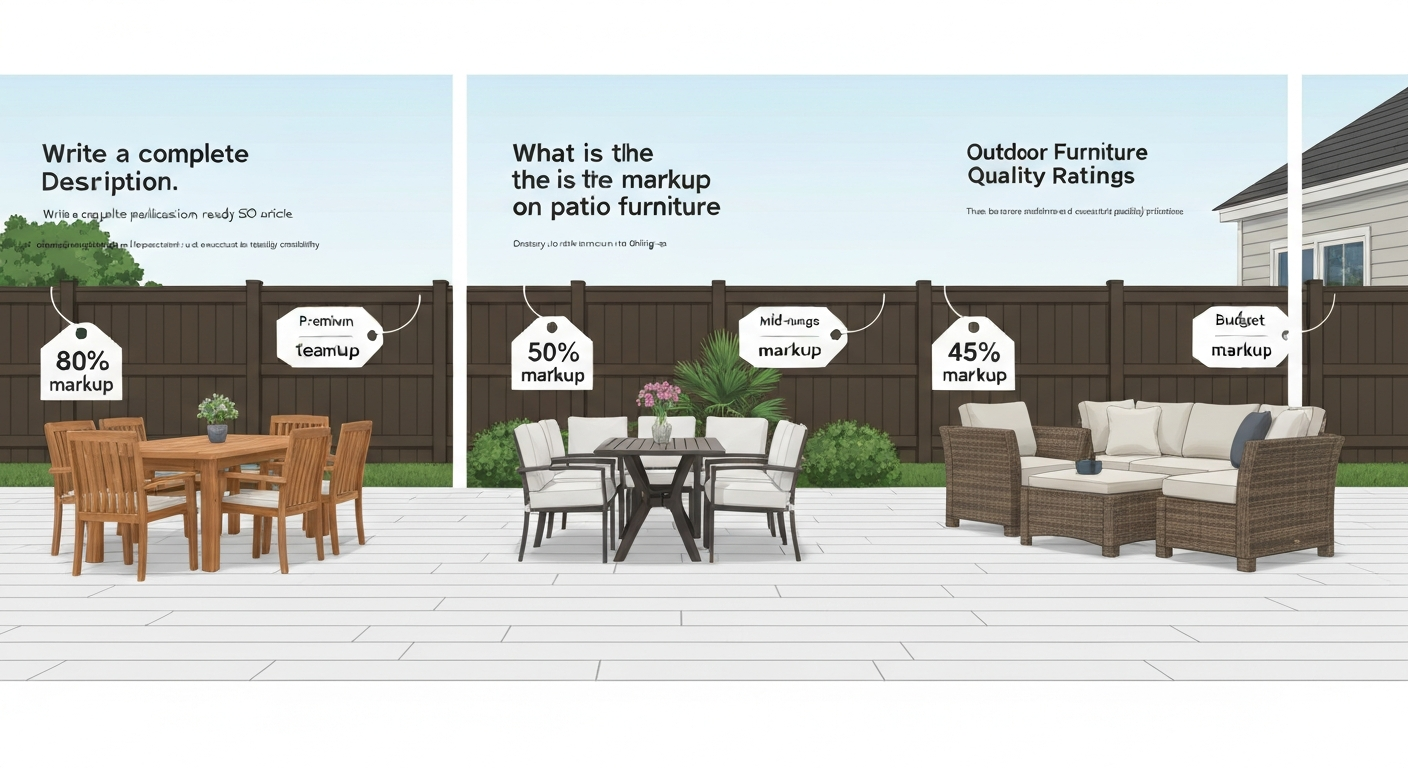
Patio furniture markups at big-box stores typically run around 47% on cost (roughly a 33% gross margin), while specialty retailers like Pottery Barn or Frontgate commonly mark up 67–89% on cost (40–47% gross margin), and luxury showrooms can exceed 80–100% on individual premium SKUs. Online marketplaces like Wayfair sit closer to the big-box range, around 43% markup on cost. Those numbers explain a lot about why a teak dining set that costs a manufacturer $1,200 to produce and ship can land on a specialty retailer's floor at $2,200 or more. For a deeper explanation of why patio furniture is so expensive, see why patio furniture is so expensive.
What Is the Markup on Patio Furniture, How Much to Pay

Marcus Kellerman
16 Jul 2026
What this guide covers and who it's for
If you've ever stood in front of a $1,800 aluminum dining set and wondered whether you're paying for quality or just a retailer's rent bill, this guide is for you. For consumer perspectives and real-world pricing anecdotes, see the Reddit discussion 'why is patio furniture so expensive' Reddit discussion on why patio furniture is so expensive. I wrote it for homeowners comparing options across materials and price points, and for outdoor designers who need to explain to clients why that teak sectional costs what it costs. We'll cover exactly what markup means in a retail pricing context, how it differs from margin (and why that distinction matters when you're doing the math), how markups vary by the type of store you're buying from, what's actually driving the price differences between a $300 Home Depot set and a $4,000 specialty piece, and how to think about lifecycle cost rather than sticker price when comparing materials like aluminum, teak, wicker, cast iron, rattan, and wood.
What retailers actually mean by markup
Markup is the percentage added to a product's cost to arrive at its selling price. The formula is straightforward: Markup % = (Selling Price minus Cost) divided by Cost. So if a retailer buys a wicker sectional for $600 and sells it for $1,000, the markup is ($1,000 minus $600) / $600 = 66.7%. That's it. It's always expressed as a percentage of cost, which means it can technically exceed 100% (and in furniture retail, it often does for premium categories).
The "cost" in that formula isn't just what the factory charged. Retailers calculate their cost on a landed basis, meaning it includes the factory price, ocean freight, import duties, inland trucking, packaging, and sometimes warehousing before the item hits the showroom floor. When you see an expensive piece at a specialty store, a meaningful chunk of that price is covering logistics costs that have ballooned in recent years, not just the retailer's profit.
Markup vs. margin: the formulas and why they're easy to confuse
These two terms get used interchangeably in casual conversation, but they're calculated differently and produce very different numbers. A 50% markup on cost does not equal a 50% margin. Understanding the difference is genuinely useful when you're trying to decode whether a "40% off" sale is actually a good deal.
| Metric | Formula | Based on |
|---|---|---|
| Markup % | (Selling Price − Cost) ÷ Cost | Cost |
| Gross Margin % | (Selling Price − Cost) ÷ Selling Price | Selling Price |
| Convert Margin to Markup | Markup = Margin ÷ (1 − Margin) | — |
| Convert Markup to Margin | Margin = Markup ÷ (1 + Markup) | — |
Worked example
Say a retailer's fully landed cost on a 5-piece aluminum dining set is $500. They apply a 100% markup, so the selling price is $500 x (1 + 1.00) = $1,000. The gross margin on that same transaction is ($1,000 minus $500) / $1,000 = 50%. Same deal, two different numbers. That's why you'll sometimes hear a salesperson say "we work on a 50% margin" and wonder how that translates to what you're actually paying over cost. In this case, a 50% margin is exactly a 100% markup on cost, which is known in retail as keystone pricing and is a common industry starting point.
A few practical rules when you're doing the math yourself. Always confirm whether a figure you've been given is markup (cost-based) or margin (price-based) before calculating anything. To find the selling price from a known cost and markup percentage, use: Price = Cost x (1 + Markup%). To find the selling price from a known cost and target margin percentage, use: Price = Cost / (1 minus Margin%). And before running any of those formulas, make sure your cost figure includes all landed costs, including freight, duties, and packaging, not just the factory invoice.
Who ultimately pays the markup
You do, always. But how the markup shows up in the list price depends on how the supply chain is structured. In a traditional multi-tier channel, a manufacturer sells to an importer or distributor at one margin, the distributor sells to a retailer at another, and the retailer marks up again before you see the price tag. That means the list price you see at a traditional brick-and-mortar specialty store may reflect two or three layers of margin stacked on top of the original production cost. Direct-to-consumer brands (DTC) cut out at least one of those layers, which is why some online-first outdoor furniture brands can appear to offer better value at the same apparent quality tier. Whether that perception holds up depends heavily on actual material specs and build quality, not just pricing strategy.
Typical markup ranges by seller type
I want to be honest about the limits of any specific number here: markups vary by product category, season, region, and individual SKU. That said, public company financial filings and industry trade data give us a reasonably solid picture of gross margin ranges by seller type, and those margins translate directly into implied markup on cost.
| Seller Type | Gross Margin Range | Implied Markup on Cost | Example Retailers |
|---|---|---|---|
| Big-box / home improvement | ~32–34% | ~47–52% | Home Depot, Lowe's |
| Online marketplace / large e-tail | ~29–31% | ~41–45% | Wayfair, Amazon |
| Specialty / lifestyle brand | ~40–47% | ~67–89% | Pottery Barn, Frontgate, West Elm |
| Luxury gallery / design showroom | ~43–50%+ | ~75–100%+ | RH, high-end local dealers |
| Wholesale / outlet / club stores | ~20–30% | ~25–43% | Costco, Sam's, factory outlets |
To put those into concrete dollar terms: Home Depot stocks Hampton Bay 5-7 piece dining sets in the $389 to $999 range. At a 47% markup on cost, a $600 set implies the retailer's landed cost was around $408. Wayfair's 5-piece aluminum and wicker dining sets range from roughly $280 to $2,195 in their current catalog. At the lower end of that range, margins are thin and the products often reflect it in build quality. At the high end, you're frequently paying for a brand's margin, not necessarily a proportionally better frame or weave. Frontgate's premium teak sets (11-piece Cassara, for example) run $6,600 to $9,800 depending on configuration. With specialty gross margins around 46%, implied cost sits somewhere in the $3,500 to $5,300 range before they made any profit. Williams‑Sonoma FY2025 results report a specialty gross margin of 46.2% Williams‑Sonoma FY2025 results report a specialty gross margin of 46.2%..
Outlet stores and floor-sample clearances are worth mentioning separately. These are situations where a retailer is deliberately selling below their normal markup to move inventory, particularly in late summer when seasonal stock needs to clear. The markups in those contexts are genuinely lower, sometimes approaching or even matching wholesale pricing on prior-season SKUs.
What's actually driving the price variation
Markup percentage is only part of the pricing story. The other part is what went into the cost before the markup was applied. Here's a breakdown of the real cost drivers, because understanding them helps you evaluate whether a price premium is justified.
Materials and manufacturing
Grade A teak sourced from certified plantations, marine-grade 316 stainless steel hardware, solution-dyed acrylic fabric, and cast aluminum frames with thicker wall stock all cost meaningfully more than their budget counterparts. A chair frame made from thin-wall extruded aluminum will always cost less to manufacture than one cast from thicker alloy. Those material and process differences flow through to the landed cost before any retailer markup is applied.
Shipping and freight
Most patio furniture is manufactured in Asia, primarily China and Vietnam, and shipped in 40-foot ocean containers. Global container freight rates tracked by indices like the Freightos Baltic Index have swung dramatically in recent years. Per-unit freight allocation on large, heavy pieces (cast iron tables, solid teak sectionals) is significant, sometimes adding $50 to $150 or more per piece before the item reaches a domestic warehouse. Importers and retailers fold that landed freight cost into their cost basis before applying markup, which means shipping volatility directly affects shelf prices.
Import duties and tariffs
Tariff structures on patio furniture imported from China have created meaningful cost disparities depending on country of origin. Pieces manufactured in Vietnam, Indonesia, or the Philippines often carry lower duty rates, which is why you've seen more sourcing shift there. A high-tariff environment adds directly to landed cost, and that cost gets marked up like everything else.
Showroom and inventory overhead
This is the cost driver that most buyers underestimate. A premium retail showroom in a major market can cost $600 or more per square foot annually in rent alone. Suburban strip centers and big-box locations pay a fraction of that, which is a direct reason why a Restoration Hardware showroom needs a higher markup than a Home Depot garden center to cover overhead. Beyond rent, carrying costs for inventory (the capital tied up in stock, plus insurance, storage, and markdown risk) typically run 20 to 25% of inventory value annually at retail. That's a real number that has to be recovered through markup.
Seasonality
Patio furniture is a seasonal category with highly concentrated demand from March through July. Retailers order inventory months in advance and carry that stock through the full season, accepting the risk that unsold units will need to be marked down at the end. To compensate for that risk, they price higher during peak season. The flip side is that late-season clearance events, particularly around Labor Day in September, represent genuine discount opportunities. Memorial Day and Fourth of July sales also produce real (if smaller) markdowns as retailers trade margin for volume.
Warranties and after-sale support
A 10-year frame warranty (as offered on some Frontgate teak sets, for example) is not just a marketing claim. Honoring warranty claims costs money, and that expected cost is embedded in the price. Budget products with no meaningful warranty are priced accordingly, but the implied cost of replacement falls entirely on the buyer rather than the brand.
Brand premium
Some of what you're paying at specialty retailers is genuinely for better materials and construction. Some of it is for the brand's design aesthetic, marketing investment, and the retail experience itself. Both are real costs. Whether the brand premium is worth paying depends on whether the underlying product spec justifies it, which brings us to material-by-material comparisons.
Typical retail price ranges by material and set size
These ranges reflect what you'll actually encounter shopping in 2026 across major U.S. retailers, from budget big-box to specialty. They're wide because quality variation within each material category is enormous. A "wicker" set can be $280 or $2,000 depending on whether the weave is UV-stabilized HDPE resin over an aluminum frame or cheap PVC over steel. The ranges below are honest about that variation.
| Material | Typical Set Size | Retail Price Range (USD) | Markup Context |
|---|---|---|---|
| Aluminum (powder-coated) | 5-piece dining | $350–$2,500 | Budget end near big-box margins; high end in specialty territory |
| Resin/HDPE wicker over aluminum | 5-piece dining | $280–$2,200 | Widest quality range; price alone is a poor quality indicator |
| Teak (Grade A solid) | 5-piece dining | $1,500–$6,000+ | Higher cost base; specialty margins apply; lifespan justifies premium |
| Wood (eucalyptus, acacia, FSC pine) | 5-piece dining | $500–$3,000 | Species matters; acacia cheapest, eucalyptus mid, teak at top |
| Cast iron / wrought iron | 5-piece bistro/dining | $400–$2,500 | Heavy shipping costs inflating landed price; long lifespan when maintained |
| Rattan (natural) | Lounge/conversation set | $600–$3,500 | Primarily indoor or covered-patio use; natural rattan degrades outdoors |
What those price ranges imply about markup: at the low end of each range, you're typically looking at a big-box or online marketplace product with a 43–52% markup on cost and proportionally thinner materials. At the high end, especially for teak and premium aluminum, the higher absolute price reflects both a larger cost base and a higher percentage markup applied by a specialty retailer. The two compound: better materials cost more to make, and the channel selling them takes a bigger percentage cut.
Material-by-material comparison: durability, climate fit, and lifecycle value
This is where the markup question gets practically useful. If you're trying to decide whether it makes sense to pay twice as much for one material over another, you need to factor in how long each will actually last in your climate, how much maintenance it requires, and what repair or refinishing will cost over time. Sticker price divided by expected years of useful life (cost-per-year) is almost always a more honest comparison than upfront price alone.
Teak
Grade A teak is genuinely exceptional outdoor material. Its natural oil content resists moisture, insects, and UV degradation without any treatment, and structural lifespans of 20 to 30+ years are realistic for quality pieces, not just marketing copy. The catch is the cost: teak commands a high base manufacturing cost and is predominantly sold through specialty and luxury channels with the corresponding 67–100%+ markup on cost. If you're in a coastal climate where other materials corrode or crack within a decade, the math often favors teak despite the higher initial outlay. A $3,000 teak set lasting 25 years works out to $120 per year. A $700 aluminum set that needs replacing in 8 years is $87.50 per year but involves the disruption and disposal cost of replacement.
Powder-coated aluminum
Well-specified powder-coated aluminum is my go-to recommendation for most homeowners who want low maintenance and don't want to pay teak prices. A properly coated aluminum frame in a non-coastal environment should last 15 to 20 years without significant structural degradation. In coastal salt-air environments, the coating matters a lot: marine-grade specifications hold up significantly better than standard powder coat. The wide price range ($350 to $2,500 for a dining set) reflects enormous variation in frame wall thickness, coating quality, and joint construction. A $400 big-box set and a $1,800 specialty set are not the same product.
Resin wicker / HDPE wicker
This is the category with the most quality variation and the most buyer disappointment at the budget end. UV-stabilized HDPE resin wicker over an aluminum frame is a legitimate 10 to 15+ year product that handles sun, rain, and moderate coastal exposure reasonably well. Cheap PVC wicker over a steel frame can start cracking, fading, and rusting within 2 to 5 years. The material you're actually buying matters far more than the visual appearance, which is nearly identical at purchase. Look for explicit HDPE or "all-weather resin" specs and aluminum (not steel) frames before trusting that a wicker set will last.
Wood (non-teak)
Eucalyptus, acacia, shorea, and FSC-certified pine are all commonly sold as patio furniture. Eucalyptus and shorea are legitimate teak alternatives with natural oil content, lifespan expectations of 10 to 20 years with regular oiling, and meaningfully lower prices. Acacia is less naturally resistant and requires more consistent maintenance to stay in good shape. Untreated pine outdoors is a poor long-term choice in most climates. If you're considering wood and want something approaching teak durability without the teak price, eucalyptus from a reputable brand is a reasonable middle ground.
Cast iron and wrought iron
Cast iron and wrought iron furniture is heavy, visually distinctive, and structurally very durable when the coating is intact. The problem is what happens when it isn't: unprotected ferrous metal in any wet or coastal climate corrodes aggressively. Powder-coat or paint needs periodic maintenance, and refinishing (including powder coating) typically runs $50 to $150 per chair and $150 to $400 for a table depending on complexity and your location. In a dry inland climate with covered storage in winter, cast iron can last decades. In a humid coastal environment without maintenance, expect accelerated rust issues. Shipping cost on cast iron is also a meaningful landed cost driver given the weight, which contributes to the pricing you'll see.
Rattan (natural)
Natural rattan is a beautiful material but a poor choice for fully exposed outdoor use in most U.S. climates. It degrades with consistent moisture exposure and intense UV radiation. It belongs in a covered porch, a sunroom, or a climate-controlled outdoor space. If you see natural rattan priced as outdoor furniture without a covered-use caveat, that's a spec mismatch worth scrutinizing before buying. Synthetic resin wicker is the functionally appropriate outdoor substitute for the rattan aesthetic.
| Material | Expected Lifespan (outdoor use) | Climate Fit | Maintenance Level | Relative Cost-per-Year Value |
|---|---|---|---|---|
| Teak (Grade A) | 20–30+ years | Excellent in all climates, including coastal | Low (oiling optional) | Excellent if bought at fair price |
| Powder-coated aluminum | 15–20 years | Very good; marine-grade spec needed for coastal | Very low | Very good |
| HDPE resin wicker / aluminum frame | 10–15+ years | Good; avoid full coastal salt exposure | Low | Good at mid-price; poor at budget end |
| Eucalyptus / shorea wood | 10–20 years | Good with annual oiling; avoid prolonged wet | Moderate | Good mid-range option |
| Acacia wood | 5–12 years | Moderate; needs consistent sealing | Moderate to high | Fair, depends on price paid |
| Cast iron / wrought iron | 15–30 years (with maintenance) | Poor in coastal/humid without upkeep; excellent in dry | Moderate; coating upkeep required | Good in right climate; poor in wet/coastal |
| Natural rattan | 2–5 years (exposed outdoor) | Poor for fully exposed outdoor use | High | Poor value for outdoor exposure |
How to use markup knowledge when you're actually shopping
Knowing markup ranges helps you evaluate prices and identify genuine value, but it's not a magic decoder ring. Here's how I'd apply this practically. First, identify which seller channel you're buying from and apply the corresponding margin context. A $1,200 dining set at Home Depot implies a much lower cost base than a $1,200 set at a specialty retailer, meaning the big-box piece was likely a lower-spec product that happened to be priced up, or the specialty piece is a better product sold at a similar margin percentage on a higher cost. Second, look for timing advantages: the deepest patio furniture discounts consistently appear around Memorial Day, Fourth of July, and especially Labor Day and September clearance. End-of-season purchases can reduce prices by 20 to 40% on remaining inventory. Third, don't be afraid to negotiate at smaller specialty dealers, especially on floor samples or end-of-season stock. Dealers with high carrying costs are motivated to move inventory and often have room below their asking price.
For readers who want to go deeper on whether a specific price point makes sense for their budget and usage pattern, the questions of how much to spend overall and whether expensive furniture is genuinely worth it are worth working through carefully based on your climate, how heavily the furniture will be used, and how long you plan to stay in your current home. For a practical budgeting checklist, read our guide on how much to spend on patio furniture. The lifecycle cost framing I've used throughout this piece, cost-per-year rather than sticker price, is the most honest framework for those decisions. If you want a quick conclusion based on the lifecycle framing, read our short piece on whether expensive patio furniture is worth it for most homeowners is expensive patio furniture worth it. For a quick estimate of how much patio furniture costs across materials and retailers, see our guide on how much does patio furniture cost. For community discussions and user recommendations, see best patio furniture reddit for firsthand experiences and crowd-sourced advice.
A practical buyer's checklist before you pay
- Identify the seller channel (big-box, online marketplace, specialty, outlet) and apply the appropriate markup context to benchmark the price.
- Confirm the actual materials: for wicker, verify HDPE resin and aluminum frame, not PVC and steel. For wood, confirm the species. For aluminum, ask about frame wall thickness and coating specification.
- Calculate cost-per-year: divide the price by a realistic expected lifespan for your climate, not the best-case scenario.
- Check whether a meaningful warranty is included. A 10-year frame warranty signals genuine manufacturer confidence and has real financial value.
- Time your purchase if possible: Memorial Day, Fourth of July, and especially late summer (Labor Day through September) offer the largest discounts.
- For cast iron or steel pieces, factor in refinishing cost ($50–$150 per chair, $150–$400 per table for powder coating) over the product's life.
- If buying from an independent dealer or specialty showroom, ask directly about floor-sample pricing, prior-season pricing, or any available promotions before accepting the listed price.
- Check community feedback and actual owner reviews, not just product descriptions, before committing to a high-priced set.
FAQ
What does “markup on patio furniture” mean, and how is it different from margin?
Markup = (Selling price − Cost) / Cost. Margin (gross margin) = (Selling price − Cost) / Selling price. To convert: Margin = Markup / (1 + Markup). Example: cost $500 with 100% markup → price = $1,000. Gross margin = ($1,000 − $500) / $1,000 = 50%.
How do I calculate markup or margin for a listing I see?
If you know the cost (seller’s COGS) and want markup: Price = Cost × (1 + Markup%). If you know cost and want margin: Price = Cost ÷ (1 − Margin%). If you only see a listed retail price and suspect a typical margin, you can estimate markup by rearranging: Markup = Margin / (1 − Margin). Always include landed cost items (materials, freight‑in, duties, packaging, any prep) before computing markup.
What are typical markup ranges by seller type (conservative ranges)?
Conservative examples (expressed as markup on cost): - Big‑box/home improvement (Home Depot, Lowe’s): ~40–55% markup (price ≈ cost × 1.40–1.55), reflecting gross margins ≈ 32–34%. - Online marketplace / large e‑tail (Wayfair/Amazon): ~35–50% markup (price ≈ cost × 1.35–1.50), gross margins ≈ 30%. - Specialty/home brands (Pottery Barn, Williams‑Sonoma, Frontgate): ~65–90% markup (price ≈ cost × 1.65–1.90), gross margins ≈ 40–47%. - Luxury/design showrooms (RH, high‑end dealers): commonly >80% markup on premium SKUs; can be higher for curated/designer items. Regional and brand variation applies; these are conservative illustrations based on public gross‑margin data.
What drives those markup differences between seller types?
Primary drivers: - Overhead: showroom rent, high‑touch sales staff and interior design services cost more for brick‑and‑mortar specialty/luxury dealers. - Inventory carrying costs and markdown risk (seasonality) push up required markup. - Scale and sourcing: big‑box and large e‑tailers buy higher volumes at lower unit cost. - Marketing and brand premium: DTC and luxury brands build margin into brand positioning and warranties. - Distribution and logistics: freight, inland transport, duties and import complexity affect landed cost. - After‑sale services and warranties increase required margin if offered in‑house.
How do materials (wood, aluminum, wicker, cast iron, teak, rattan) affect expected price ranges and implied markup?
Typical retail price ranges by material and set size (conservative broad bands; regional/brand variation applies): - Teak (solid, premium grade): 4‑6 seat dining sets commonly $1,200–$8,000+; premium sets with long warranties imply higher markups and a larger portion of price is material cost. - Powder‑coated aluminum: 4‑6 seat sets $400–$3,000; good aluminum with quality coating tends toward mid range and expected life 15–20 years. - HDPE / resin wicker over aluminum: 4‑6 seat sets $400–$2,000; quality HDPE implies longer life and commands higher price. - Steel/cast‑iron: heavier sets $600–$3,000; if not properly protected, shorter useful life in wet/salt climates. - Rattan (natural) is more niche and often priced variably; synthetic rattan (HDPE) is more common outside covered areas. These retail prices incorporate both COGS and retailer markup; lower price bands are often at lower markup or lower COGS, while specialty brands at higher price bands reflect higher markup and/or higher material/labor costs.
How can I interpret a retail price to judge whether markup is reasonable?
Steps: 1) Identify the material and approximate landed cost benchmarks (for mass goods, imagine wholesale cost roughly half retail at keystone; specialty brands will diverge). 2) For big‑box/online mass items, assume ~40–50% markup on cost; if a simple aluminum set is very expensive versus competitors, inspect build quality and warranty. 3) For premium teak or heavily warrantied products, higher markups are normal; assess whether higher price buys longer life, better warranty, or design you value. 4) Compare across sellers and factor shipping/installation and warranties into effective price.
Next Articles
How Much Does Patio Furniture Cost? Prices by Type
Patio furniture cost by type, materials, and quality, plus tips to budget delivery, cushions, covers, and long-term valu
Best Patio Furniture Reddit Picks by Material, Brand, and Climate
Reddit-backed patio furniture picks by material and climate, plus brand strengths, failure points, and buying specs

Why Patio Furniture Is So Expensive: Real Cost Drivers
Learn why patio furniture costs more: materials, construction, coatings, labor, and total cost of ownership by climate.