
Yes, cast iron patio furniture rusts, and so does wrought iron patio furniture. Both are iron-based materials, and iron corrodes when it is exposed to oxygen and moisture. There is no version of iron outdoor furniture that is inherently rust-proof. What varies is how quickly rust forms, how severe it gets, and how well a protective finish delays the process. A well-maintained piece with intact powder-coat or paint can go years without visible rust. A neglected piece left on wet ground through a coastal winter can show surface rust within weeks. The difference comes down to finish quality, placement, and care, not some magical property of the metal.
Does Cast Iron Patio Furniture Rust? Risks, Care & Fixes

Marcus Kellerman
14 Jul 2026
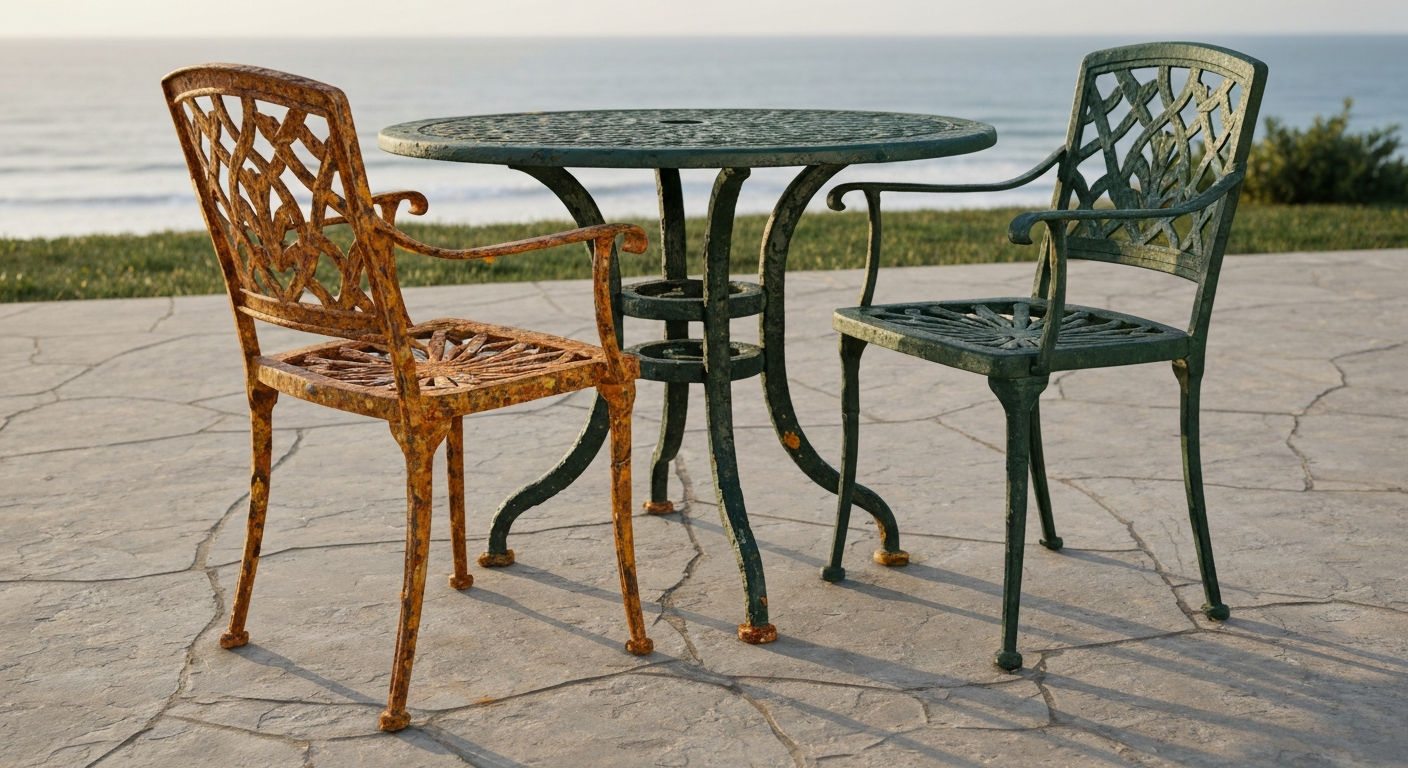
How iron corrodes: the chemistry behind rust
Rust is technically hydrated iron oxide, formed when iron reacts with oxygen in the presence of moisture. The process is electrochemical: iron at an anodic site gives up electrons and becomes ferrous ions, while oxygen is reduced at a nearby cathodic site. Corrosion of iron in atmospheric exposure is an electrochemical process requiring an anodic reaction, a cathodic reaction, and an electrolyte, see Corrosion fundamentals (citing Fontana, Corrosion Engineering). Water (or a thin film of condensation) acts as the electrolyte that allows ions to move between those two sites. Take away any one of those three elements and the reaction stalls. That is why keeping iron furniture dry and coated slows corrosion so dramatically.
Salt makes things significantly worse. Chloride ions from sea spray or road salt dissolve in moisture films and make the electrolyte far more conductive, which accelerates the electrochemical cycle. Industrial pollutants like sulfur dioxide have a similar effect. This is why the same piece of furniture will corrode much faster in a coastal environment or near a heavily trafficked road than it will in a dry inland setting. ISO 9223 formalizes this by classifying atmospheric corrosivity from C1 (very low, typically indoor/dry) through C5 and CX (extreme, coastal/industrial), and carbon steel corrosion rates jump from under 1.3 micrometers per year at C1 to between 80 and 200 micrometers per year at C5. That is not a small difference: it is roughly a 150-fold increase in corrosion rate between the most benign and the most aggressive environments.
Galvanic effects also matter when iron furniture is in contact with other metals. If cast iron or steel contacts copper, brass, or stainless steel hardware in a wet environment, the iron becomes the more active (anodic) metal and corrodes preferentially. This is worth knowing if you are mixing fastener materials or adding metal decorative accents to an iron frame.
Cast iron vs. wrought iron: how composition affects rust risk
Cast iron and wrought iron are both iron-based, but they have meaningfully different microstructures that change how they corrode. Cast iron (the gray and ductile varieties used in heavy outdoor furniture) contains significant carbon that forms graphite flakes or nodules distributed throughout the metal matrix. Those graphite regions are cathodic relative to the surrounding ferrous matrix, which creates lots of tiny local electrochemical cells across the surface. The practical result is that cast iron can develop non-uniform, sometimes pitting-type corrosion rather than the uniform surface rust you see on plain mild steel.
Historic wrought iron was a different material entirely: it had very low carbon content and contained slag stringers that actually gave it some corrosion resistance compared to pure carbon steel. Here is the critical point for furniture shoppers: almost nothing sold today as 'wrought iron patio furniture' is made from true metallurgical wrought iron. It is almost universally mild steel or low-carbon forged steel shaped to look like traditional wrought iron. 'Wrought iron' has become a style descriptor and a marketing term, not an accurate material label. So when you are comparing cast iron vs. wrought iron patio furniture, you are often comparing cast iron (heavy, brittle, excellent compressive strength) against mild steel (more ductile, weldable, slightly lower density). Both rust. Neither has a meaningful inherent corrosion advantage over the other without a protective finish. For a focused comparison of cast iron vs. wrought iron patio furniture, see the guide on cast iron vs. wrought iron patio furniture.
| Property | Cast Iron | 'Wrought Iron' Style (Mild Steel) |
|---|---|---|
| Actual material | Iron with 2–4% carbon, graphite inclusions | Low-carbon steel (C < 0.25%), sometimes forged |
| Weight | Heavy (typical chair: 30–50+ lbs) | Moderate to heavy (15–40 lbs) |
| Corrosion morphology | Non-uniform, potential pitting near graphite | More uniform surface rust |
| Brittleness | Brittle, can crack under impact | More ductile, bends before breaking |
| Rust risk without coating | High | High |
| Repair-ability | Difficult to weld; requires specialist repair | Easier to weld and repaint |
| Typical furniture use | Tables, benches, heavy accent pieces | Chairs, bistro sets, railings, decorative frames |
What rust looks like on iron furniture, and how fast it spreads
Early surface rust shows up as small orange-brown spots or a faint reddish haze, usually in areas where the finish has been chipped, scratched, or worn thin. These spots can appear within a season if the furniture is left unprotected in wet conditions. Left untreated, the rust spreads laterally under the paint or coating, a process called undercutting or delamination, where the coating lifts away from the metal as the rust layer expands. Once that happens, moisture reaches even more bare metal and the process accelerates.
On cast iron specifically, localized pitting can occur even where the surface looks relatively intact, because the graphite inclusions in the microstructure promote tiny anodic attack zones. You might sand off the orange rust and find shallow pits underneath. That does not mean the piece is ruined, but it does mean the surface prep before repainting needs to be thorough. On mild steel ('wrought iron' style) pieces, rust tends to be more uniform and layer-by-layer, which is actually slightly easier to address mechanically.
In a humid coastal environment (C4 to C5 corrosivity), uncoated or poorly coated iron furniture can show structural surface rust within one to two seasons. In a dry inland climate (C2), the same piece might take several years to show comparable damage. The key practical lesson: small rust spots caught early are a half-hour wire-brush and touch-up job. Deep pitting or flaking on a neglected piece is a weekend project involving stripping, priming, and repainting.
Protective finishes explained: paint, powder-coat, enamel, and galvanizing
The finish is the entire game with iron furniture. The metal itself will rust; the finish is what stands between the iron and the atmosphere. There are four main systems you will encounter on outdoor iron furniture, and they vary considerably in durability, repairability, and cost.
Powder coating
Powder coating is the current industry standard for mid-to-high-end outdoor iron furniture. Electrostatically applied dry powder is baked onto the metal at high temperature, forming a dense, hard film. A well-applied powder coat over properly prepared steel (ideally with a zinc-rich primer underneath) delivers excellent corrosion resistance and good UV stability. The catch is surface preparation: powder coat applied over contaminated or inadequately blasted steel fails quickly, often within a year, because the coating does not bond correctly. When evaluating furniture, ask about the primer system under the topcoat. Quality manufacturers use a multi-layer system: zinc or zinc-rich primer, possible epoxy intermediate coat, then a UV-stable polyester or polyurethane powder topcoat. Expected performance in a moderate environment (C3) with proper prep can reach 10 to 15 years before significant touch-up is needed, though that lifespan shortens dramatically in coastal or tropical settings.
Conventional paint and enamel
Oil-based alkyd or epoxy paints applied by brush or spray are common on lower-cost iron furniture and on pieces you are repainting yourself. A proper system mirrors the industrial approach: zinc-rich or red-oxide primer directly on bare/prepped metal, followed by a compatible mid-coat if needed, and finished with a UV-stable polyurethane or alkyd enamel topcoat. The dry film thickness matters: too thin and the coating cracks and chips easily. Consumer spray paint over un-primed iron is the worst possible approach and will fail within one season in any wet environment. Enamel finishes are paintable and touchable at home, which is a real advantage over powder coat, which requires a spray booth and oven to refinish properly.
Hot-dip galvanizing
Galvanizing involves immersing the steel in molten zinc to create a metallurgically bonded zinc coating. Under ASTM A123, the thickness and thus service life is predictable: in a typical urban or suburban atmosphere, hot-dip galvanized steel can realistically last 30 to 40 years before the zinc layer is consumed and the underlying iron begins to corrode. Galvanizing also provides sacrificial cathodic protection, meaning the zinc corrodes preferentially to protect any bare iron spots. The limitation for furniture is aesthetic: galvanized steel has a dull gray metallic look that most homeowners paint over anyway. It also adds weight. Galvanizing is less common as a standalone finish on decorative patio furniture, but it is an excellent base layer under paint on working or commercial outdoor furniture.
Finish comparison at a glance
| Finish Type | Corrosion Protection | UV Resistance | DIY Repairability | Typical Lifespan (moderate climate) | Best For |
|---|---|---|---|---|---|
| Powder coat (with zinc primer) | Excellent | Good to excellent | Low (requires pro equipment) | 10–15 years | Mid/high-end decorative iron furniture |
| Alkyd/enamel paint system | Good (if properly primed) | Moderate | High (brush or spray) | 3–7 years | DIY restoration, budget furniture |
| Hot-dip galvanizing | Excellent (sacrificial zinc) | N/A (needs topcoat) | Low | 30–40 years (zinc layer) | Commercial/working iron, base coat under paint |
| Basic spray paint (no primer) | Poor | Poor | Easy but ineffective | 1 season or less | Temporary touch-up only |
Everyday care and storage that actually prevents rust
The single most corrosion-promoting condition for outdoor iron furniture is sustained contact with moisture, especially pooled water. Legs sitting in wet soil or on perpetually damp stone pavers will rust from the bottom up regardless of how good the finish is. Elevating furniture on rubber feet or placing it on a dry, well-drained surface extends finish life meaningfully. A few millimeters of clearance between the leg and the ground can make a real difference.
Covers help but need to be used correctly. A fitted waterproof cover over furniture that is already wet traps moisture inside and accelerates corrosion, especially when temperatures are warm. Let furniture dry fully before covering, or use breathable covers that allow vapor to escape while blocking rain. Good furniture covers are worth the investment: cheap ones tear, trap moisture, and rub against the finish.
For seasonal climates with real winters, the best practice is to move iron furniture indoors or into a dry garage or shed from roughly late October through March. Iron furniture stored in a heated or at least dry indoor space will outlast furniture left outside year-round by a significant margin. Freeze-thaw cycling is particularly destructive: water that has infiltrated a coating chip expands when it freezes, mechanically forcing the coating away from the metal and exposing more surface area to the next wet cycle.
- Elevate legs off wet pavers or soil using rubber feet or furniture pads
- Dry furniture completely before applying covers, especially in warm and humid conditions
- Use breathable or vented covers rather than sealed plastic tarps
- Inspect all joints, welds, and leg bottoms at the start of each season for early rust spots
- Apply a thin coat of paste wax or outdoor furniture wax to the painted surface once or twice a year to add a moisture barrier
- Move furniture indoors or into a dry storage area for winter in freeze-thaw climates
- Keep furniture out of areas where lawn sprinklers or gutter runoff hits it repeatedly
Climate matters: matching your care routine to your region
Where you live determines how aggressive your maintenance needs to be. The same piece of cast iron furniture that holds up for fifteen years with minimal care in Arizona will need annual attention and strategic storage in coastal Maine. Here is how to calibrate your expectations and effort by climate.
Coastal and salt-air environments
Within about one mile of saltwater (and sometimes much farther, depending on prevailing winds), chloride deposition levels push atmospheric corrosivity into the C4 to C5 range. At those levels, even quality powder coat can show early failure within three to five years without maintenance. In coastal settings, I would honestly recommend aluminum furniture over iron for most people: it does not rust at all. If you are set on the look of iron, choose pieces with the heaviest possible powder coat over a zinc-rich primer, inspect them every six months rather than annually, rinse with fresh water regularly to wash off salt deposits, and plan on touch-up repainting every two to four years. Storing furniture indoors during salt-storm season is not optional, it is necessary.
Humid and tropical climates
High humidity without salt is a C3 environment at best, higher if there are industrial pollutants nearby. Iron furniture in Florida, coastal Southeast Asia, or the Gulf Coast deals with near-constant moisture film on surfaces, which keeps the electrochemical corrosion cycle running almost continuously. Annual waxing, semi-annual inspection, and covered or shaded storage when not in use are minimum-viable maintenance. Consider pieces with thicker gauge iron, since heavier material means more iron to corrode through before structural integrity is compromised, even if surface rust appears.
Freeze-thaw and cold-winter climates
As noted above, freeze-thaw is mechanically destructive to coatings, not just chemically corrosive. Road salt deicing compounds are also an issue near driveways and roads. The non-negotiable practice here is indoor winter storage. Even a dry, unheated garage is far better than outdoor exposure from November through March. Inspect and touch up any chips before storage so moisture cannot infiltrate during the freeze-thaw cycles of spring.
Dry and arid climates
Low humidity means slow corrosion. In Phoenix, Denver, or similar low-precipitation inland areas, iron furniture is genuinely low-maintenance. You will still want to inspect and touch up chips every year or two, and cover or store furniture during monsoon or rainy seasons if they exist in your area. But the baseline corrosion risk is low enough that iron furniture becomes a very practical choice, and the aesthetic durability (iron holds its visual weight and does not fade or warp like wicker or wood) is a real advantage.
How to remove rust from iron patio furniture: step-by-step
The approach scales with severity. Light surface rust caught early is a straightforward job. Heavy scale, deep pitting, or compromised structural welds are a larger project and sometimes a reason to evaluate whether refinishing is worth the cost compared to replacement.
What you will need
- Safety glasses, nitrile gloves, and a dust mask (N95 minimum for heavy rust removal)
- Wire brush (hand brush and/or wire wheel attachment for a drill)
- 80- to 120-grit sandpaper or sanding sponges for flat areas
- Naval jelly or phosphoric acid-based rust converter (products like Ospho work well)
- Clean rags and a degreaser or acetone for surface prep
- Zinc-rich metal primer (spray or brush-on)
- UV-stable outdoor enamel or polyurethane topcoat in your chosen color
- Fine (220-grit) sandpaper for between-coat sanding
Light to moderate rust (surface discoloration, no deep pitting)
- Clean the surface with soap and water to remove dirt, bird droppings, and loose debris. Rinse and let dry completely.
- Use a wire brush or 80-grit sandpaper to remove all loose rust and any flaking paint around the affected area. You want to reach solid, adherent metal or coating.
- Wipe down with a degreaser or acetone on a clean rag. This step is critical: oil or contamination under primer causes adhesion failure.
- Apply a phosphoric acid-based rust converter to any remaining rust stain. Let it dwell for the time specified on the product (typically 15 to 30 minutes). It will turn the rust from orange-brown to a dark gray or black iron phosphate film, which is more stable and provides a bonding surface for primer.
- Once fully cured and dry, apply a zinc-rich or etching primer to the bare or converted area. Feather the edges into the existing sound coating. Allow to dry per product specs.
- Sand lightly with 220-grit to smooth primer edges, wipe off dust, and apply your color topcoat. Two thin coats are better than one thick coat. Allow full cure time before putting the piece back into service.
Heavy rust, flaking, or significant coating loss
- Strip the entire piece down to bare metal if more than 30 to 40 percent of the coating is compromised. Partial patching over failing paint will fail again quickly.
- Use a wire wheel on a drill or angle grinder for large surfaces, and hand wire brush or wire-tip attachments for ornate details. Media blasting (sand or soda blasting) is the professional-grade option and gives the best surface profile for primer adhesion, but it requires equipment and a containment area.
- Inspect for deep pitting. Use a finger or probe to feel for structural thinning, especially at joints and leg bottoms. Extensive deep pitting on structural members is a reason to consult a metal fabricator before refinishing.
- Degrease thoroughly. Any trace of oil, old wax, or contamination will cause primer failure.
- Apply phosphoric acid rust converter to any residual rust staining in pits or crevices.
- Prime with a zinc-rich primer over all bare metal. On cast iron, use a primer formulated for non-ferrous or high-silicon surfaces if available, as adhesion can differ from mild steel.
- Apply two coats of UV-stable polyurethane or alkyd enamel topcoat, sanding lightly between coats with 220-grit.
- Allow full cure (typically 48 to 72 hours minimum for hard cure before outdoor use) before reinstalling cushions or returning the piece to service.
A note on rust converters vs. full removal
Phosphoric and tannic acid-based rust converters are legitimate, research-backed treatments used by conservators on iron artifacts. See Conservators Converse (AIC/ASG blog), comparative testing and discussion of commercial rust converters and conservator recipes for detailed comparative testing and discussion of commercial rust converters and conservator recipes See Conservators Converse (AIC/ASG blog) — comparative testing and discussion of commercial rust converters and conservator recipes for detailed comparative testing and discussion of commercial rust converters and conservator recipes.. They convert active iron oxides to more stable iron phosphate or iron tannate compounds. They are a real option for hard-to-reach ornate details where mechanical removal is impractical. However, they are not a substitute for mechanical removal of loose, flaking, or layered rust. Converter applied over thick or loose scale will not penetrate adequately, and the coating system will fail. The conservator principle is: remove loose corrosion products mechanically first, then convert what remains chemically, then seal.
Buying iron patio furniture with durability in mind
When you are shopping, the finish quality and wall thickness of the metal are the two most important durability indicators, and neither is obvious from a photo or a product listing. For cast iron pieces, weight is your proxy for thickness: a heavier piece has more material to corrode through before structural failure. For mild steel 'wrought iron' pieces, look for a minimum wall thickness of around 1.5 to 2mm on structural members. Thinner tube steel is cheaper to manufacture but rusts through faster once the coating is compromised.
Ask about the primer system, not just the topcoat. Any quality manufacturer will tell you they use a zinc-rich or phosphate primer before the powder coat. If the answer is vague or the salesperson does not know, treat that as a warning sign. Warranties on outdoor iron furniture vary widely: some reputable brands offer five to ten year structural warranties on their iron frames, which tells you something about their confidence in the coating system. Short or absent warranties on an expensive piece are a red flag.
On price and long-term value: cast iron furniture is expensive relative to aluminum or resin wicker, but it lasts decades if maintained. For specific price ranges and factors that affect cost, see how much is wrought iron patio furniture (ref de6f4dc1-c552-49a0-9060-1a5bb806d038). For comparison shopping and to locate the best price wrought iron patio furniture, check current retailer listings and review aggregated price comparisons. A cast iron bench that costs $400 and lasts 30 years with periodic refinishing costs roughly $13 per year. An aluminum piece at $200 that lasts 20 years costs $10 per year with essentially zero maintenance. The cost-per-year numbers are actually competitive, but iron demands more active maintenance investment. If you are not willing to do (or pay for) periodic repainting, aluminum, teak, or quality resin wicker will give you better practical value over time in most climates.
The choice between cast iron and the mild-steel 'wrought iron' style pieces is largely aesthetic and weight-preference. If you're wondering whether wrought iron patio furniture is out of style, see the section titled 'is wrought iron patio furniture out of style' for current trend and styling advice. Cast iron has a heavier, more ornate traditional look and is extremely wind-stable. Mild steel 'wrought iron' style furniture is lighter, more workable, and easier to repair or repaint. If you want to explore specific options across both categories, the distinctions between cast iron and wrought iron furniture run deeper than most product listings suggest. For a curated list of durable options, see our guide to the best iron patio furniture. For help choosing models and brands, see our roundup of the best cast iron patio furniture. If you'd like product recommendations, see our guide to the best wrought iron patio furniture for choices across styles, finishes, and budgets.
Iron furniture care checklist
Use this as your seasonal reference. The goal is catching small issues before they become large ones.
| Task | Frequency | Notes |
|---|---|---|
| Full visual inspection for chips, scratches, rust spots | Start of each season | Pay special attention to leg bottoms, welds, and joints |
| Clean with mild soap and water, rinse and dry | Monthly or after heavy rain events | Do not let water pool on surfaces or in joints |
| Apply paste wax or outdoor furniture wax | Once or twice per year | Adds a moisture barrier over the paint or powder coat |
| Touch up chips and rust spots with primer and topcoat | As needed, at least annually | Catch spots before they undercut the surrounding coating |
| Rinse with fresh water (coastal environments) | Weekly or after saltwater events | Removes chloride deposits before they penetrate coating |
| Elevate off wet surfaces | Ongoing | Use rubber feet or furniture pads |
| Cover or store furniture | During extended wet periods and winter | Use breathable covers; store indoors in freeze-thaw climates |
| Full strip, prime, and repaint if coating condition is poor | Every 5–10 years depending on climate and use | Invest in proper surface prep for lasting results |
FAQ
Does cast iron patio furniture rust?
Yes. Cast iron is an iron‑based material and will corrode (rust) when exposed to oxygen and moisture. The graphite phase in cast iron changes how corrosion appears—often producing localized pitting or undercutting where the iron matrix corrodes around graphite—but it does not prevent oxidation. Proper coatings and maintenance are required to keep cast iron furniture rust‑free in outdoor use.
Does wrought iron patio furniture rust?
Yes. 'Wrought iron' as sold for outdoor furniture is usually low‑carbon (mild) steel or forged steel; chemically it behaves like other ferrous metals and will rust when wet and exposed to oxygen. Historic wrought iron (with slag inclusions) has different microstructure, but modern ornamental 'wrought' furniture still needs protective finishes and maintenance to avoid corrosion.
Why and how does iron rust — basic corrosion chemistry?
Rusting is an electrochemical process requiring an anode (iron → Fe2+), a cathode (oxygen reduction), and an electrolyte (water or a wet film). Moisture and dissolved ions (especially chlorides) speed the reactions. Removing or interrupting any of those elements—drying, barrier coatings, sacrificial zinc—reduces or arrests corrosion.
How do corrosion risks differ between cast iron and wrought/mild steel?
Both corrode, but morphology and risk differ: cast iron contains graphite (flakes or nodules) that creates microgalvanic differences between graphite (cathodic) and the iron matrix (anodic), promoting localized attack and undercutting. Mild/forged steels are more homogeneous and tend to exhibit more uniform rusting. Cast iron is brittle and less forgiving to deep pitting; steel may deform but often is easier to weld/repair.
What protective finishes are commonly used, and how effective are they?
Common systems: - Paint (multiple coats): cost‑effective; performance depends on surface prep and coating system (primer + topcoat) and film thickness. - Powder coating: durable, uniform finish ideal for outdoor use if properly pretreated; mechanical damage that exposes metal can lead to localized rust. - Enamel: wet paint enamel can provide glossy finish; longevity depends on formulation and prep. - Hot‑dip galvanizing (zinc): sacrificial protection that can last decades in many atmospheres; best for exposed cut edges and long service life. - Zinc/zinc‑rich primers + epoxy/urethane topcoats: multi‑layer systems recommended for the longest service life. Effectiveness depends on environment (UV, salt), coating thickness, and maintenance.
How should I store iron patio furniture to minimize rust?
Keep furniture dry and ventilated: - Store indoors or under a breathable cover during prolonged wet periods. - Avoid airtight plastic sheeting that traps moisture. - Elevate off wet ground and avoid contact with soil. - In freeze–thaw climates, dry completely before storage to avoid trapped water that expands and cracks coatings. - For coastal areas, bring items indoors or rinse frequently to remove salt.
Next Articles
Is Wrought Iron Patio Furniture Out of Style in 2026?
2026 verdict on wrought iron patio furniture: modern styling, rust care, comfort, durability vs aluminum, wood, teak, an
Cast Iron vs Wrought Iron Patio Furniture: Practical Comparison
Compare cast iron vs wrought iron vs steel patio furniture for rust risk, strength, weight, comfort, maintenance, and li
Best Wrought Iron Patio Furniture: Buying Guide and Care Checklist
Buy the best wrought iron patio furniture: quality checks, rustproof finishes, and care steps for long-lasting outdoor u