
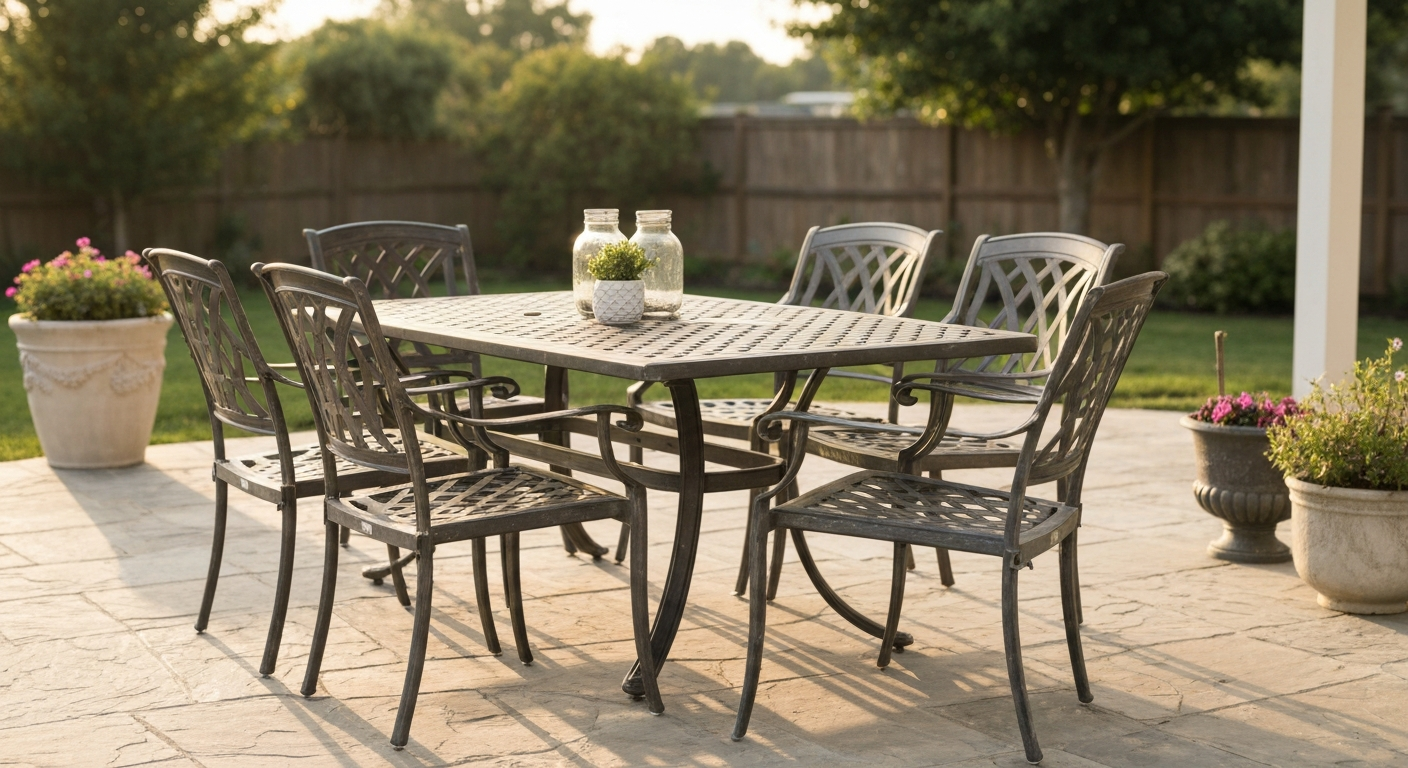
A well-made aluminum patio set will last 15 to 20 years in most climates with routine care. Cast aluminum pieces push that further, commonly reaching 20 to 25 years, and vintage cast examples from the mid-century era regularly hit 30 years when properly maintained or restored. Budget tubular sets with thin walls and basic painted finishes sit at the lower end, realistically 10 to 12 years before structural or finish failure catches up with them. The range is wide because aluminum's longevity depends less on the metal itself and far more on how it was cast or formed, what coating protects it, what hardware holds it together, and where you live.
How Long Does Aluminum Patio Furniture Last: Lifespan Guide
Marcus Kellerman
26 Jul 2026
What to Expect at Different Quality Levels
| Construction Type | Typical Lifespan | Finish Warranty (typical) | Frame Warranty (typical) |
|---|---|---|---|
| Budget tubular/extruded (painted) | 8–12 years | 1–2 years | 2–5 years |
| Mid-grade powder-coated extruded | 12–18 years | 3–5 years | 5 years |
| Premium powder-coated extruded | 15–20 years | 5 years | 5–10 years |
| Consumer cast aluminum | 15–20 years | 3–5 years | 5 years |
| Premium / commercial cast aluminum | 20–25+ years | 5 years | 10–15 years |
| Vintage / restored cast aluminum | 25–30+ years | N/A (repainted) | N/A |
Warranty language is a useful proxy for quality, but read it carefully. Many mainstream brands offer a 5-year structural warranty on frames and a separate 1-to-5-year finish warranty. Some premium and commercial-grade lines extend frame coverage to 15 years, which tells you something real about how the manufacturer is thinking about long-term structural performance. A finish warranty that only lasts one year on a piece you expect to use for two decades is not a confidence signal.
How Aluminum Ages Outdoors
Aluminum does not rust in the way steel does, but it does corrode. When bare aluminum is exposed to air, it forms a thin aluminum oxide (Al2O3) passive film almost instantly. That film is genuinely protective in most conditions, which is why aluminum has earned a reputation for being low-maintenance outdoors. The problem is that chloride ions, the kind that come from coastal salt air or de-icing road spray, attack that passive film and initiate pitting. Pitting corrosion is localized and can penetrate deep into the metal while the surrounding surface still looks fine, which is what makes it insidious.
Pitting is the dominant corrosion mechanism for outdoor aluminum in marine and high-chloride environments, and it progresses through wet-dry cycles and occluded (tight crevice) geometries like folded joints and blind rivet holes. Studies of aluminum alloys like AA5005 in natural seawater show pitting initiation within months to a few years depending on alloy and chloride deposition rate. For furniture, that means an uncoated or poorly coated piece near the coast can show visible surface damage within two to three seasons, while the same design 50 miles inland might stay pristine for over a decade.
Beyond pitting, the other common failure modes I see in the field are coating delamination (peeling or blistering powder coat), filiform corrosion (thread-like worms creeping under the coating from a scratch or edge), fastener corrosion causing loose joints, weld cracking on thin extruded frames under repeated load, and in cast pieces, fracture at sections with internal porosity. The good news is that most of these are slow-moving and visible before they become structurally dangerous, if you know what to look for.
Cast Aluminum vs Other Aluminum Constructions
The distinction between cast aluminum and extruded (tubular) aluminum matters a lot when you are thinking about how long a piece will last and how it will fail. Cast aluminum furniture is made from molten aluminum poured into molds, producing thick, heavy sections with complex ornamental shapes. Extruded aluminum furniture is made from aluminum forced through a die to create hollow profiles, which are then cut, bent, and welded or riveted into frames.
Cast Aluminum: Strengths and Trade-Offs
Cast pieces are genuinely robust. The mass and thickness of a cast chair or table leg resists bending under load, and because there are fewer joints, there are fewer mechanical weak points. The downside is that gravity casting and sand casting can introduce shrinkage porosity inside the metal, small voids that you cannot see from the outside. In a piece sitting on your patio the porosity is generally not an issue, but if a casting takes repeated impact or stress near a thin section, it can crack at those internal flaws. That said, I have handled 30-year-old cast aluminum garden sets that are structurally sound while their powder coat is long gone, which tells you how forgiving the underlying metal is when the original casting was done well.
Extruded and Tubular Aluminum: Strengths and Trade-Offs
Extruded profiles have very uniform wall thickness and essentially zero porosity, which is a real advantage for corrosion performance in the base metal. The issue with tubular furniture is the joints. Every welded corner, every rivet hole, every end cap is a potential entry point for water and a potential corrosion site. Thin walls (below about 1.2 mm) on budget pieces flex and fatigue over time under the cyclic loads of daily use. Premium extruded furniture uses thicker-wall profiles, better weld quality, and stainless hardware, and that is where the 15-to-20-year service life becomes realistic.
| Feature | Cast Aluminum | Extruded / Tubular Aluminum |
|---|---|---|
| Wall thickness / mass | Thick, heavy (3–8 mm+ sections) | Lighter, hollow (1–2.5 mm walls typical) |
| Porosity risk | Possible internal porosity in castings | Very low (uniform extrusion) |
| Joint count | Low (fewer mechanical joints) | Higher (welded/riveted nodes) |
| Failure mode | Fracture at porous/thin sections | Joint loosening, weld fatigue, fastener corrosion |
| Corrosion resistance (base metal) | Good | Good to excellent |
| Typical lifespan (well-finished) | 20–25+ years | 15–20 years |
| Weight | Heavy (harder to move) | Lighter (easier to store/rearrange) |
| Best for | Permanent/semi-permanent placement | Flexible, frequently moved sets |
My recommendation: if you want the longest-lived piece and you are not moving it around constantly, cast aluminum is the better bet. If you need lightweight furniture you can stack, store seasonally, or rearrange regularly, a premium extruded set with thick walls and stainless fasteners will serve you well for 15 to 20 years without the weight penalty.
How Coatings and Finishes Drive Longevity
The aluminum itself is almost never what fails first. The coating is. This is the single most important factor separating a 10-year set from a 20-year set, and it is often invisible at the point of purchase because two pieces can look identical on a showroom floor.
Powder Coat
Thermosetting powder coat is the gold standard for outdoor aluminum furniture. A properly applied powder coat involves a chemical pretreatment of the aluminum surface (chromate or chrome-free conversion coating) before the powder is electrostatically applied and cured in an oven. The pretreatment is critical: skip it or do it poorly and the coating will delaminate within a few years even if the powder itself is high quality. Architectural and super-durable polyester powder systems, specified and applied under programs like QUALICOAT, are rated for 12 to 20 or more years in non-extreme exposures. See Powder Coating & Seaside Class, QUALICOAT UK & Ireland for the Seaside classification details and specification guidance for marine-grade powder-coating systems Powder Coating & Seaside Class — QUALICOAT UK & Ireland. For coastal use, QUALICOAT's Seaside classification adds enhanced pretreatment requirements and additional accelerated tests including filiform corrosion and extended salt spray (AASS) specifically to address the chloride environment.
Anodized Finishes
Anodizing creates a thick aluminum oxide layer by electrochemical process rather than depositing a film on top of the metal. It is harder and more abrasion-resistant than powder coat and does not peel. The trade-off is a more limited color palette (silver, bronze, and dark tones mostly) and cost. Anodized aluminum is common in architectural applications and some high-end outdoor furniture, where it delivers excellent long-term performance. Scratches in anodized surfaces do not progress to delamination the way they can with powder coat.
Liquid Paint and Clearcoats
Liquid-applied paint and simple clearcoat finishes on budget furniture perform significantly worse outdoors. They are thinner, less adhesion-resistant, and more prone to chipping and UV degradation. If a piece lists 'painted finish' without mentioning powder coat or anodizing, treat it as a shorter-life product and price accordingly. Clearcoats on bare aluminum can delay oxidation but typically need reapplication every 2 to 4 years to maintain effectiveness.
| Finish Type | Typical Outdoor Durability | Coastal Suitability | Repairability |
|---|---|---|---|
| Architectural powder coat (QUALICOAT) | 12–20+ years | Good (Seaside spec required near coast) | Touchup possible; full refinish if widespread |
| Standard powder coat | 8–15 years | Moderate (needs enhanced pretreatment) | Touchup scratches; refinish at end of life |
| Anodized | 15–25+ years | Very good | Scratches do not spread; hard to refinish DIY |
| Liquid paint / enamel | 5–10 years | Poor to moderate | Easy to repaint; more frequent attention needed |
| Clearcoat only | 3–6 years before recoat needed | Poor | Reapply every 2–4 years |
Hardware, Fasteners, and Joinery: The Parts That Fail First
If I had to pick one thing that separates furniture that lasts 8 years from furniture that lasts 20, it would be fastener quality. Zinc-plated steel hardware is cheap to source and it is what you will find in a lot of budget outdoor furniture. It is also a disaster waiting to happen in any damp or coastal environment. Zinc plating degrades, the underlying steel corrodes, and then you have rust staining, loose joints, and eventually structural failure, often within 3 to 5 years in a marine environment and 6 to 10 years in a typical inland humid climate.
The right hardware choices for aluminum furniture are aluminum rivets or bolts for low-stress connections, and 316 (marine-grade) stainless steel for higher-stress fasteners where you need stainless strength. Grade 316 contains molybdenum which improves its resistance to chloride pitting. Grade 304 stainless is acceptable in mild inland settings but the British Stainless Steel Association explicitly does not recommend it for continuous seawater or splash-zone use. In practice, most good-quality aluminum furniture uses 316 stainless hardware throughout, while budget lines use 304 or worse, zinc-plated steel.
There is also a galvanic corrosion consideration. When aluminum contacts a more cathodic metal (like steel or copper-alloy hardware), the aluminum becomes the anode in the galvanic cell and corrodes preferentially. For authoritative guidance on galvanic corrosion, area effects, and practical mitigation (compatible fasteners, electrical isolation, and area-ratio design), see Corrosion Engineer’s Reference Book (NACE/AMPP reference material) – galvanic corrosion, area effect and mitigation. The rate depends on the area ratio: a large aluminum frame with a few small steel fasteners creates a high area-ratio scenario that limits the current density and keeps the corrosion relatively slow. But if you use a large steel bracket touching a small aluminum section, the corrosion accelerates. Good design uses compatible metals, electrical isolation through plastic washers or sleeves, or the correct area ratio to keep galvanic risk manageable.
- 316 stainless steel fasteners: best choice for coastal and humid climates, safe for all aluminum furniture
- 304 stainless: acceptable in dry inland locations, avoid near coasts or splash zones
- Aluminum rivets and bolts: excellent compatibility, ideal for non-structural connections
- Zinc-plated steel: high failure risk in any damp environment, common in budget furniture, avoid if possible
- Plastic or nylon washers: use between aluminum and any dissimilar-metal contact point to reduce galvanic risk
- Inspect weld seams: look for continuous, clean welds at corners and joints rather than spot welds or visible gaps
Climate and Region: Where You Live Changes Everything
ISO 9223 and ISO 12944 give engineers a framework for categorizing atmospheric corrosivity from C1 (very low, think dry indoor) to C5 and CX (very high marine or industrial). For practical purposes, your furniture is living somewhere on that spectrum and the coating spec and maintenance schedule should match it. Here is how I think about it for each major climate type.
Coastal and Marine Environments (within 5 km of the ocean)
This is the hardest environment for any outdoor furniture material, aluminum included. Chloride deposition from salt air attacks passive oxide films and coating edges constantly. QUALICOAT Seaside and equivalent marine-grade specifications exist specifically for this scenario. At a practical level: look for furniture explicitly marketed or specified for coastal use, inspect your finish quarterly rather than annually, rinse furniture with fresh water monthly (especially after storms), and treat any chip or scratch immediately with compatible touch-up paint to prevent filiform corrosion from spreading under the coating. Expect to refinish or repaint cast aluminum pieces at the 10-to-12-year mark even if the structure is sound.
Humid Subtropical and Tropical Climates
High humidity without direct salt air is less aggressive but still accelerates coating failure and fastener corrosion. Furniture in Florida, coastal Georgia, or Houston faces year-round humidity and warm temperatures that keep the surface wet for extended periods. A twice-yearly deep clean with mild soap and water, attention to any scratches, and keeping cushions and furniture covers from trapping moisture against the metal frame will significantly extend life. Good drainage design in chairs and tables (no pooling water) matters here.
Arid and Semi-Arid Climates
Low humidity and low chloride make this the easiest environment for aluminum furniture. UV radiation becomes the primary concern, causing powder coat fading and chalking over time. A once-per-year clean and occasional application of a UV-protective wax or sealant to the finish will preserve color and gloss significantly longer. A well-made piece in Phoenix or Las Vegas can realistically hit 20-plus years with minimal intervention.
Cold Climates with Freeze-Thaw Cycles
Aluminum itself handles freeze-thaw well because it does not absorb water the way wood does. The risk in cold climates is road salt if your furniture is stored near a garage or on a deck where de-icing salt drift can reach it. The other issue is that water trapped in hollow tube sections can freeze, expand, and stress welds or crack thin-wall extrusions over time. Seasonal storage (even just tipping pieces or covering them to prevent water ingress into tube ends) meaningfully extends service life in climates with hard winters.
High-UV Environments
High altitude or low-latitude sun accelerates UV degradation of organic coatings. Standard powder coats can show chalking and fading within 5 to 7 years in very high UV locations without UV stabilizers. Super-durable polyester powders are specifically formulated with enhanced UV resistance and are worth specifying (or asking about at point of purchase) for locations above 5,000 feet or in the sun belt.
Common Concerns Answered Directly
Does Aluminum Patio Furniture Rust or Corrode?
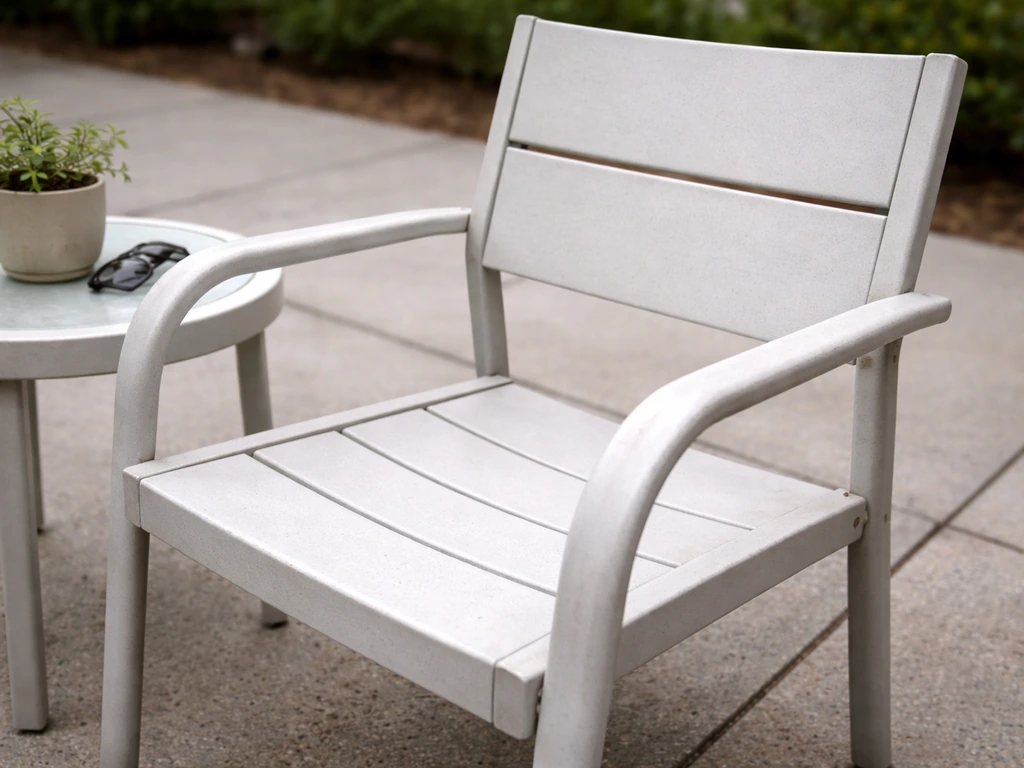
Aluminum does not rust. Rust is iron oxide, and aluminum contains no iron. What aluminum does do is corrode through the formation of white aluminum oxide on bare metal surfaces (that dull, chalky whitish film) and, in chloride environments, through pitting corrosion. Neither of these is as visually dramatic or as structurally aggressive as rust on steel, and the passive oxide layer that forms on bare aluminum is actually somewhat self-protective. The corrosion story for aluminum furniture is really about coating integrity and fastener selection, not about the base metal turning to flakes the way a steel chair would. For a focused Q&A on whether aluminum patio furniture rusts and how to prevent corrosion, see does aluminum patio furniture rust.
Does Aluminum Patio Furniture Get Hot in the Sun?
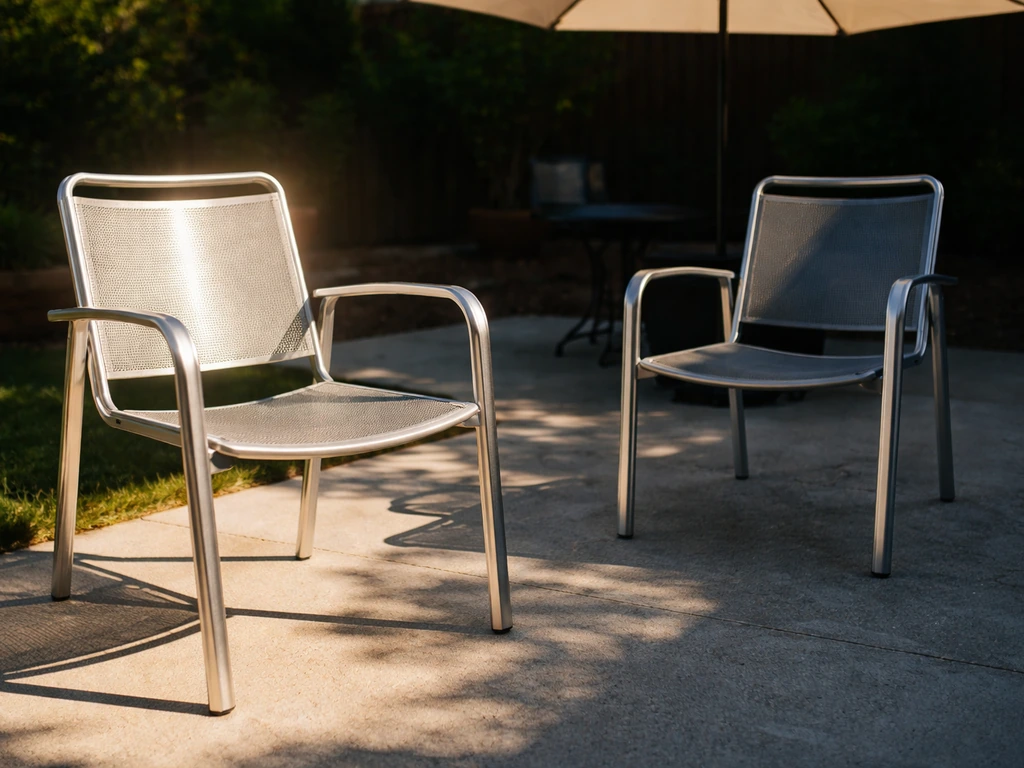
Aluminum conducts heat well, which means it absorbs solar energy quickly but also sheds it quickly once you move into shade or a breeze picks up. For more on how finish color and sunlight affect surface temperature, see does aluminum patio furniture get hot. Dark-colored powder coats absorb more solar radiation and will feel hotter to the touch on a bright afternoon than light or reflective finishes. In direct sun, arm rests and table tops on dark aluminum can reach temperatures uncomfortable to touch, though not as extreme as wrought iron or steel. Light-colored or silver finishes stay noticeably cooler. If heat is a concern in your climate, it is worth factoring finish color into your buying decision.
Is Aluminum a Good Choice for Patio Furniture?
For most homeowners in most climates, yes, aluminum is one of the best-value outdoor furniture materials available. It is lightweight compared to cast iron or teak, genuinely corrosion-resistant compared to steel, and far easier to maintain than either wood or wrought iron. Its cost-per-year of service life is excellent when you choose a quality piece: a well-made cast aluminum dining set at $1,200 that lasts 20 years costs you $60 per year. The same money spent on a cheap painted steel set that lasts 5 years costs $240 per year and delivers a worse experience along the way. The key is buying a quality construction with the right finish, not just any aluminum furniture.
Signs of Failure and Safety Issues to Watch For
Aluminum furniture rarely fails catastrophically without warning. Learning to spot the early signs of trouble lets you repair or reinforce before something becomes dangerous. Here is the inspection checklist I use when evaluating both pieces I am buying and furniture I already own.
Inspection Checklist: Buyers and Homeowners
- Coating surface: look for blistering, peeling, or filiform corrosion (worm-like threads under the coating near scratches or edges) — any of these indicate moisture is getting under the finish
- Pitting on bare metal: where the coating has worn away, check for small pits or white powdery deposits — pitting that has already started suggests the piece has seen chloride exposure without adequate protection
- Weld integrity: at every corner and joint, look for cracks in the weld bead, visible separation, or rust staining that indicates a steel fastener hidden inside is failing
- Fastener condition: check all exposed bolts, rivets, and screws for rust staining, corrosion products, or heads that have distorted (which can indicate the fastener has expanded from corrosion inside)
- Structural rigidity: sit in chairs and apply moderate load to table corners — any racking, creaking, or visible flex at joints that should be rigid is a sign of fastener loosening or weld fatigue
- Cast section integrity: on cast pieces, run your hands along legs and armrests looking for hairline cracks, especially at thin cross-sections, connection points, and any area that shows impact marks
- Tube end caps and drainage holes: on extruded furniture, check that end caps are intact (open tube ends trap water) and that any designed drainage holes are clear and unobstructed
- Bending or distortion: any visible bending of a structural member (not just surface damage) is a structural warning — aluminum does not spring back the way steel does once plastically deformed
- Flaking finish on welds: weld areas often get less pretreatment coverage; flaking specifically at welds is an early sign of adhesion failure that will spread
- Stability on flat surface: tip the piece or lift one leg slightly — unequal leg lengths or a twisted frame indicates prior structural deformation and warrants closer inspection before use
The safety-critical issues are structural bending in load-bearing members, cracked cast sections, and loose joints in chairs where a sudden failure under body weight is possible. Surface pitting and coating flaking are cosmetic-to-moderate concerns that affect longevity but not immediate safety. When I see any structural bending in a frame or a crack in a cast leg, I retire the piece from regular use until it can be evaluated properly.
Maintenance Schedule to Maximize Lifespan
Aluminum requires less maintenance than wood or iron but it is not truly zero-maintenance if you want it to reach its maximum service life. The single biggest payoff activity is regular washing, because it removes chloride, dirt, and airborne pollutants that degrade coatings over time. Here is the routine I recommend based on climate zone.
| Task | Inland / Dry Climate | Humid / Subtropical | Coastal (within 5 km of ocean) |
|---|---|---|---|
| Fresh water rinse | Annually (spring) | Every 2–3 months | Monthly (after storms: immediately) |
| Soap wash (mild detergent) | Once per year | Twice per year | Quarterly |
| Inspect coating for chips/scratches | Annually | Twice per year | Quarterly |
| Touch up paint / powder coat chips | As needed (annually check) | As found, promptly | As found, promptly (within days) |
| Apply wax or UV sealant to finish | Every 2–3 years | Annually | Annually |
| Inspect and tighten fasteners | Every 2 years | Annually | Every 6 months |
| Check for structural deformation | Annually | Annually | Annually |
| Winter storage or covers | Recommended in hard-freeze areas | Not required but extends finish life | Recommended; rinse before storing |
Repair, Restoration, and When to Replace
Aluminum furniture is unusually repair-friendly compared to most other materials. Surface coating failures, including widespread peeling or fading powder coat, can be addressed by professional powder coat refinishing, which strips the old coating and applies a fresh one. This process costs roughly $50 to $150 per chair at a local powder coat shop and effectively resets the finish life of the piece. It is economically viable on quality cast or heavy extruded furniture that still has sound structural integrity, and I have seen beautifully restored 25-year-old cast sets that came out of the shop looking better than new.
For extruded furniture with loose joints, replacement stainless hardware and epoxy re-bonding at weld failures can extend life by several more years. Replacement slings, cushions, and webbing are readily available for most standard frame sizes. The point at which repair stops making sense is when the structural aluminum itself is compromised: multiple cracked welds, bent load-bearing members, or deeply pitted cast sections that have lost cross-sectional integrity. At that point, cost-per-use stops working in repair's favor.
What Happens at End of Life: Recycling and Disposal
Aluminum is one of the most recyclable materials in existence, retaining essentially all of its value in the recycling stream regardless of how old or corroded it is. At end of life, aluminum patio furniture can be taken to a metal scrap dealer who will pay by weight for clean aluminum. A typical cast aluminum dining set might yield 15 to 30 pounds of material, and scrap aluminum has historically traded between $0.30 and $0.80 per pound at local yards, so you are realistically looking at $10 to $25 back on a large set. More importantly, recycled aluminum uses only about 5% of the energy required to produce new aluminum from ore, making it one of the most environmentally sound end-of-life scenarios for any furniture material. Some municipalities also accept aluminum furniture in curbside metal collection. Powder coat and other finishes do not need to be stripped before recycling since the smelting process handles them.
Buying Tips: Getting to 20 Years
The decisions you make at point of purchase have more impact on how long your furniture lasts than almost anything you do afterward. A well-chosen piece bought once is far better value than a cheap replacement cycle. Here is what I look for.
- Wall thickness on extruded pieces: ask or measure; 1.5 mm or above is a quality indicator, under 1.2 mm signals a budget product
- Powder coat specification: ask if it is a super-durable or architectural polyester powder, and whether pretreatment was applied; QUALICOAT certification or explicit coastal/marine rating is meaningful
- Fastener material: look for 316 stainless steel or aluminum hardware; zinc-plated steel is a red flag
- Weld quality: visually inspect at corners and joints for full, consistent welds rather than spot welds or obvious gaps
- Frame warranty: five years is the floor for a quality consumer product; 10 to 15 years on a cast piece from a reputable brand signals genuine manufacturer confidence
- Weight as a proxy: heavier cast and thick-wall extruded pieces almost always indicate better material quality than unusually light sets at the same price point
- Coastal rating: if you live near the ocean, look for products explicitly rated or tested for coastal exposure, not just 'weather-resistant'
- Brand transparency: brands that publish alloy type, coating specification, and warranty terms in plain language tend to stand behind quality; vague marketing language about 'rust-resistant finish' without specifics is a caution
Viewed through a cost-per-year lens, the economics of quality aluminum furniture are hard to argue with. A premium cast aluminum set that costs twice as much as a budget alternative but lasts three times longer is not just a better product, it is a better financial decision. Aluminum's combination of genuine structural durability, low maintenance requirements relative to wood or iron, full recyclability at end of life, and wide availability across style types makes it one of the most practical materials for outdoor furniture across most climates and use cases.
FAQ
How long does aluminum patio furniture typically last in normal outdoor conditions?
High‑quality powder‑coated extruded (tubular) aluminum furniture generally lasts about 10–20 years with routine maintenance; many sources and manufacturer guidance cite 15–20 years as realistic for well‑finished extrusions in ordinary (non‑marine) exposure. Lifespan depends on finish quality, hardware, and local climate.
How long does cast aluminum patio furniture usually last compared with extruded/tubular aluminum?
Cast aluminum (thicker, solid cast components) is commonly reported to last about 15–25+ years with normal outdoor exposure and routine care. Well‑maintained vintage cast pieces can remain serviceable for 25–30+ years. Cast parts resist bending but can have porosity or thin sections that influence long‑term durability; extruded profiles have more uniform walls but depend on welds and joints.
What environmental factors most affect aluminum furniture lifespan?
The main factors are chloride/salt exposure (coastal/marine environments accelerate pitting and coating failure), frequency of wet‑dry cycles, humidity, UV exposure, temperature swings, and presence of dissimilar metals that can create galvanic corrosion. ISO corrosivity categories (C1–C5/C5‑M) map local environment to recommended coating and maintenance practices.
Does aluminum patio furniture rust or corrode?
Aluminum does not 'rust' (iron oxide) but can corrode. It forms a protective Al2O3 film that slows uniform corrosion, but localized pitting/crevice corrosion can occur in chloride‑rich environments. Proper pretreatment, powder coating, and compatible hardware (e.g., 316 stainless fasteners in marine areas) greatly reduce corrosion risk.
How do coatings and pretreatment affect service life?
Coating system and pretreatment are critical. Standard powder coat systems protect well in inland settings for a decade or more. Premium architectural/super‑durable polyester powders with proper pretreatment (QUALICOAT/Seaside or equivalent) significantly extend finish life and resist filiform and chloride‑driven failures—often enabling multi‑decade performance in non‑extreme exposures. In coastal areas, Seaside‑rated systems and more frequent maintenance are recommended.
How do hardware and fastener choices change longevity?
Dissimilar‑metal contact (e.g., aluminum with zinc‑plated steel) can cause galvanic corrosion. Use aluminum fasteners, aluminum rivets, or marine‑grade 316/316L stainless steel in coastal environments. Plastic washers or isolators also reduce electrical contact. Improper hardware is a common early failure point.
Next Articles
Does Aluminum Patio Furniture Get Hot in the Sun?
Find out if aluminum patio furniture gets hot, what affects heat, and how to shade and cool it for comfort
Does Aluminum Patio Furniture Rust? Causes, Fixes, Prevention
Learn if aluminum patio furniture rusts, how to spot oxidation or powder-coat damage, plus fixes and prevention steps.
Is Aluminum Patio Furniture Good? Durability, Pros, Cons
Learn if aluminum or cast aluminum patio furniture is good for weather, rust resistance, and low-maintenance longevity.