
Steel patio furniture is a smart choice for most homeowners, but only when you pick the right type and finish for your climate. A well-made powder-coated or galvanized steel set is genuinely durable, heavy enough to stay put in wind, and usually cheaper upfront than aluminum or teak. The catch is that bare or poorly coated steel will rust, sometimes within a single season in coastal or humid climates. If you want a quick answer to 'does steel patio furniture rust', read the rust timelines and prevention tips in this guide. Get the coating right, maintain it properly, and steel will outlast a lot of the competition. Ignore it, and you'll be sanding rust spots every spring.
Steel Patio Furniture Pros and Cons: Buy Care & Rust Guide

Marcus Kellerman
17 Jul 2026
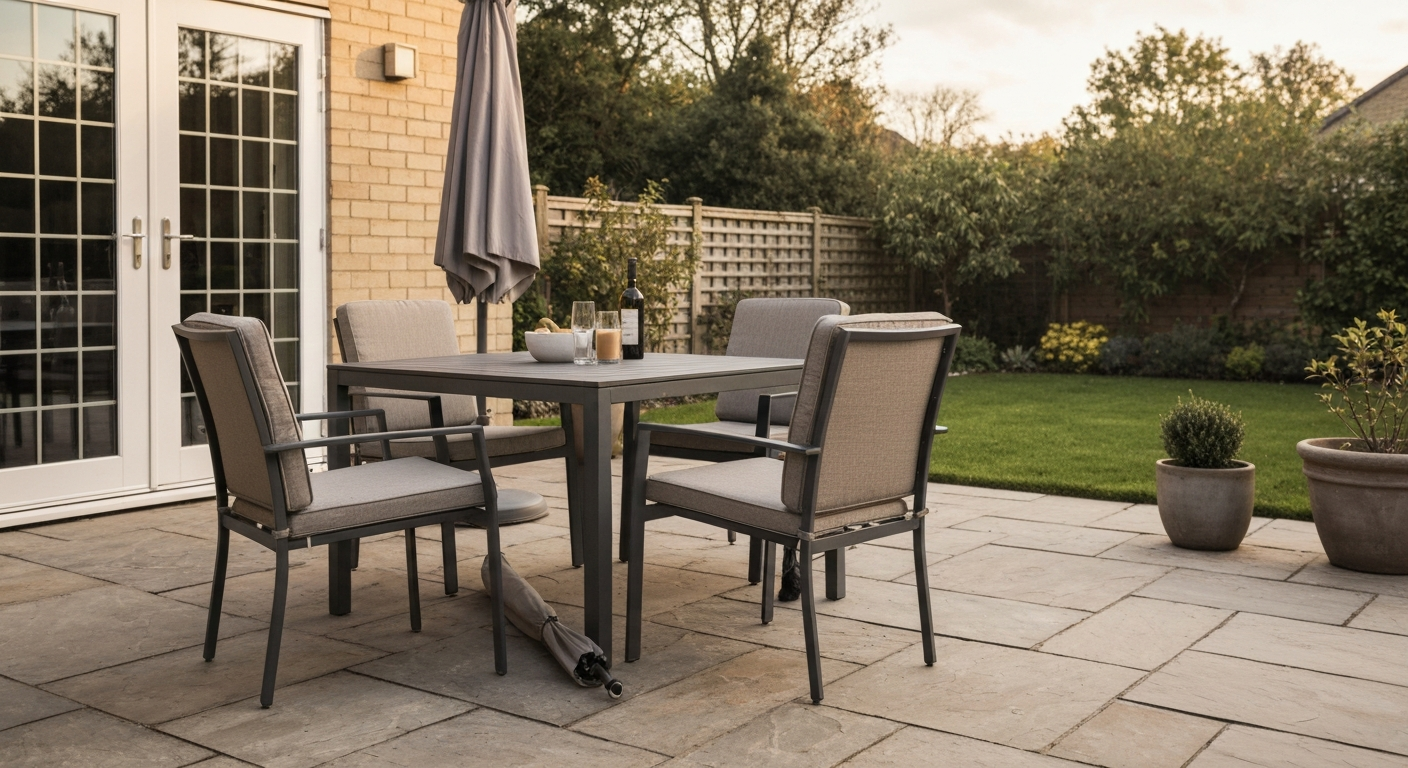
Quick verdict: is steel good for patio furniture?
Yes, with conditions. Read our full guide 'Is steel good for patio furniture' on this site for detailed buying and maintenance advice. Steel is one of the strongest and most rigid materials used in outdoor furniture, and mid-range powder-coated sets hold up well for 10 to 15 years with basic annual maintenance. The material disadvantages, mainly rust risk and weight, are real but manageable. Where steel falls short is in coastal or permanently humid environments: uncoated or thinly coated steel in a salt-air climate can show surface rust within 6 to 12 months. For dry, temperate, or urban climates, steel is an excellent value. For coastal yards within roughly a mile of saltwater, you need stainless 316 or aluminum instead, unless you're committed to diligent upkeep.
Pros and cons of steel patio furniture
Here's the honest breakdown. These aren't marketing talking points, they're the practical realities I've seen play out across different climates and quality levels.
Advantages
- High structural strength and rigidity: steel is far stronger pound-for-pound than most woods and won't flex or wobble the way thin-walled aluminum can on heavy pieces like dining tables and loungers
- Wind stability: the weight of steel (typically 30 to 60 lbs for a chair, 80 to 150 lbs for a dining table) keeps it in place without anchoring in moderate winds
- Wide price range: entry-level powder-coated steel sets start around $200 to $400; quality mid-range sets run $600 to $1,500, which is significantly less than comparable teak or cast iron
- Design versatility: steel can be welded, bent, and formed into intricate shapes that aluminum extrusions and wood can't match — a big reason wrought-style and modern geometric outdoor furniture uses steel
- Repairability: scratches, chips, and minor rust can be addressed with sandpaper, rust converter, and touch-up powder coat or enamel spray — you don't have to replace a piece for cosmetic damage
- Long lifespan when properly coated: galvanized or duplex-coated (galvanized plus powder coat) steel can realistically last 20 or more years in non-coastal environments
- Recyclable and widely available for repair parts and welding
Drawbacks
- Rust is the primary liability: any chip, scratch, or gap in the coating exposes bare steel to oxygen and moisture, triggering iron oxide corrosion that spreads under the coating if not caught early
- Heavy weight makes moving and storing the furniture genuinely difficult — not ideal if you rearrange furniture frequently or need to haul it indoors every winter
- Heat absorption: dark-coated steel in direct sun can reach surface temperatures uncomfortable to touch, which matters for armrests, table surfaces, and chair frames
- Lower corrosion resistance than aluminum or stainless steel in chloride-heavy (coastal/marine) environments without significant coating investment
- Coating quality varies enormously: cheap sets with thin powder coat or simple paint finishes degrade quickly, so the gap between a $300 set and a $900 set is often measured in years of useful life
- Fasteners and joints are common rust initiation points if made from standard carbon steel hardware rather than stainless
How steel rusts: risk factors, timelines, and what to look for
Rust (iron oxide) forms when bare steel is exposed to oxygen and moisture simultaneously. The electrochemical reaction is straightforward, but the rate at which it progresses depends heavily on the environment. ISO 9223 classifies atmospheric corrosivity from C1 (very low, dry indoor conditions) through C5 and CX (high to extreme, industrial or marine coastal). The same steel piece sitting in an Arizona yard (C1 to C2) behaves very differently from one on a Florida beach (C4 to C5), where chloride deposition and prolonged wetness accelerate the corrosion rate dramatically.
For furniture specifically, the design matters almost as much as the climate. Several structural features concentrate corrosion risk: horizontal surfaces where water pools, tight crevices in lap joints and bolt connections where oxygen depletion creates aggressive local chemistry, uncoated or poorly coated weld heat-affected zones, and any contact point between steel and a dissimilar metal (like brass hardware) that creates a galvanic couple. These aren't abstract concerns, they're the spots where I consistently see rust initiate first on furniture that's otherwise held up reasonably well.
Typical timelines for surface rust on uncoated or poorly coated steel range from as little as a few weeks in a coastal/humid C4 to C5 environment to several years in a dry inland C1 to C2 location. Once rust starts under a coating, it undercuts the surrounding finish rapidly. A chip the size of a dime can produce a rust blister several inches wide within a single rainy season if left untreated. Visible signs to check for include orange-brown staining around joints and fasteners, bubbling or flaking in the powder coat or paint, and white-gray streaking on surfaces below weld points, that last one is often the first indicator of weld-zone corrosion.
Preventing and repairing rust: practical steps that actually work
Prevention
The most effective prevention happens before you buy: choose furniture with a high-quality coating suited to your climate (more on that in the next section), look for stainless steel hardware on joints and fasteners, and pick designs that drain water naturally rather than trapping it in horizontal tube ends or flat shelves. Once you have the furniture, keep it clean and dry. Rinse off salt, pollen, and debris monthly with fresh water and mild soap. After drying, apply a coat of automotive or marine wax to the frame two or three times a year, this adds a hydrophobic barrier over the powder coat that measurably slows coating degradation. Cover furniture during extended periods of rain or off-season storage, or move it undercover. Furniture covers trap humidity if not vented, so look for covers with ventilation panels.
Repairing rust when it appears
- Catch it early: inspect all joints, weld seams, and fastener points at least once a season. Small spots are far easier to address than spreading rust under the coating.
- Sand or wire-brush the affected area down to clean metal, feathering the edges of any surrounding coating. 80 to 120 grit works well for surface rust; heavier pitting may need a rotary wire brush attachment.
- Apply a phosphoric acid-based rust converter or rust-inhibiting primer to the bare metal before any topcoat. Rust converter chemically transforms iron oxide into a stable compound and significantly improves adhesion.
- Touch up with a color-matched enamel spray or aerosol powder coat alternative. Quality touch-up sprays from the original manufacturer will provide the best color match and adhesion; generic hardware-store enamel works as a functional (if not cosmetic) fix.
- For significant coating loss or deep pitting on a piece worth keeping, professional re-powder-coating is available from many industrial coating shops for $100 to $250 per piece and restores factory-grade protection.
- Replace any standard carbon steel fasteners showing rust with stainless steel hardware of the same size — this eliminates a recurring initiation point.
Steel types and finishes explained
Not all steel patio furniture is the same material. The base alloy and the protective finish make an enormous difference in how the piece performs outdoors. Here's what each option actually means and where each makes sense.
Powder-coated carbon steel
This is the most common type in residential outdoor furniture. Carbon steel (plain mild steel) is strong and cheap to fabricate, and the powder coat finish, an electrostatically applied polymer cured at high heat, provides the corrosion barrier. Quality architectural powder coat runs 45 to 75 microns (roughly 1.8 to 3.0 mil) thick, per published product data from major coatings manufacturers. The performance tier matters: coatings specified to AAMA 2604 must pass roughly 3,000 hours of humidity and salt-spray testing; AAMA 2605 is the highest architectural grade and demands even stricter UV and corrosion resistance. ISO 9227:2022, Corrosion tests in artificial atmospheres, Salt spray tests specifies apparatus, reagents, and procedures for neutral and other salt‑spray (NSS/AASS/CASS) testing and does not by itself predict field lifetime ISO 9227:2022 — Corrosion tests in artificial atmospheres — Salt spray tests. Most big-box retail furniture uses unnamed or AAMA 2603-grade coatings, which are significantly weaker. Powder coat can fail at edges, scratches, drilled holes, and any spot where surface prep was inadequate before coating, these spots let moisture under the film and undercutting begins. For inland and temperate climates, a good powder-coated steel set is an excellent value. For coastal environments, it requires more diligent maintenance.
Hot-dip galvanized steel
Hot-dip galvanizing (HDG) immerses clean steel in molten zinc, producing a metallurgically bonded zinc-iron alloy coating. Per ASTM A123 and industry guidance from the Galvanizing Association of Australia and International Zinc Association, minimum average coating thicknesses typically range from about 45 microns on thin sections (under 1.5 mm) up to 55 to 70 microns on sections over 3 mm thick. Zinc protects steel in two ways: as a physical barrier and as a sacrificial anode (it corrodes preferentially, protecting any exposed steel nearby). In rural low-corrosivity environments, zinc corrodes at roughly 0.5 to 3 microns per year; in urban or coastal conditions, that rises to 1 to 8 microns per year. This gives a useful life of 15 to 50 years depending on environment and coating thickness before the zinc layer is depleted to the point of steel exposure. Bare galvanized furniture has an industrial aesthetic that isn't for everyone, but it's one of the most genuinely durable options. Many quality steel pieces combine HDG with a powder coat topcoat, what the industry calls a blank" rel="noopener noreferrer">duplex system, which can extend service life by roughly 1.8 to 2 times versus either coating alone.
Stainless steel (304 and 316)
Stainless steel is a chromium-bearing iron alloy where the chromium content (minimum 10.5% by standard definition) forms a self-repairing passive oxide layer that resists corrosion without any additional coating. Grade 304 (18% chromium, 8% nickel) is the workhorse for most inland outdoor furniture; it has a yield strength around 205 to 215 MPa and handles most non-marine environments well. Grade 316 adds 2 to 3% molybdenum, which dramatically improves resistance to pitting and crevice corrosion in chloride-bearing environments. Major stainless producers are explicit that 316 is the appropriate grade for coastal and marine applications; 304 can show pitting and crevice staining within months in direct salt air. The tradeoff is cost: 316 is commonly 30 to 50% more expensive per kilogram than 304, which flows through to finished furniture pricing. Full stainless furniture tends to appear at the premium end of the market, often alongside teak or other high-end materials. It requires little maintenance beyond cleaning but benefits from periodic polishing to maintain the passive layer, especially in humid conditions.
Painted steel
Wet-applied liquid paint (enamel or epoxy-based) is the lowest-cost finish option and the one most common on budget import furniture. It provides a physical barrier only, no sacrificial protection like zinc, and no chemical bonding to the metal surface compared to powder coat. Adhesion depends entirely on surface preparation quality, which is hard to assess when buying. Painted steel furniture typically shows rust at chips and joints within 2 to 5 years in moderate climates. It's worth avoiding unless the price is genuinely exceptional and you understand what you're getting.
Which steel type works best in your climate
Climate is the single biggest variable in how long steel patio furniture lasts. The ISO 9223 corrosivity classification system provides a useful framework: it categorizes atmospheric environments by first-year corrosion loss and key drivers including time-of-wetness, sulfur dioxide (urban/industrial pollution), and chloride deposition (coastal proximity). Here's how to match steel type to real-world climate categories.
| Climate / Environment | ISO 9223 Class | Recommended Steel Type | Minimum Coating |
|---|---|---|---|
| Dry inland (desert, high-altitude) | C1–C2 | Powder-coated carbon steel | AAMA 2603 or better |
| Temperate inland (suburbs, most of continental US) | C2–C3 | Powder-coated carbon steel | AAMA 2604 recommended |
| Urban/industrial (air pollution, acid rain risk) | C3–C4 | HDG + powder coat (duplex), or 304 stainless | AAMA 2604 or AAMA 2605 |
| Humid subtropical (SE US, Gulf Coast, SE Asia) | C3–C4 | HDG + powder coat (duplex), or 304/316 stainless | AAMA 2604 minimum; 2605 preferred |
| Coastal within 1 mile of saltwater | C4–C5 | 316 stainless or aluminum | Avoid plain powder-coated carbon steel |
| Marine/direct oceanfront exposure | C5–CX | 316 stainless only | Not suitable for carbon steel regardless of coating |
Cold climates add a separate consideration: freeze-thaw cycles and road salt (if furniture is near driveways or walkways treated in winter) significantly accelerate coating failure. For cold-climate yards, rinse furniture thoroughly before storage, store it dry, and inspect all joints in spring before the season begins. HDG plus powder coat is the most resilient combination for cold northern climates that also see road salt.
Steel vs aluminum vs wood (and a note on wicker, teak, and rattan)
The steel vs aluminum comparison comes up constantly, and it's genuinely a close call depending on priorities. For a focused comparison of steel vs aluminum patio set options, pros, and tradeoffs, see our dedicated guide. For a side-by-side comparison, see our guide on metal vs wood patio furniture. Aluminum doesn't rust, period, it forms a stable aluminum oxide layer that protects the base metal without any coating. If you want patio furniture that will not rust, prioritize aluminum or 316 stainless-steel options which resist corrosion in humid and coastal environments. That makes it the lower-maintenance choice for coastal and humid climates. The downsides: aluminum is lighter (good for moving, bad for wind stability), less rigid at equivalent tube wall thickness, and can feel less substantial in heavier furniture like dining sets. Powder-coated aluminum is also vulnerable to coating damage, but since the underlying metal doesn't rust, coating failure is cosmetic rather than structural. Aluminum typically costs 10 to 25% more than equivalent-quality steel for the same piece.
Wood, particularly teak, eucalyptus, and acacia, brings a completely different set of tradeoffs. There's no corrosion risk, but there's biological degradation risk: wood checks, cracks, grays, and rots if not maintained. Teak and old-growth hardwoods are genuinely long-lived (20 to 30 years with care), but they require oiling or sealing, they're heavy, and quality pieces are expensive. On a cost-per-year basis, quality teak and quality steel land in similar territory; mid-grade wood is less durable than mid-grade steel. Wood furniture is far more comfortable to the touch in hot sun than dark-coated steel.
Wicker and rattan (especially synthetic resin wicker) are worth a brief mention. Natural rattan is not suitable for prolonged outdoor exposure, it dries, cracks, and degrades. Synthetic all-weather wicker over an aluminum frame is a genuinely durable product, but the wicker weave itself can loosen and sag over time. Teak gets its own detailed treatment on this site because it's a category unto itself in terms of longevity. For a more complete look at how steel stacks up against aluminum specifically, the steel vs aluminum patio set comparison goes deeper into that decision.
Side-by-side comparison: steel, aluminum, and wood
| Attribute | Steel (powder-coated) | Steel (HDG or 316 SS) | Aluminum | Hardwood (teak/eucalyptus) | Synthetic wicker (Al frame) |
|---|---|---|---|---|---|
| Typical weight (dining chair) | 25–45 lbs | 30–55 lbs | 10–20 lbs | 20–35 lbs | 12–22 lbs |
| Corrosion resistance | Moderate (coating-dependent) | High (HDG) / Very high (316 SS) | Very high (no rust risk) | N/A (biological decay risk) | High (Al frame; wicker UV-resistant) |
| Structural durability | Excellent | Excellent | Good–Very good | Very good | Good |
| Typical lifespan (maintained) | 10–15 years | 20–30+ years | 15–25 years | 20–30+ years (teak) | 8–15 years |
| Upfront cost (4-seat set) | $300–$1,500 | $1,000–$4,000+ | $600–$3,000 | $1,500–$8,000+ | $500–$2,500 |
| Annual maintenance effort | Low–Moderate | Low | Very low | Moderate (oiling/sealing) | Low |
| Rust/corrosion risk | Yes (if coating fails) | Low (HDG) / Very low (316 SS) | None | None | None (frame) |
| Heat absorption in sun | High (dark coatings) | Moderate–High | Moderate | Low | Low–Moderate |
| Wind stability | High | High | Moderate | High | Low–Moderate |
| Repairability | Good (touch-up possible) | Good–Excellent | Good (cosmetic) | Excellent (sand/re-oil) | Fair (weave repairs difficult) |
What to look for when buying steel patio furniture
The quality gap in steel furniture is wider than in almost any other outdoor furniture category because the cost of high-quality coating preparation versus cheap spray paint isn't visible until six months after purchase. Here's the shopping checklist I actually use.
- Coating specification: ask for or look up the powder coat grade. AAMA 2604 or 2605 is a meaningful quality signal; unlabeled or 'durable powder coat' language tells you nothing.
- Hardware material: fasteners, bolts, and any moving parts (hinges, recline mechanisms) should be stainless steel. Carbon steel hardware rusts independently of the frame coating and is the first thing to fail on otherwise good furniture.
- Weld quality: look at weld seams on the actual piece or in close-up product photos. Clean, smooth welds with no visible porosity, gaps, or sharp slag edges suggest quality fabrication and better coating adhesion at joints.
- Wall thickness: heavier-gauge steel tube (1.5 mm or greater wall thickness) resists denting and deformation better than thin-wall construction. Cheaper sets often use thinner gauge to reduce cost and weight.
- Drainage design: check horizontal tube ends (they should be capped or angled to drain), flat shelves (should have drain holes), and joints (should not create water traps).
- Warranty: a meaningful structural warranty of 3 to 5 years for carbon steel, or 5 to 10 years for stainless or galvanized, signals manufacturer confidence. One-year or no-warranty sets are priced that way for a reason.
- Duplex coating: for humid or semi-coastal climates, furniture marketed as galvanized plus powder-coated (duplex) is worth a 20 to 40% price premium over powder-coat-only for the extended corrosion life.
- Test for finish quality at purchase: run your fingernail firmly across a flat surface. Quality powder coat should not scratch with fingernail pressure; if it does, the coating is thin or under-cured.
Lifespan and long-term value
On a cost-per-year basis, the math usually favors paying more upfront for better coating quality. A $400 budget set that lasts 5 years costs $80 per year. A $900 AAMA 2604 powder-coated set that lasts 15 years costs $60 per year and involves less maintenance time and aggravation. A $1,800 duplex-coated or stainless set lasting 25 years drops to $72 per year with almost no maintenance costs. I consistently recommend that buyers skip the bottom of the market entirely and look for mid-range sets with documented coating specifications and stainless hardware, that's where the value actually lives for most homeowners.
Maintenance calendar and seasonal storage
Consistent light maintenance outperforms occasional heavy intervention every time. Here's a practical annual schedule: in spring, wash the frame with mild soap and water, inspect every joint and weld point for early rust or coating bubbles, sand and treat any spots immediately, and apply a coat of paste wax to the frame. Through the season, rinse furniture monthly (especially after rain in coastal or industrial areas) and re-wax quarterly if the furniture gets heavy use or exposure. In fall, do a full inspection before covering or storing, catching rust before winter storage prevents it from spreading for six months unobserved. For storage in cold climates, store the furniture dry and elevated off damp ground. Remove cushions to separate storage regardless of climate, as trapped moisture between cushions and steel frames accelerates coating degradation at contact points.
Cushions and fabric compatibility
Cushions on steel furniture need to be specified for outdoor use: solution-dyed acrylic fabric (Sunbrella is the benchmark brand, but there are credible alternatives) resists UV fading and dries quickly. Avoid polyester fill cushions that retain moisture against the steel frame, this is a significant contributor to coating failure at contact points and, in worst cases, to fabric mold. If cushions don't have drainage holes in the seat base, add them or store cushions upright when not in use. Anti-rust strips (thin rubber or felt furniture pads) between cushion frames and steel contact points reduce abrasion that exposes bare metal.
Anchoring steel furniture in high-wind areas
While steel's weight is a natural anchor in moderate wind, heavy gusts, particularly in coastal areas, open plains, or elevated decks, can still move even a heavy steel table and cause injury or damage. Options include deck anchoring straps (fabric straps with stainless hardware that clip to existing furniture legs and bolt or screw into deck boards), concrete anchor pads for freestanding umbrella bases, and furniture leg weights designed for heavier patio sets. For steel dining tables, storing umbrellas horizontally during storms eliminates the single greatest wind-loading factor. Any anchoring hardware used with steel furniture should itself be stainless to avoid introducing new rust initiation points at the contact area.
FAQ
Is steel a good choice for patio furniture — what's the short verdict?
Yes — steel can be an excellent choice when matched to the climate, finished correctly, and maintained. It offers high strength, stability, and design versatility. For inland, low‑chloride locations powder‑coated or hot‑dip galvanized steel performs very well; for coastal/marine exposure choose 316 stainless or a duplex system (galvanize + high‑performance topcoat). The tradeoffs are extra weight, potential for rust if coatings or design allow water traps, and higher maintenance or material cost for marine‑grade stainless or duplex systems.
What are the main pros of steel patio furniture?
- Strength and stiffness: supports weight, slimmer profiles than wood for same load. - Durability: long service life with proper corrosion protection (galvanize, powder coat, stainless). - Design flexibility: easy to form, weld, and finish — suits modern and traditional styles. - Stability: heavy enough to resist wind without constant anchoring. - Cost spectrum: can be economical (basic mild steel with coating) or premium (316 stainless or duplex).
What are the main cons of steel patio furniture?
- Corrosion risk: unprotected or damaged coatings will rust. - Weight: heavier to move and ship than aluminum/wicker. - Maintenance: occasional touch‑ups and inspections required to prevent edge/crevice corrosion. - Cost for premium options: 316 stainless or duplex systems are pricier. - Potential heat retention: metal can get hot in sun unless finished or shaded.
How does rust form on steel outdoor furniture and how big is the risk?
Rust (iron oxide) forms where steel contacts oxygen and water; salts, industrial pollutants and time‑of‑wetness accelerate the process. Design features that trap moisture (horizontal surfaces, lap joints, crevices, unsealed weld zones) and damaged coatings are typical initiation sites. Coastal or industrial atmospheres (higher ISO 9223 corrosivity classes) significantly increase corrosion rate; inland rural locations are far less aggressive. Proper material choice and coatings greatly reduce risk.
How can I prevent rust — practical strategies?
- Choose corrosion‑appropriate materials: 316 stainless in coastal settings; hot‑dip galvanized or duplex systems elsewhere. - Use high‑quality coatings: architectural powder coatings meeting AAMA 2604/2605 or properly specified liquid topcoats. - Design for drainage/venting and avoid tight crevices. - Isolate dissimilar metals with non‑conductive washers. - Inspect and touch up chips promptly with compatible primer/topcoat. - Use covers/cover storage during heavy wet seasons; store indoors for winter if practical.
How do I repair rust or damaged coatings step‑by‑step?
1) Remove loose rust and paint with a wire brush or 80–120 grit sandpaper; for heavy rust use a rust converter or mechanical grinding. 2) Clean surfaces with solvent/degreaser and dry. 3) If base metal is exposed on galvanized parts, use zinc‑rich cold galvanizing compound or zinc repair paste; on stainless, clean to bright metal and consider passivation if heavily contaminated. 4) Prime with compatible metal primer (zinc‑rich primer for galvanized or bare steel; epoxy/etch primer for shop steel). 5) Topcoat with matching powder‑coat touch‑up paint or high‑quality exterior enamel/polyurethane; for best durability consider re‑applying complete powder coat via a professional. 6) Re‑inspect joints and touch‑ups annually.
Next Articles
Patio Furniture That Will Not Rust: Best Materials Today
Shop patio furniture that will not rust: best materials, coating checks, fastener tips, and maintenance for coastal or d
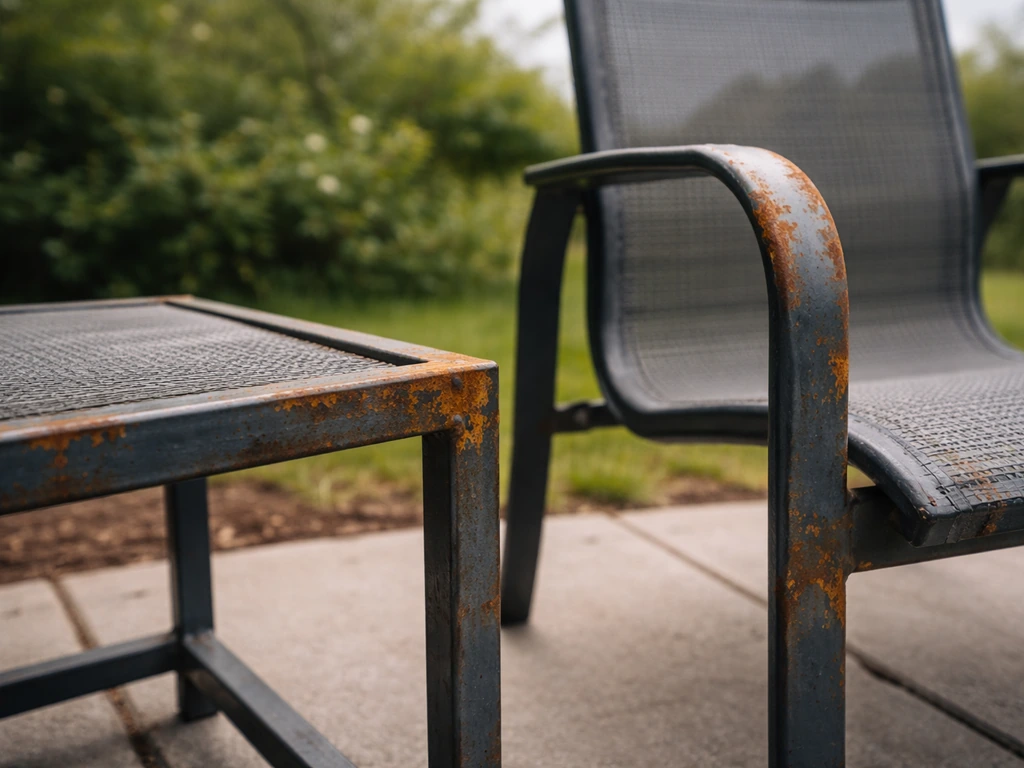
Does Steel Patio Furniture Rust? How to Prevent and Stop It
See if steel patio furniture rusts and how to prevent or stop it fast with coatings, cleaning, drying, and repair steps.

Best Metal Patio Furniture: Aluminum vs Steel vs Iron Guide
Aluminum, steel, or wrought iron patio furniture? Compare durability, coatings, hardware, and pick best sets, chairs, an