
Style Selections patio furniture is a private-label brand owned by LF, LLC, the corporate entity that manages Lowe's proprietary brand portfolio. That means Lowe's controls the trademark (USPTO Registration No. 3,202,837), sets the specs, and acts as the importer of record on most SKUs. The actual physical manufacturing is handled by third-party OEMs, with Sunjoy documented as one supplier on warranty and product-attachment PDFs. You will not find a single independent company called 'Style Selections Furniture' because there is no such company. What you will find is a Lowe's exclusive line sourced from offshore factories, dressed in a house-brand label, and supported through Lowe's own parts and warranty infrastructure.
Who Makes Style Selections Patio Furniture: Identify Maker

Marcus Kellerman
11 Aug 2026
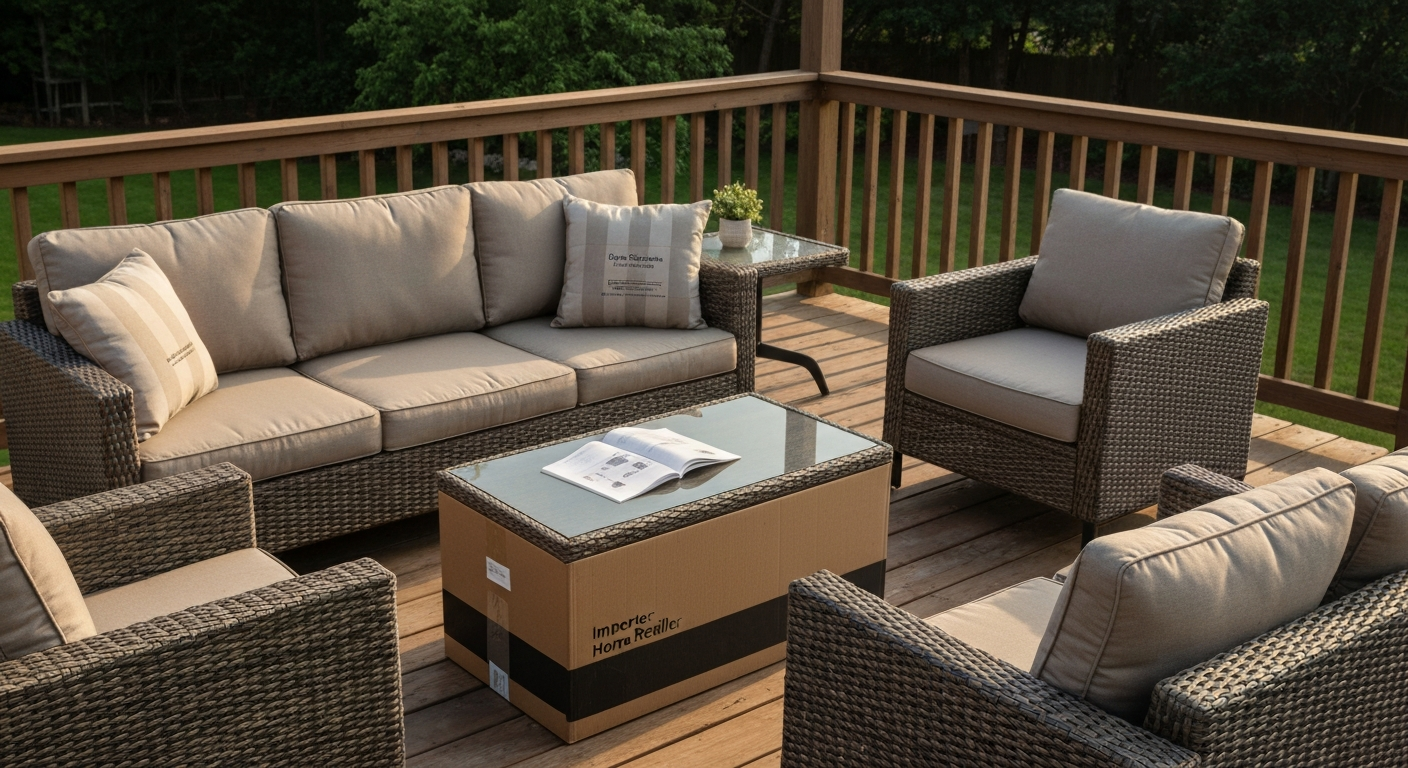
Why people ask who makes Style Selections
The question comes up in a few recurring situations. A piece breaks and you need a replacement part. You want to know if the materials are worth the price. You are trying to decide whether to repair or replace an aging set. Or you have found a Style Selections item at a discount and want to know if it compares to a name-brand alternative. All of those situations require knowing who actually built the thing, and that answer is almost never printed on the front of the box. This guide walks through the full process: the private-label system that produces brands like Style Selections, a field checklist for identifying any furniture piece, step-by-step tracing techniques, advanced research tools, and a material identification primer so you can evaluate what you actually own. See our focused walkthrough on how to identify patio furniture manufacturer for step-by-step tracing methods and field tests. (b52be67c-a404-4173-94f3-7c04183ccfc8).
The private-label reality: what a brand name actually tells you
When a brand name is owned by a retailer rather than a manufacturer, the brand name tells you almost nothing about who built the product or what quality level to expect. Lowe's operates several private labels simultaneously: Style Selections, Allen + Roth, and Origin21 are all Lowe's house brands. Home Depot does the same with Stylewell (trademark held by Home Depot Product Authority, LLC). Big Lots runs Real Living as its proprietary furniture brand. In each case the retailer owns the trademark, writes the product specifications, selects the OEM factory, and controls distribution. The OEM builds to those specs and ships to the retailer's import account. That is why product manuals for Style Selections show 'Import name: Lowe's Home Centers LLC' rather than a factory name.
This model is not inherently bad. A retailer with strong sourcing discipline can deliver good quality through private-label channels. The problem is that without knowing the OEM, you cannot easily find replacement parts through normal channels, you cannot cross-reference build quality against the factory's other clients, and you have no independent quality history to consult. That is exactly why the identification and tracing steps below matter.
Quick identification checklist before you start digging
Before you spend time on databases and reverse-image searches, collect everything that is physically attached to the furniture. This takes ten minutes and will determine how deep you need to go.
- Tags and labels: check under frames, inside cushion zippered covers, on seat undersides, and on the underside of tabletops. Look for a model number, item number, or SKU printed in small type.
- Manuals and assembly documents: these are often the single best source. The first or last page of a Style Selections manual typically lists the model number, a Lowe's item number, and 'Import name: Lowe's Home Centers LLC.' Some also list an OEM contact or a Sunjoy product reference.
- Original packaging and receipt: if you have the box, the UPC barcode on the side panel is your fastest path to a GS1 lookup. A Lowe's receipt includes an item number that maps directly to a product page.
- Photos of the piece: photograph the frame from multiple angles, the label area, any cast or stamped markings on metal components, and any hardware that has a country-of-origin stamp. These photos feed directly into reverse-image searches.
- Retailer product page: search the item number on lowes.com. The 'Guides & Documents' tab on Lowe's product pages often hosts the original assembly manual, which contains the import name and sometimes an OEM reference.
- Warranty paperwork: any warranty card or PDF document registered at time of purchase will repeat the trademark owner (LF, LLC) and direct you to the parts contact point (PartsPlus).
Step-by-step: how to trace a patio furniture manufacturer
1. Inspect every label on the physical piece
Turn frames upside down. Most outdoor furniture manufacturers stamp or sticker their factory code, model number, or country of origin somewhere on the underside of a structural member. On tubular aluminum frames the sticker is often on the inside of a leg or rail. On cast pieces there may be a mold mark. Write down every number you find, even if it looks like a random string. A single six-digit model code can unlock a full product history.
2. Decode the model and serial number
Enter the model number directly into Google with quotes. Add terms like 'assembly manual,' 'replacement parts,' or 'OEM.' For Sunjoy-sourced pieces, the model codes often appear in Sunjoy's own product catalog PDFs or on their SunjoyOnline.com product pages. If the model appears on an overseas marketplace (Alibaba, Made-in-China.com, or a Chinese factory's English-language site) under a different brand name, you have found the OEM.
3. Run a UPC or GTIN lookup through GS1
The barcode on your original packaging or receipt encodes a GTIN. Go to the GS1 Verified by GS1 registry (gepir.gs1.org or gs1.org/services/verified-by-gs1) and enter the 12- or 13-digit number. The result will show the company prefix owner, which for Lowe's products will resolve to Lowe's or one of its subsidiaries. This confirms the brand owner but usually does not reveal the factory. However, if the GTIN resolves to a company name you do not recognize, that company may be the OEM.
4. Use reverse-image search to match the OEM catalog
Take a clean photo of your furniture piece and run it through Google Lens, TinEye, and Bing Visual Search simultaneously. OEM factories frequently sell the same design to multiple retailers under different brand names. If your Style Selections sectional also appears on a factory's direct export page or on an international marketplace under a different label, you have identified the likely manufacturer. This technique is especially useful when physical labels are missing or worn.
5. Pull the retailer SKU lookup and warranty documents
On lowes.com, every product page has a 'Guides & Documents' section where Lowe's hosts assembly manuals and warranty PDFs. These documents consistently show the trademark holder (LF, LLC), the import name (Lowe's Home Centers LLC), and occasionally an OEM reference or customer service number. Download and read the full document, including the fine print on the last page.
6. Contact the retailer's parts program
Lowe's directs Style Selections warranty and parts inquiries to PartsPlus: email [email protected] or visit lowespartsplus.com. When you contact them, ask directly: 'Who is the OEM manufacturer for item number [X]?' Customer service reps sometimes have factory names in their back-end system even when that information is not publicly published. Document every response you receive, including the representative's name.
Advanced tracing: patents, trademarks, import records, and photo forensics
Trademark and patent searches
The USPTO's TESS database (tmsearch.uspto.gov) lets you search by trademark name or owner. Style Selections resolves to LF, LLC as noted above. But also search for the specific design element of your piece: an unusual finial shape, a distinctive weave pattern, or a named finish. If an OEM filed a design patent for that element, the patent record will show the filing company. Google Patents is faster for casual searches; the full USPTO patent database is more complete.
Import records
Commercial import data providers like ImportGenius and Panjiva index U.S. Customs shipment records. Free previews typically show shipper and consignee names; paid subscriptions show product descriptions, bill-of-lading details, and container counts. Searching 'Style Selections' or 'Lowe's Home Centers' in these databases returns shipment records that often include supplier names from Vietnam, China, Cambodia, and Indonesia. This is how researchers confirmed that at least some Lowe's private-label patio goods originate from offshore OEM factories.
EXIF and product-photo forensics
Product photos downloaded from retailer pages often retain EXIF metadata including the camera used and occasionally GPS data if the photo was taken at a factory or showroom. Tools like Jeffrey's EXIF Viewer (exifdata.com) or ExifTool can read this data. More practically, look at the background environment in product photos: distinctive warehousing layouts, specific flooring types, or visible shipping containers can hint at factory location or the trade show where the item was first presented.
Part number sleuthing
Hardware components, especially hinges, brackets, and gas-lift mechanisms, often carry separate part numbers from their own manufacturers. Search those part numbers independently. A specific hinge stamped with a code that traces to a Taiwanese hardware supplier, for example, can confirm a factory's procurement chain and sometimes the factory itself if that supplier is regionally concentrated.
How private-label relationships actually work
There are three distinct models you will encounter when tracing patio furniture brands, and knowing which model applies changes how you search.
| Model | Who owns the brand | Who makes the product | Where to look first |
|---|---|---|---|
| Private label | Retailer (e.g., Lowe's, Home Depot, Big Lots) | Third-party OEM factory | Product manuals, import records, reverse image search |
| OEM / white label | Manufacturer (or shared trademark) | Same factory that sells under own name elsewhere | Model number cross-reference, OEM catalogs, overseas marketplaces |
| Licensed brand | Brand licensor (designer or legacy brand) | Factory contracted by licensor or retailer | License holder trademark filings, retailer press releases |
Style Selections is a clean private-label case: Lowe's owns the trademark, writes or approves the specs, and contracts OEM factories to produce finished goods. The retailer is listed as the importer of record, absorbs the warranty obligation, and handles parts through its own PartsPlus infrastructure. The OEM (Sunjoy and others, depending on the SKU) has no customer-facing identity in this transaction. This differs from a licensed brand, where a furniture designer's name appears on a retailer tag but the designer still controls quality standards, or from a true OEM situation, where the same product ships under the factory's own brand in other markets.
Targeted checks for Style Selections, Stylewell, Grand Resort, and Real Living
Style Selections (Lowe's)
The fastest verification path: go to the Lowe's product page for your item, open the 'Guides & Documents' tab, download the assembly manual or warranty PDF, and read the 'Import name' line and any OEM reference on the last page. If the OEM is named, contact PartsPlus ([email protected]) and that OEM simultaneously. Sunjoy is confirmed as a supplier for at least a portion of the line, so searching 'Sunjoy [model number]' is worth trying for gazebo, umbrella, and casual seating SKUs.
Stylewell (Home Depot)
Stylewell's trademark is held by Home Depot Product Authority, LLC, which mirrors exactly the LF, LLC structure at Lowe's. The tracing process is identical: find the item number on homedepot.com, check the 'Resources' or documents tab on the product page, and look for an import name on any warranty PDF. Home Depot's parts and service contact varies by product; the product page or the warranty document will direct you to the appropriate channel.
Grand Resort (Costco)
Grand Resort is sold through Costco and follows the same private-label mechanics. For details, see who makes Grand Resort patio furniture. Costco product numbers (printed on the warehouse shelf tag and on the receipt) are highly specific and can be searched on costco.com even after an item has sold through. Costco's member services are often more responsive than big-box competitors when it comes to providing OEM contact information, because Costco maintains tighter supplier relationships as part of its sourcing model.
Real Living (Big Lots)
Real Living is Big Lots' proprietary home and furniture brand, documented in Big Lots' own corporate materials. The tracing path is the same: find the SKU on the receipt or the tag, search biglots.com for the product page and any linked documents, and contact Big Lots customer service with the item number. Import records are publicly searchable and show Big Lots' domestic import entities as the consignee on Real Living shipments. If you need to trace suppliers for Big Lots' Real Living line, see our guide on who makes Real Living patio furniture for targeted tracing steps and sources.
Material identification: how to tell what your furniture is actually made from
Knowing who made your furniture matters less than knowing what it is made from when you are making a repair or replace decision, or evaluating suitability for your climate. Here is a practical field guide for each major material type, with tests you can run without a lab.
Aluminum (cast and tubular)
Aluminum is lightweight, will not rust, and is the dominant frame material in mid-to-upper price-tier outdoor furniture. The magnet test is definitive: a magnet will not stick to aluminum. Tubular aluminum feels noticeably lighter than steel when you pick up a chair; cast aluminum pieces are heavier but still lighter than cast iron. Look for powder coating on the surface. A good powder coat will feel uniform and slightly textured. Chips or peeling near weld points after one season indicate thin or improperly cured coating rather than a material problem. Powder-coated aluminum frames from reputable OEMs can last 15 to 20 years in coastal or high-humidity climates.
Steel and cast iron
A magnet sticks firmly to both steel and cast iron. Steel tubing feels lighter than cast iron and will flex slightly if you press on a long unsupported span. Cast iron is very heavy, rigid, and typically found on traditional bistro-style pieces. Both rust if the protective coating is compromised. Run your fingernail along any chip or scratch: visible orange-brown oxidation underneath confirms ferrous metal. Steel and cast iron are viable choices in dry climates but require annual touch-up painting in humid or coastal zones. Cast iron's longevity is remarkable when maintained; neglected, it will pit and crack within a few seasons.
Teak
Genuine teak is dense, slightly oily to the touch when fresh, and produces a faint leathery or vanilla-like scent when freshly sanded. The grain is straight with visible golden-brown color that weathers to silver-gray without sealing. It is substantially heavier than most other outdoor hardwoods at similar dimensions. Scratch a hidden area with your fingernail: teak resists scratching noticeably better than eucalyptus or shorea. Teak sold under private-label brands is often Grade B (minor knots, some sapwood) rather than Grade A (clear, kiln-dried), which matters for long-term weather resistance. Grade A teak from certified sustainable sources has a realistic 25-year outdoor lifespan. Grade B needs more maintenance to achieve the same longevity.
Other outdoor hardwoods (eucalyptus, shorea, acacia)
These woods are commonly sold as teak alternatives in private-label lines. They are genuine hardwoods but differ meaningfully in oil content and density. Eucalyptus is lighter than teak and has a more varied grain pattern with occasional spiral or interlocked grain. Acacia has prominent dark streaking and is the lightest of the three. None of them have teak's natural silica and oil content, so they require more frequent oiling (annually versus every two to three years for teak) in wet climates. A water-drop test helps: place a droplet on the surface. Teak repels it for several seconds due to natural oils; eucalyptus and acacia absorb it more quickly, especially if the piece is a few years old.
Synthetic wicker (HDPE resin)
Better outdoor wicker is made from high-density polyethylene (HDPE) strands woven over an aluminum frame. The key field test is the flex test: HDPE wicker strands bend without cracking and spring back. Cheaper PVC wicker becomes brittle in cold temperatures and will crack if you bend a strand sharply. Hold a strand in both hands and bend it to roughly 90 degrees: PVC will resist and then crack or turn white; HDPE will flex smoothly. Look also at the weave tightness and the core frame. Run your hand along the underside of the frame: aluminum underneath a wicker set confirms a more durable build than steel, which you can verify again with the magnet test.
Natural rattan
Natural rattan is a tropical vine, not a wood, and it is genuinely not suitable for permanent outdoor exposure. It will absorb moisture, swell, crack, and develop mold within one to two seasons if left outside in humid or rainy climates. The identification test is simple: natural rattan has visible node rings at regular intervals along the strand (every few inches), a textured bark surface, and a hollow or pithy interior visible at any cut end. Synthetic wicker has no node rings and a solid, uniform cross-section. If your wicker furniture has visible node rings, it is natural rattan and belongs on a covered porch or in a sunroom, not exposed to rain.
Material durability and climate suitability at a glance
| Material | Best climate | Worst climate | Typical lifespan (maintained) | Repair potential |
|---|---|---|---|---|
| Powder-coated aluminum | All, including coastal | None (very adaptable) | 15–20 years | High: repaintable, weldable |
| Steel (powder-coated) | Dry/arid inland | Coastal, high humidity | 8–12 years | Medium: rust repair is ongoing |
| Cast iron | Dry, moderate | Coastal, freeze/thaw cycles | 20+ years with maintenance | High: repaintable, heavy |
| Grade A teak | All, including coastal/tropical | None (very adaptable) | 25+ years | High: sandable, oilable |
| Eucalyptus / acacia | Moderate, covered use | High humidity, full sun | 10–15 years | Medium: needs annual oiling |
| HDPE synthetic wicker | All, including coastal | Extreme UV without UV inhibitor | 10–15 years | Low: strand replacement is difficult |
| Natural rattan | Covered porch, low humidity | Rain, coastal, humid | 3–5 years outdoors | Low: structural repair is impractical |
Repair or replace: a practical decision framework
The answer depends on frame material, part availability, and cost-per-year math. A powder-coated aluminum or teak frame that is structurally sound but has degraded cushions, faded paint, or worn wicker wrapping is almost always worth repairing. Authoritative sources such as How to Weatherproof Furniture - This Old House recommend repairing durable frames (powder‑coated aluminum, teak) while replacing consumable parts like cushions, zippered covers, and low‑end wicker, since parts availability and cost often make replacement cheaper than full repair. These frames are the expensive and durable component. Cushions, covers, and synthetic wicker strands are consumables. Replacing them costs a fraction of a new set and extends a quality frame's life by another five to ten years.
- Replace if: the frame is bent, cracked, or heavily rusted through (not just surface rust), welds are failing, cast iron has deep pitting, or parts are genuinely unavailable and the retailer is no longer in business.
- Repair if: the frame is structurally sound, cushions or fabric are the main problem, powder coat has surface chips (repaint is straightforward), or wicker stranding is fraying but the aluminum underframe is intact.
- Check parts availability first: for Style Selections, contact PartsPlus ([email protected]) and, if Sunjoy is the OEM, check SunjoyOnline.com. Many Sunjoy-supplied replacement parts are stocked.
- Calculate cost per year: divide the original purchase price by the number of years you have owned it. If that number is under $50 per year and a repair costs less than one additional year's value, repair is the clear answer.
- Document everything before contacting anyone: model number, item number, photos of damage, and original purchase date. This documentation determines warranty eligibility and part compatibility.
American-made claims and how to verify them
Style Selections products, based on import records showing Lowe's as the importer of record with offshore suppliers, are not American-made. That is not automatically a quality disqualifier, but it means the 'American-made' bar does not apply here. If American manufacturing matters to you for quality assurance, labor ethics, or parts-availability reasons, the verification path is: look for FTC-compliant 'Made in USA' labeling (which requires all or virtually all components and labor to originate domestically), check the company's own factory location disclosures, and cross-reference against import databases to confirm no significant offshore sourcing. For comparisons, see our guide to the best American made patio furniture. Retailers and brands that genuinely manufacture domestically are typically forthcoming with factory names and locations because it is a selling point, not something they obscure.
Next steps: what to do with what you have found
Once you have identified the OEM or confirmed the retailer as your sole contact point, the practical path is straightforward. For parts and warranty on Style Selections, start with PartsPlus. For design or OEM questions on Sunjoy-sourced items, SunjoyOnline.com is publicly accessible. For any private-label brand, the product manual is your most reliable starting document, and downloading it from the retailer's product page before that SKU goes out of stock is worth doing now if you have a recent purchase. Keep a folder with the model number, item number, purchase receipt, and any warranty documents. That ten-minute filing job has saved a lot of people significant money when a structural issue appears two or three seasons in and they can demonstrate they are within a warranty window.
FAQ
Who makes "Style Selections" patio furniture?
Style Selections is a Lowe’s private/exclusive brand. The word mark STYLE SELECTIONS is registered to LF, LLC (the corporate entity tied to Lowe’s private brands), and Lowe’s product pages and warranty documents list Lowe’s (Lowe’s Home Centers LLC) as importer/distributor. Some Style Selections items are manufactured by third-party OEMs (Sunjoy is one documented supplier for some SKUs) and imported from overseas.
How can I identify the maker of any patio furniture line (including private labels)?
Step-by-step identification checklist: 1) Check labels/tags on the piece (under frame, inside cushions) for model, serial, UPC, or manufacturer name. 2) Search product manuals, warranty PDFs, or retailer product pages for ‘import name’ or OEM contact. 3) Use the UPC/GTIN with GS1 Verified by GS1 (GEPIR) to find the company prefix. 4) Run reverse-image searches (Google Lens, TinEye, Bing Visual Search) on clear photos to find identical SKU listings or OEM catalogs. 5) Search trademark/USPTO records for the brand name (to see owner—retailer or manufacturer). 6) Check import/shipping records or trade-data providers for importer/OEM clues. 7) Contact the retailer’s parts/customer service (e.g., Lowe’s PartsPlus) and any named OEMs found in documentation.
What retailer vs. manufacturer patterns should I know (private label, OEM, licensed brand)?
Common patterns: - Private label: Retailer owns the brand name (Style Selections, Stylewell, Real Living) and curates/specs products; the retailer is often importer of record. - OEM/supplier: An independent factory (often overseas) manufactures products to retailer specs and may appear in paperwork (e.g., Sunjoy). - Licensed/brand-name: A branded manufacturer supplies products under its own brand or under license. Knowing which pattern applies helps locate warranty support and parts.
What specific records or places should I inspect for model numbers and origin data?
Inspect: physical tags/labels (frames, cushions, underneath slats), product manuals and PDFs on retailer sites (‘Guides & Documents’), retailer product pages (product details and 'import name'), UPC/GTIN barcodes, OEM attachments or warranty inserts, trademark records (USPTO/Justia), and import listings (commercial trade-data services). Also save clear photos for reverse-image searching.
How do I verify an "American-made" claim or find higher-quality American manufacturers?
Verification steps: 1) Look for clear country-of-origin markings on the product label or manual. 2) Check the GTIN/UPC owner via GS1 and cross-check company info. 3) Review retailer/importer documentation (import name vs. factory origin). 4) Search company filings, manufacturer websites, or press releases for manufacturing locations. Criteria for higher-quality American manufacturers: domestic manufacturing of primary frame/materials, transparent supply chain, US-based customer/parts support, use of premium materials (teak, powder-coated aluminum, HDPE), and independent quality reviews. Be cautious—retailer-owned brands may be designed by a US company but assembled/imported overseas.
How should I evaluate materials by climate (wood, aluminum, wicker, cast iron, teak, rattan, poly)?
Material-by-climate guide: - Teak: Excellent in humid/coastal climates; natural oils resist rot—best long-term choice where budget allows. - Powder-coated aluminum: Good for humid, coastal, and freeze-thaw climates if coatings and welds are high quality; lightweight, rust-resistant. - Cast iron/steel (powder-coated): Very durable but heavier; watch for coating chips and rust in coastal salt air—requires maintenance. - High-quality resin/HDPE wicker: Good for wet and UV-exposed climates; choose furniture with aluminum frames for longevity. - Rattan (natural): Poor for wet/outdoor use unless under covered porch; better for dry climates or indoor/outdoor covered spaces. - Wood (other than teak): Species matters—cedar and eucalyptus are moderate; pine and low-grade woods need sealing and cover. - HDPE/poly lumber: Excellent in wet/salty climates, resists rot and splintering. Fabrics: choose solution-dyed acrylics (Sunbrella) for UV/fade resistance. Always match joinery, fastener materials, and cushion construction to local weather stresses.
Next Articles
Best Stain for Teak Patio Furniture, Top Picks by Climate
Best stain for teak patio furniture: expert picks, climate-based choices, prep, application, and maintenance tips.
Is Teak Patio Furniture Good? Durable, Smart Buying Guide
Is teak patio furniture good? Evidence-based verdict, lifespan, care, buying tips, comparisons, and eco guidance.
How Long Does Teak Patio Furniture Last? Lifespan Guide
Teak patio lifespan ranges, factors that shorten or extend durability, and a maintenance plan to protect joints and fini