
Genuine wrought iron patio furniture is heavy, forged by hand or machine hammer, joined by rivets or forge-welds, and shows slight irregularities across its surface that no two casting molds or machine tubes can replicate. If the piece pulls a magnet strongly, weighs noticeably more than a comparable aluminum or thin-steel frame, has non-uniform cross-sections on its bars, and shows hammer or pleating marks rather than smooth seams or sand-cast texture, you are almost certainly looking at wrought iron. This guide walks you through every layer of that identification, from a 30-second field check to a full photographic documentation session, and then helps you decide whether to keep, restore, replace, or buy.
How to Identify Wrought Iron Patio Furniture: Quick Guide

Marcus Kellerman
24 Jul 2026
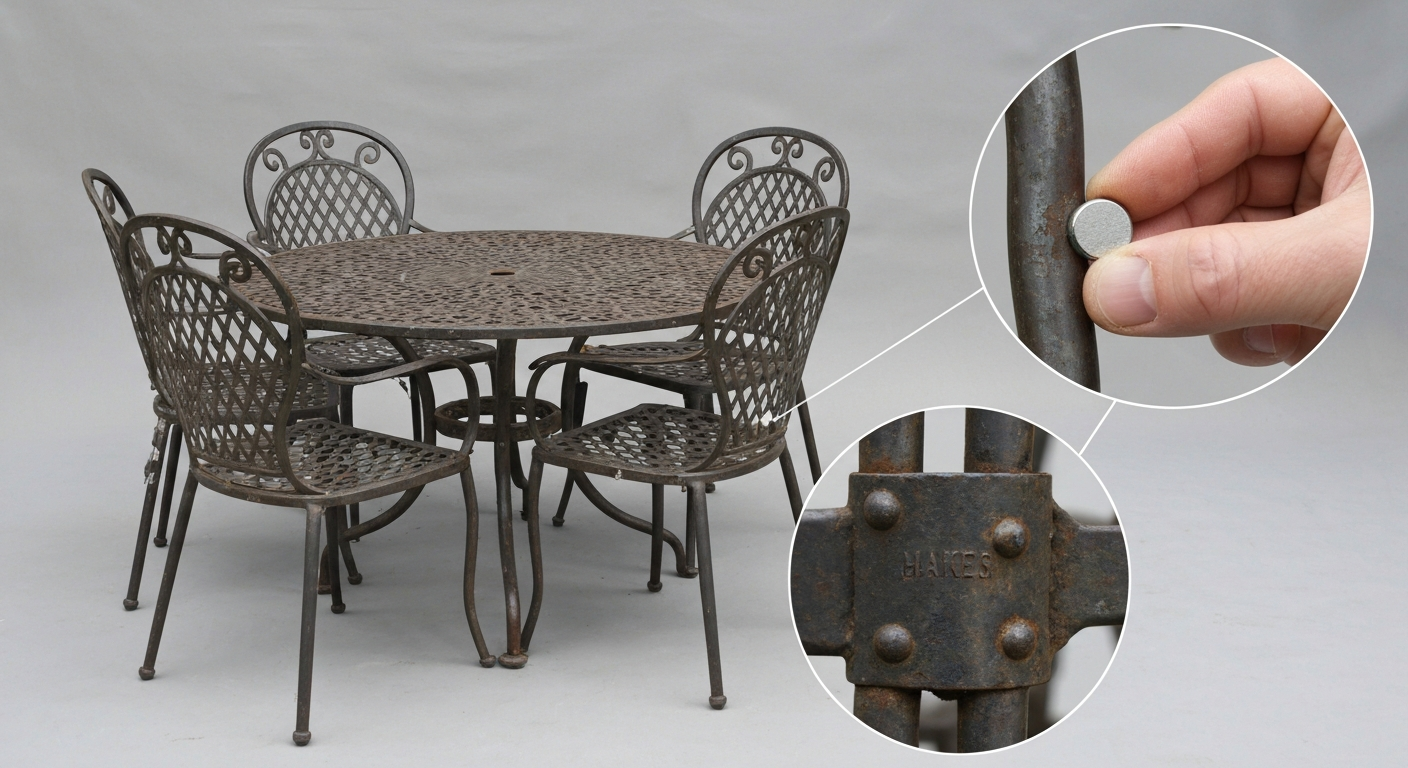
What this guide actually covers
Outdoor furniture marketed as wrought iron spans a wide range: true hand-forged wrought iron pieces from the early-to-mid 20th century, vintage tubular steel sets dressed up with wrought-style scrollwork, cast iron elements bolted to welded steel frames, and modern powder-coated steel reproductions that carry the wrought iron label mostly for aesthetic reasons. Each material behaves differently in the elements, repairs differently, and carries different collector or resale value. Understanding which one you actually have is the starting point for every downstream decision: restoration scope, maintenance schedule, climate suitability, and whether it is worth bringing in patio furniture repair professionals or simply replacing the piece.
This guide focuses on four materials you will realistically encounter when shopping, inheriting, or evaluating a patio set: true wrought iron, cast iron, steel tubing, and aluminum. Vintage Woodard pieces are a useful benchmark throughout, since Woodard used genuine wrought iron in many of its mid-century lines and left documented maker stamps that make authentication tractable. For specifics on maker stamps and distinguishing features, see our guide on how to identify vintage Woodard patio furniture.
Quick keep / restore / replace / buy decision flow
Before you spend an hour examining joints and tapping metal, run through this short diagnostic. It will tell you which branch of this guide matters most for your situation.
- Does a strong magnet stick firmly? If no, the piece is aluminum or another non-ferrous metal. Skip to the aluminum comparison table and the buy/replace branch.
- Does the piece weigh noticeably more than a similar-size aluminum chair (roughly three times denser at around 7.8 g/cm³ vs. 2.7 g/cm³)? If yes, continue. If it feels surprisingly light despite the magnet sticking, suspect thin steel tubing.
- Are there visible seams, parting lines, or sand-grain texture on the decorative elements? If yes, suspect cast iron components. Note them and continue.
- Are there hammer marks, riveted joints, or slight non-uniformity in bar cross-sections? If yes, you likely have wrought iron or hand-forged steel. Proceed to the step-by-step ID below.
- Is the frame structurally sound (no cracks, broken joins, or severe section loss from rust)? If yes: keep and maintain, or restore if the finish is failed. If no: assess repair cost versus replacement value before committing.
- Is there a maker stamp or label? If yes, document it before anything else. Identified pieces from known makers carry higher restoration value and may warrant professional conservation work.
- Estimated restore cost exceeds roughly half the replacement cost of a comparable new piece, and there is no collector or sentimental value? Replace. Otherwise, restore or repair.
Step-by-step identification process
Work through these steps in order. Each one narrows the field. Bring a strong rare-earth magnet, a tape measure, a bright flashlight, and your phone camera.
- Step 1 - Magnet test: Hold a strong rare-earth magnet against a bare or lightly rusted section of frame. Ferrous metals (wrought iron, cast iron, steel) attract strongly. Aluminum and zinc-based alloys do not attract at all. If the magnet slides off, you have aluminum or a non-ferrous alloy and the wrought iron question is settled.
- Step 2 - Heft check: Lift one end of the piece and compare its weight to what you would expect from aluminum or thin-walled steel. A solid wrought iron chair typically weighs 20 to 35 pounds or more depending on size. A comparable aluminum chair is often under 15 pounds. If it feels dense and substantial, continue.
- Step 3 - Tap test: Tap a structural bar with a metal key or coin. Wrought iron and solid steel bars produce a relatively clear ring. Cast iron tends to produce a duller, flatter sound. Hollow steel tubing produces a noticeably hollow knock. This is a rough guide, not a definitive test, but it quickly flags tubular steel reproductions.
- Step 4 - Surface and seam inspection: Examine flat bar stock and decorative elements under your flashlight. Look for parting lines (a raised ridge running along the length of a cast piece), sand-grain texture (cast iron), or smooth uniform tubing with clean MIG/TIG weld beads (modern steel reproduction). True wrought iron and hand-forged steel show slight surface irregularities, tool or hammer marks, and forge-weld or rivet joins.
- Step 5 - Joint and connection inspection: At every joint, identify how the pieces connect. Riveted or bolted connections, forge-welded collars, and upset-end joins (where the bar is thickened at the join point) are classic wrought iron construction. Cast elements often bolt onto a separate steel or wrought frame. Clean, uniform bead welds with no forge marks indicate modern steel fabrication.
- Step 6 - Maker mark search: Flip chair seats, check undersides of table tops, look inside frame bends and along leg undersides. Photograph every mark before touching it. Compare to known manufacturer records or auction catalog images to begin dating.
- Step 7 - Condition documentation: Note and photograph every area of rust, cracking, section loss, previous repair (look for mismatched paint, filler, or misaligned joints), and any structural failures. This documentation drives your keep/restore/replace decision.
Visual identification cues
Surface texture and finish
True wrought iron has a fibrous internal structure due to slag inclusions from the historical puddling process. You will not see the microstructure without a cross-section, but the surface behavior gives it away. Under good light, wrought iron bars often show slight faceting or hammer-dressing marks. Paint adheres in slightly irregular layers that follow surface texture. Cast iron, by contrast, has a granular, almost sandy texture where paint is thin or missing, and its surface is more porous-looking under a flashlight. Modern steel tube reproduction furniture is noticeably smooth, often with a mirror-consistent paint or powder-coat finish that reflects light evenly.
Patterns and decorative motifs
Wrought iron scrollwork and decorative elements were traditionally forged or bent individually, meaning no two scrolls are truly identical at close inspection. Even mass-produced wrought iron furniture from mid-century makers shows slight variation in scroll tightness, bar taper, and surface marking. If every decorative rosette, leaf, or scroll is perfectly identical, you are almost certainly looking at cast elements or stamped/pressed steel components. Identical repeating motifs are one of the most reliable field indicators of cast iron or cast aluminum decorative inserts.
Rust and patina
Wrought iron rusts, but it tends to rust in a stratified, layered way that follows its fibrous grain. You may see rust that appears to peel in thin sheets or show a slightly laminar pattern at edges. Cast iron rust often looks more uniform and powdery across its granular surface, and it is more prone to catastrophic cracking because it is brittle. Steel tubing rusts at seams and welds first, and you will often see rust bubbles originating from weld points or cut ends. Aluminum does not rust; it oxidizes with a chalky white or grayish film instead.
Tactile and weight cues
Weight is the most immediate tell. Pick up the piece or lift one corner. True wrought iron furniture is dense, and even a small side chair will feel substantially heavier than you expect if you are used to handling aluminum or thin-steel sets. If a chair that looks visually identical to a solid iron piece feels surprisingly light, the frame is almost certainly hollow steel tubing regardless of what the label says.
Run your fingers along bar stock or structural members. Wrought iron bars feel solid, with a slight irregularity in cross-section if you move your fingertips along the length. Hollow steel tubing feels perfectly uniform and you may feel a slight give or flex if you apply lateral pressure to a long unsupported run. Cast iron elements feel solid and dense but are also rigid in a different way: they do not flex at all and will fracture rather than bend under overload. Aluminum feels light, slightly less cold to the touch than iron or steel in the same ambient temperature, and will not attract a magnet.
Slight flexibility in individual bars (not in the overall frame) is actually a positive sign for wrought iron and mild steel. Both materials have some capacity to deform before fracture. A brittle snap or crumbling of a thin section under minimal pressure, by contrast, is a red flag for heavily corroded cast iron.
Simple tests and tools
You do not need any specialized equipment to perform a credible first-pass identification. Here is what to bring and how to use each tool.
| Test | Tool needed | What a positive result looks like | What it rules in / out |
|---|---|---|---|
| Magnet test | Strong rare-earth magnet (neodymium) | Magnet sticks firmly and holds its own weight | Ferrous metal confirmed (wrought iron, cast iron, or steel). Rules out aluminum and non-ferrous alloys. |
| Tap / ring test | Metal key or coin | Clear ring on solid bars; hollow knock on tubing; dull thud on cast sections | Distinguishes solid bar stock from hollow tubing; flags brittle cast iron sections by dead sound |
| Weight comparison | Your hands; optionally a bathroom scale | Piece weighs noticeably more than aluminum equivalent | Supports ferrous/dense metal ID; thin steel tubing is lighter than expected for apparent size |
| Seam inspection | Bright flashlight or phone torch | Parting lines or sand texture = cast; uniform smooth tubing = modern steel; hammer marks/rivet collars = forged iron or steel | Distinguishes cast from forged from tube-fabricated construction |
| Visual flex test | Hands only | Slight flex in long unsupported bar without cracking = wrought iron or mild steel; no flex at all, snaps = cast iron | Helps identify brittle cast iron sections vs. ductile wrought/steel |
A note on more advanced tests: spark testing (grinding a small area and observing the spark pattern) and micro-sampling for metallography are legitimate identification methods used in conservation and industrial contexts, but they require training, appropriate PPE, and will damage the surface. For a patio furniture identification, the non-destructive tests above are sufficient in nearly every practical case. Reserve anything more invasive for a piece where provenance or collector value justifies it.
How to photograph a piece for identification
Good documentation photographs are worth more than any single test result, especially if you later need to get a professional opinion, list the piece for sale, or track down maker records. Appendix O: Curatorial Care of Metal Objects, National Park Service recommends documenting condition and provenance before restoration decisions Appendix O: Curatorial Care of Metal Objects — National Park Service recommends documenting condition and provenance before restoration decisions.. Conservation practice calls for a specific sequence of shots, and it translates directly to practical home use. For detailed step-by-step procedures on assembly, maintenance, and restoration, see fdw patio furniture instructions.
The photo sequence to work through
- Overall context shot: photograph the full set or piece in its environment, ideally against a neutral background or at least without strong backlight. This establishes scale and style at a glance.
- Three-quarter front and three-quarter rear: two shots from opposite diagonal angles. These capture how the frame connects and show overall condition.
- All maker marks and labels: flip the piece or have a second person tilt it. Photograph every stamp, label, cast logo, or engraved mark on undersides, inside frame bends, and along leg bases. Include a ruler or coin in the frame for scale.
- Joint and weld closeups: photograph each type of joint present: riveted collars, forge-weld points, cast collars, MIG/TIG bead welds, bolted connections. Shoot from directly above or directly to the side for clarity.
- Texture details on decorative elements: a tight macro shot (your phone's portrait or macro mode works) of a scroll or decorative panel shows whether the surface is cast-granular, smooth-pressed, or hammer-marked.
- Rust, corrosion, and damage: document every area of active rust, section loss, cracks, or old repairs. These photos drive your condition assessment and repair scope.
- Fastener and foot details: photograph foot pads, glides, and any original fasteners. Original hardware supports dating and is often a clue to manufacture era.
Always include a common reference object (a coin, a ruler, or a business card) in at least one shot from each area so that scale is unambiguous. If you are photographing patina or finish color for matching purposes, a standard gray card or even a white sheet of paper in the frame gives anyone reviewing the images a color reference. Metadata from your phone camera (date, time) is automatically recorded and becomes part of your documentation record.
Construction and joinery: the definitive material tells
Of everything in this guide, construction and joinery clues are the most reliable differentiators between material types. The way metal is shaped and joined is determined by the material's properties, and those properties do not change regardless of what a label says.
Wrought iron construction signatures
Wrought iron is worked hot. Smiths hammer, bend, and join it while it is at temperature. The result is visible: joints show forge-weld collars (a wrapped or collar-bound connection where two bars meet), riveted connections where a bar end is peened over through a hole in another member, or upset joins where the bar is swaged (thickened) at the connection point. Bar cross-sections are not perfectly uniform along their length. Scrolls may show slight pleating or crease marks on the inside of the curve where the metal was worked. These are not defects; they are the fingerprints of hand or hammer-die forming.
Cast iron construction signatures
Cast iron is poured into a mold. The clearest evidence of casting is a parting line: a raised or recessed ridge that runs along the axis of a symmetrical element where the two halves of the sand mold met. You may also see small pits or rounded depressions from sand inclusions, sprue marks (where molten iron fed into the mold), and vent or riser marks (small bumps or filed-flat spots where gas escaped). Every cast copy of a decorative motif is dimensionally identical. Because cast iron is brittle, cast furniture pieces are often designed with thicker sections than equivalent wrought iron work, and they do not show bending or deformation even at failed joints (they crack instead).
Steel tubing construction signatures
Modern outdoor furniture marketed as wrought iron style is most commonly fabricated from mild steel tubing or solid rod, joined by MIG or TIG welding. The welds are consistent, bead-shaped, and often ground smooth. Tubing shows a hollow cross-section at cut ends, drain holes at low points, and a perfectly uniform outside diameter along its entire length. Decorative elements on these pieces are almost always cast or pressed separately and welded or mechanically fastened to the tube frame. The overall construction is lighter than genuine wrought iron and noticeably cleaner in its joinery.
Aluminum construction signatures
Cast aluminum furniture uses sand or die-casting, producing surfaces similar to cast iron but without magnetic response and at much lower weight. Extruded aluminum tubing is perfectly uniform, very light, and may show a slight longitudinal grain from the extrusion die. Welding on aluminum is typically TIG and produces a smooth, bright bead. Aluminum does not rust; surface degradation appears as chalky oxidation or pitting rather than red-brown iron oxide.
| Material | Joint type | Surface texture | Magnet | Weight (relative) | Rust behavior |
|---|---|---|---|---|---|
| Wrought iron | Forge-weld collars, rivets, upset joins | Slight hammer/pleat marks, non-uniform cross-section | Strong attraction | Very heavy | Layered, grain-following rust |
| Cast iron | Cast-in connections, bolted, or attached to steel frame | Granular/sandy, parting lines, sprue marks | Strong attraction | Very heavy | Uniform powdery rust; brittle cracking |
| Steel tubing | MIG/TIG bead welds, clean and consistent | Smooth, uniform diameter, hollow at cut ends | Strong attraction | Moderate | Rust at welds, seams, cut ends first |
| Aluminum (cast or extruded) | TIG welds or mechanical fasteners | Smooth; cast shows parting lines; extrusion shows grain | No attraction | Light | White/gray chalky oxidation, no rust |
Reading maker marks and dating vintage pieces
If you find a stamp or label, photograph it before anything else. Marks can be stamped directly into the metal, cast into a decorative element, applied as a paper or metal tag, or stenciled onto the frame. See Wrought Iron Patio Furniture, 1stDibs (sales and maker identification notes with photos) for example images of maker marks and stamp types useful for matching style and approximate manufacture era Wrought Iron Patio Furniture — 1stDibs (sales and maker identification notes with photos). On genuine mid-century American wrought iron furniture, marks are most commonly found on undersides of chair seats, inside leg bends, or on the underside of table aprons. The mark may be a company name, a catalog number, a patent date, a country-of-origin stamp, or simply a production code.
Woodard is the most documented example: the company stamped or cast its name and often a model reference into frames across its mid-century lines, and its catalogs (available through collector archives and auction records) allow cross-referencing of stamp style to approximate production decade. Other significant makers include Brown Jordan, Salterini, Russell Woodard, and Lyon-Shaw, each with their own stamp conventions. If you need to verify a brand, for example, who makes Garden Treasures patio furniture, compare stamps, tags, and catalog references against maker databases. Comparing your photographs to auction catalog images and company archive records is the most practical path to a confirmed attribution. If you need to know who makes Allen + Roth patio furniture, check retailer sourcing notes and brand attribution resources for information on this private-label manufacturer. For help identifying lesser-known brands, consult specialized resources on who makes Halmuz patio furniture.
If the stamp is obscured by paint or rust, do not scrape aggressively. Use a soft brass brush to clear loose material, then photograph in raking light (flashlight held at a very low angle to the surface) to make shallow stampings readable. Raking light reveals text that is completely invisible under overhead illumination.
Condition assessment and climate suitability
A structurally sound wrought iron frame with surface rust and failed paint is almost always worth restoring. The material is durable, genuinely repairable, and, if it is a known maker's piece, potentially appreciating. A frame with section loss from deep corrosion, cracked cast elements, or broken joins requires a more careful cost-benefit analysis.
Climate matters considerably. Coastal environments with salt air accelerate corrosion on all ferrous metals, and a high-quality finish (professional powder coating applied over properly prepared bare metal) is not optional in those settings, it is the difference between a five-year and a twenty-year lifespan. Inland humid climates are less aggressive but still require annual inspection and touch-up. Dry climates are the most forgiving. If you are in a coastal region and are choosing between restoring a wrought iron set or buying a new aluminum or marine-grade aluminum piece, the honest answer is that powder-coated aluminum requires far less long-term maintenance near the ocean, and that context should factor into your keep/restore/replace decision.
Restoration considerations and what it actually costs
Professional restoration of wrought iron patio furniture involves three separable cost components: structural repair (welding broken joins, fabricating missing sections), surface preparation (rust removal, grinding, priming), and finish application (paint or powder coat). You can handle light surface prep yourself with a wire brush, rust converter, and rattle-can paint, but the result will last two to five years at best before requiring touch-up. Professional powder coating, which is oven-cured at around 400°F, bonds far more durably and typically carries a service life of ten to thirty or more years depending on environment and prep quality.
Industry pricing for small furniture pieces (chairs, side tables) runs roughly $75 to $300 per item for powder coating alone, with variation based on complexity, stripping required, and regional labor rates. Add welding or fabrication work and the per-item cost climbs. For a full four-piece set with structural repairs, plan for $600 to $1,500 or more depending on condition and your market. For assembly or care instructions specific to a common four-piece patio set, see homall 4 pieces outdoor patio furniture instructions. Always get three written, itemized quotes that separate prep labor, welding, coating, and transport. A shop that cannot or will not itemize is a shop to avoid.
The keep-versus-replace math is straightforward in principle: if total restoration cost exceeds roughly 50% of comparable replacement cost, and the piece has no significant collector or sentimental value, replacement is the rational choice. If the piece is a known maker's original, confirmed as genuine wrought iron, and in structurally sound condition, restoration almost always makes sense on both financial and quality grounds, since a restored mid-century wrought iron set outperforms most current budget reproductions in longevity.
When to call a professional
DIY is appropriate for surface rust treatment, repainting, re-tipping feet, and replacing minor hardware. Call a professional for any of the following: structural weld failures or cracked joints, broken cast iron elements that require fabrication of replacements, deep section loss from corrosion affecting load-bearing members, or preparation for powder coating (which requires sandblasting or chemical stripping to bare metal). If you have a piece you suspect is a significant vintage collectible, a conservator with metalwork experience should be consulted before any irreversible treatment. Improper stripping or welding can destroy provenance evidence and reduce collector value substantially.
Patio furniture repair specialists who work regularly with iron and steel frames understand the material behavior and have the equipment for proper surface preparation. For specialized restoration and finishing, consider contacting a local shop such as quality interiors & patio furniture repair that regularly works with wrought iron and powder-coating preparation. When contacting a shop, ask specifically whether they have experience with wrought iron (not just mild steel tubing), whether they powder coat in-house or subcontract, and whether they can match historical finishes if the piece has collector relevance. These questions separate generalist welding shops from specialists worth hiring. For hands-on repairs and accurate quotes, contact local patio furniture repair pros experienced with wrought iron and powder coating.
Buyer's inspection checklist for used and vintage pieces
If you are buying rather than assessing what you already own, run through this checklist before committing to a purchase. Bring the magnet, your phone, and enough time to actually look at the piece properly.
- Magnet test on multiple frame sections including decorative elements (some pieces mix materials)
- Lift and assess weight against size
- Tap structural members for hollow sound
- Inspect all joints: riveted/forge-welded (original wrought) vs. MIG bead welds (modern steel) vs. bolted cast elements
- Look for parting lines and sand texture on decorative motifs (indicates cast iron or aluminum inserts)
- Check all maker marks: undersides, inside bends, leg bases
- Photograph every mark before negotiating price
- Examine for section loss rust (not just surface rust): probe with a fingernail at any bubbling paint area
- Check structural integrity: no flex in joints, no cracked welds, no cracked cast sections
- Assess finish condition: powder coat vs. paint, any delamination, chalking, or blistering
- Ask seller for any provenance documentation, original receipts, or catalog references
- Factor in transport cost to a powder-coat shop if the finish will need professional restoration
FAQ
What are the quickest non‑destructive checks to tell if a patio piece is wrought iron vs cast iron, steel tubing, or aluminum?
Start with three simple field checks: (1) Magnet test — ferrous metals (wrought, cast, steel) attract a magnet strongly; aluminum does not. (2) Weight/density sense — pick up a piece or compare similar sizes: aluminum is much lighter; cast iron and solid wrought/steel feel heavy for size. (3) Visual/tactile inspection — look for parting lines, repeating identical decorative elements and sand/granular texture (cast iron/cast reproductions); look for hammer marks, irregular cross‑sections, rivets, forged/upset joins, and non‑uniform shapes (wrought/forged). Use tapping: a brittle cast piece often gives a dull/thuddy sound; forged/solid steel/wrought rings more. These are first‑line, non‑destructive checks; avoid grinding/sparking unless you have PPE and experience.
What photographic shots should I take to document and support identification?
Follow conservator photodoc practice: (1) Overall context shot showing the set in place. (2) Three‑quarter front and back views of each piece. (3) Closeups of all maker stamps/labels (undersides/inside frames). (4) Closeups of joins, welds, seams, fractures, rust holes and decorative repeats. (5) At least one shot with a scale bar or ruler visible. (6) A neutral color/gray card if finish/patina color matters. Record metadata: date, camera, lighting, and where on the piece each photo was taken.
How do I distinguish wrought (forged) iron from cast iron using construction and joinery clues?
Wrought/forged iron usually shows: hammer/forge marks, varied cross‑sections, hand‑formed scrollwork, riveted or forge‑welded joins, and occasional non‑uniformity. Cast iron shows: identical repeating decorative units, parting/seam lines from molds, sand/granular texture, and vent/riser marks. Modern reproductions often mimic wrought shapes but use thin gauge metal, repetitive cast motifs, and clean machine welds (MIG/TIG). Look under pieces where joins and internal structure are exposed.
What tools and simple tests are safe for homeowners to use at home?
Safe, low‑skill tools: a small handheld magnet, a tape measure/ruler, camera/phone, gloves, and a flashlight. Non‑destructive tests: magnet test, weight comparison, visual inspection for seams/toolmarks, and basic tapping with a wooden spoon to listen for ringing vs dullness. Avoid spark or grinder tests unless trained and using PPE; for any destructive or metallurgical testing consult a conservator or metal shop.
How can I read and interpret maker stamps and date marks on patio furniture?
Inspect undersides and inside frame members for stamped or cast logos, numbers, or paper labels. Photograph marks with scale and good lighting. Compare stamp shape, font and placement with manufacturer catalogs, archived brand images and auction listings (many makers like Woodard historically stamped undersides). Use company catalogs, brand archives and specialist dealer/auction photos to match mark style and likely era. If uncertain, consult collector forums or a conservator for help attributing and dating.
What are clear signs a piece is a modern 'wrought‑style' reproduction rather than an original vintage wrought iron item?
Common indicators of modern reproductions: very thin gauge metal, precisely identical repeated decorative parts (indicating casting), smooth uniform machine welds (MIG/TIG) rather than rivets or forged joins, and uniformly applied factory powder‑coat finishes. Also look for modern fasteners, stickers with UPCs, or mass‑produced hardware that didn’t exist historically.
Next Articles
Who Makes Garden Treasures Patio Furniture: Origin & Guide
Who makes Garden Treasures patio furniture? Origin, ID checks, materials, buying & warranty tips, repairs, alternatives.
Who Makes Halmuz Patio Furniture? How to Verify the Maker
Learn how to confirm who makes Halmuz patio furniture using labels, documents, listings, and quality checks.
Patio Furniture Repair Pros: DIY vs Repair Guide
DIY vs pros for patio furniture repair: triage damage, material-specific fixes, costs, and vetting local repair experts.