
Powder coating a single patio chair typically runs $75 to $195 professionally, while a full 4-to-6-piece set lands somewhere between $350 and $1,200 depending on condition, finish, and where you live. Those numbers assume standard stock colors and reasonably clean metal. Add rust, custom colors, or sandblasting, and the per-piece cost climbs fast. The good news: for solid cast iron, wrought iron, or quality aluminum furniture, powder coating almost always beats buying new on a cost-per-year basis.
How Much to Powder Coat Patio Furniture: Complete Cost Guide
Marcus Kellerman
23 Jul 2026
National and Regional Price Ranges
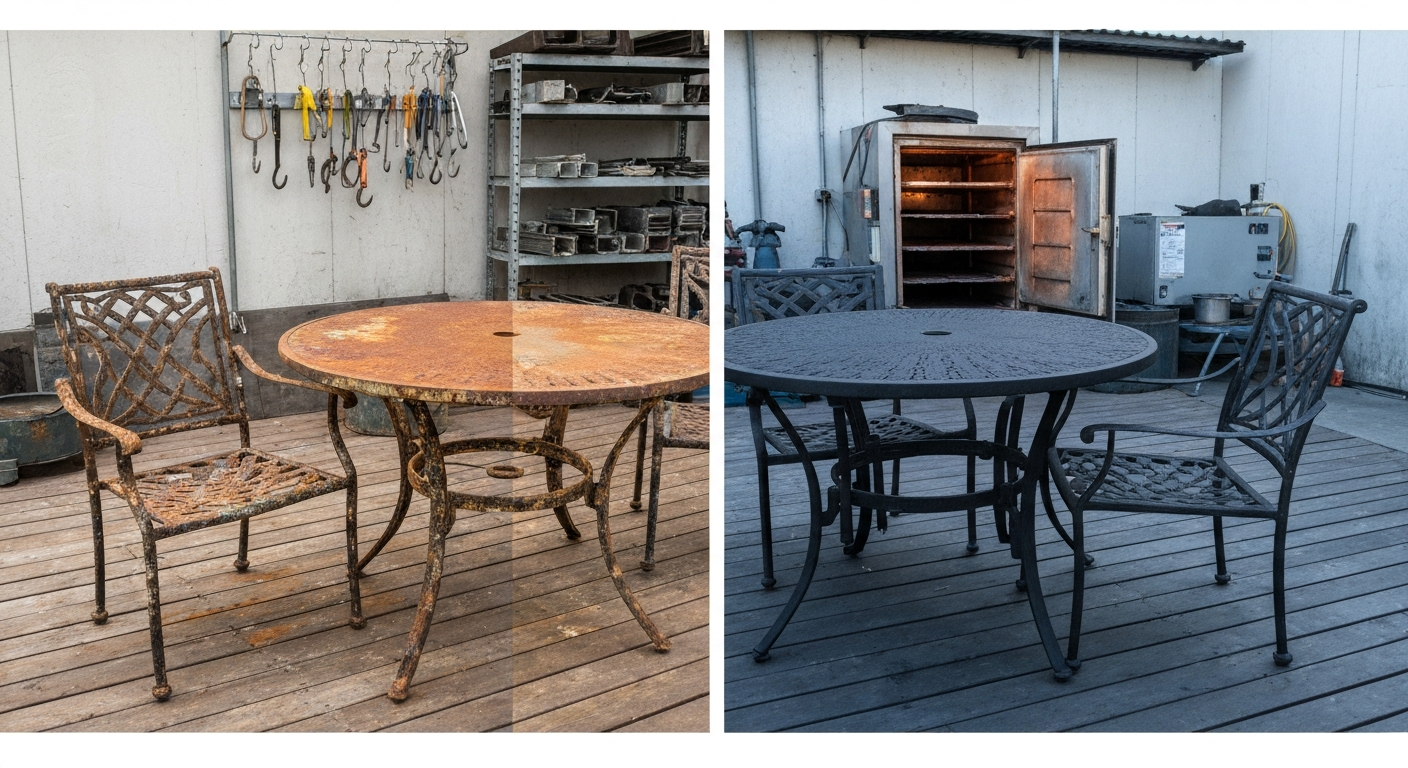
Across the country, Angi's 2026 data puts typical homeowner powder-coating project totals at $345 to $1,122. That range covers everything from a single accent piece to a full dining set with moderate prep work. But the national average only tells part of the story because local labor rates, shop density, and regional climate expectations all push prices in different directions.
| Region | Typical Per-Chair Range | Typical Per-Table Range | Notes |
|---|---|---|---|
| Northeast (Boston, NYC, Philly) | $120–$220 | $160–$300 | Higher labor rates; rust prep common due to road salt exposure |
| Midwest (Chicago, Columbus, KC) | $75–$160 | $120–$230 | Competitive shop density keeps prices moderate; seasonal demand spikes |
| South (Charlotte, Atlanta, Houston) | $80–$150 | $100–$200 | Aluma-Shield (Charlotte) lists chair at $100, large table at $150 stock color |
| West (LA, San Diego, Seattle) | $100–$200 | $150–$280 | Seattle Powder Coat quotes single chair ~$195; San Diego shops start 4-chair/1-table set at ~$525 |
Western markets, especially coastal cities, trend toward the higher end because of elevated overhead and strong demand from design-conscious homeowners. Southern shops generally offer the most competitive pricing, particularly in markets like Charlotte and Houston where there are multiple shops competing for residential work. Northeast shops often layer on rust-prep charges that push totals above the national midpoint, especially on older wrought iron pieces that have spent decades near salt air or salted roads.
How Shops Actually Calculate Your Price
Most powder coating shops use one of three pricing models, and understanding them helps you compare quotes intelligently. Shops that do a lot of residential furniture work typically use flat per-item rates because it's faster to quote and easier for homeowners to understand. Industrial and fabrication-oriented shops lean on per-pound or per-square-foot math. Some use a hybrid, starting with a flat rate and adjusting for surface area or weight.
Per-Item Pricing
This is the most common format for residential furniture. Shops maintain internal price lists by item category (chair, side table, dining table, bench), and they simply quote from those lists. Ingham's Powder Coating, for example, publishes a lawn furniture price sheet with a cast iron chair at $125 and a small side table at $95 for stock colors. These flat rates bake in assumed prep time and powder usage for typical pieces, so they work well for standard items but can be adjusted upward for unusually heavy, ornate, or damaged pieces.
Per-Square-Foot Pricing
Applied-cost estimates from finishing industry sources put shop work (material, labor, and overhead combined) at roughly $1.50 to $4.00 per square foot for standard exterior polyester powder on small-batch residential jobs. This model is most useful for large flat surfaces like tabletops or bench slats where area is easy to measure. A 36-by-60-inch patio table top has about 15 square feet of surface, putting powder cost alone at $22 to $60 before prep labor.
Per-Pound Pricing
Some shops, particularly those with established industrial customers, price by the pound of material processed or by the weight of the part. This matters most for cast iron and heavy steel furniture, which can weigh significantly more than aluminum equivalents. A cast iron bistro chair can weigh 25 to 40 pounds versus 8 to 12 pounds for an aluminum counterpart. Coverage math: at typical film thickness and around 60% transfer efficiency, one pound of powder covers roughly 28 square feet of surface area. Bulk commercial powder runs under $1 per pound at scale, but small-lot retail powder can cost $25 to $33 per pound, which is why shop volume and material sourcing matter enormously to your final bill.
Per-Item Examples and Sample Quotes
Here are concrete price examples drawn from actual shop price lists and published consumer guides. These reflect stock-color, standard-condition pricing. Add prep surcharges and finish upgrades as detailed in the sections below.
| Item | Low End | Typical Mid-Range | High End | Notes |
|---|---|---|---|---|
| Side/Arm Chair (aluminum or steel) | $50 | $100–$125 | $195 | HomeAdvisor low at $50–$75; Aluma-Shield $100; Seattle Powder Coat ~$195 |
| Cast Iron Chair | $95 | $125 | $180+ | Ingham's published rate $125 stock; heavier weight = more powder and handling |
| Small Side/End Table | $75 | $95–$130 | $175 | Ingham's $95; HomeAdvisor $100–$130; varies by leg complexity |
| Large Dining/Patio Table | $130 | $150–$200 | $300+ | Aluma-Shield large table $150; complex or glass-insert frames cost more |
| 4-Piece Set (4 chairs + 1 table) | $350 | $525–$700 | $950 | Quality Powder Coatings San Diego starts at ~$525; upper end adds prep |
| 6-Piece Set (6 chairs + 1 table) | $500 | $700–$950 | $1,200 | Angi project total ceiling ~$1,122; high end includes blasting and specialty finish |
One thing I consistently see in shop quotes: the spread between the cheapest and most expensive quote for the same item can be $50 to $100 on a single chair. That gap is almost never arbitrary. It usually reflects whether the shop is including a proper pretreatment wash cycle, what grade of powder they're using, and whether their oven calibration and cure times are dialed in. Cheap quotes that look attractive often skip multi-stage pretreatment, which is exactly what kills outdoor powder coats prematurely.
What Actually Drives the Cost
Eight factors move your final bill. For more detail on why patio furniture is so expensive, see our in-depth buyer’s guide that breaks down material, labor, and design factors. Some are fixed (the material your furniture is made from), and some are negotiable or avoidable with smart planning. For more anecdotal buyer perspectives see discussions like 'why is patio furniture so expensive' on Reddit.
- Material type: Cast iron requires more powder and handling time than tubular aluminum; the weight alone increases cost on per-pound shops and increases oven space needs.
- Size and surface area: Larger and more complex pieces (scrollwork, ornate legs, wide tabletops) consume more powder and significantly more hang/mask time during prep.
- Weight: Directly affects material usage and handling labor; a heavy cast iron set can cost 30–50% more to coat than a comparably sized aluminum set.
- Condition and prep required: This is the biggest wildcard. A clean, previously coated piece in good shape may need minimal prep. A rusted wrought iron set can add $45–$300 per piece in prep charges alone.
- Color and finish type: Standard stock polyester colors cost less. Metallic finishes add roughly 20%, two-tone adds ~30%, and candy or custom colors can add 45% or more to the base coat price.
- Quantity: More pieces in a single batch almost always lower the per-item price. Many shops offer implicit or explicit volume discounts of 10–40% when you bring in a full set versus individual pieces.
- Pickup and delivery: If you can't transport furniture yourself, expect to add $50–$200 for shop pickup/delivery depending on distance, item count, and whether the shop offers this service at all.
- Local labor rates: Shop overhead, rent, and technician wages vary significantly by region. A shop in rural Ohio has meaningfully lower overhead than one in Los Angeles or Seattle, and that flows directly into quoted prices.
Surface Prep: Rust, Stripping, Blasting, and Repairs
Prep is where powder coating quotes balloon and where corners get cut. Powder coat bonds to metal, not rust, grease, or old paint. Any contamination under the new coating will cause lifting, peeling, or bubbling within one to two seasons outdoors. Good shops will tell you exactly what your pieces need before they quote a final price.
Media Blasting and Sandblasting
For outdoor furniture that has any rust, pitting, or old coating, media blasting is the right call. Utah Powder Werks publishes their blasting rate at $115 per hour. Across the market, chair-level blasting is commonly quoted at $45 to $150 per piece depending on rust severity and surface complexity. Ornate wrought iron with heavy rust can easily run $150 to $300 per piece in blasting charges alone before a single gram of powder is applied.
Chemical Stripping
Some shops offer chemical stripping as an alternative to blasting for pieces with old powder coat or paint but minimal rust. It's typically slower but gentler, and it can be cheaper per piece for small quantities. However, chemical stripping doesn't profile the metal surface the way blasting does, so adhesion on outdoor pieces can be marginally lower. For anything living outdoors year-round, especially in humid or coastal climates, I'd push for blast prep over chemical strip.
Welding and Structural Repairs
Cracked welds, broken legs, and bent frames need to be addressed before coating, not after. Most powder coating shops either do light welding in-house or have a referral relationship with a metal fabricator nearby. Welding is typically billed at $70 to $150 per hour, and a cracked joint on a chair leg might take 15 to 30 minutes to fix properly. Budget $50 to $150 per repair point as a rough working figure.
Red Flags to Watch For
- A shop that quotes without seeing the pieces in person or examining photos of the condition is guessing, not quoting.
- No mention of pretreatment: ask specifically whether they use a multi-stage chemical wash (3-stage minimum, 5-stage is better for outdoor pieces) and a conversion coating like iron or zinc phosphate.
- Prices that seem too low for the described prep: a chair quote of $45 including blasting and coating should make you ask what's being skipped.
- No cure time or oven temperature specification: proper exterior polyester powder cures at around 400°F for 20 minutes; shops cutting cure time to increase throughput produce brittle coats.
- No warranty offered for outdoor applications: reputable shops typically offer 1- to 3-year finish warranties on properly prepped outdoor furniture.
Color, Texture, and Finish Upgrades
Stock colors (typically flat or satin blacks, whites, greens, and browns from a shop's standard powder inventory) are always the most affordable option. Once you move outside that palette, you're paying for specialty powder procurement, possibly a custom color match, and sometimes additional oven runs. Here's how typical finish premiums stack up.
| Finish Type | Premium Over Standard Stock | Notes |
|---|---|---|
| Standard polyester (stock color) | Baseline | Most weather-resistant workhorse; good UV stability |
| Metallic (bronze, copper, silver) | +15–25% | Popular for wrought iron and cast iron; slightly higher powder cost |
| Textured (wrinkle, hammertone) | +10–20% | Good at hiding surface imperfections; common on outdoor furniture |
| Two-tone / dual color | +25–35% | Requires masking between coats and a second oven run |
| Candy / translucent | +40–50% | Requires a base coat metallic layer plus candy topcoat; two full processes |
| Super-durable polyester (PVDF/fluoropolymer) | +30–60% | Significantly better UV and color retention; worth considering in high-sun climates |
| Custom color match (non-stock) | +$20–$50 flat or 15–30% depending on shop | Minimum powder order usually required; some shops charge a setup fee |
For patio furniture in high-UV regions like the Southwest, Arizona, or South Florida, the upgrade to a super-durable polyester or PVDF-based powder is genuinely worth the extra cost. Standard polyester powders can chalk and fade noticeably within three to five years of intense sun exposure. Super-durable polyesters routinely last twice as long with minimal color shift. That's the same logic I apply to material selection generally: calculate cost per year, not just sticker price.
Batching Your Order to Cut Per-Piece Costs
Powder coating shops are set up around batch efficiency. Every time a shop loads and runs an oven cycle, they have a fixed cost regardless of whether it's one chair or twelve. When you fill more of that cycle, the fixed overhead gets spread across more pieces, and shops typically pass some of that savings along. Volume discounts of 10 to 40% per piece are commonly available when you bring in a full set rather than individual items.
Practical Batching Strategies
- Bring everything at once: Don't drop off two chairs now and come back with the table next month. One trip, one batch, one prep cycle saves you real money.
- Ask neighbors or friends: If you can consolidate pieces from multiple households into a single shop drop-off, some shops will treat the whole group as one batch order.
- Time your drop-off strategically: Shops are typically slower in late fall and winter. Off-peak timing sometimes gives you more negotiating room on price or faster turnaround.
- Strip old coating yourself (carefully): Some shops will reduce their prep charge if you bring in already-stripped bare metal. Chemical strippers like aircraft remover can get old powder or paint off, though you need to fully neutralize and dry the metal before drop-off.
- Choose stock colors: If you can work with a shop's existing powder inventory rather than requesting a custom color, you avoid minimum-order powder fees and custom color premiums.
One tactic worth asking about directly: some shops have a minimum lot price rather than a per-piece floor. If their minimum order is $200, and your four chairs would only quote at $160, they'll charge $200 anyway. Knowing this, you might strategically add a garden gate, a plant stand, or other metal pieces to hit a better pricing tier and get more done for essentially the same charge.
DIY Powder Coating: Real Costs and Honest Risks
DIY powder coating setups are real and they work, but the economics only make sense if you plan to coat a lot of metal over time. The entry-level equipment costs alone put you well past what a professional shop would charge for a single set. Here's what you're actually looking at.
- Entry-level electrostatic gun (Eastwood, HF): $80–$200
- Powder (small lots): $25–$33 per pound from retail suppliers, vs under $1/lb at commercial volume
- Curing oven large enough for furniture pieces: $300–$800+ for a used commercial oven, or a dedicated garage oven; a standard kitchen oven is too small for most furniture and cross-contaminates food surfaces
- Media blasting cabinet (optional but strongly recommended for outdoor pieces): $150–$600 for a basic cabinet
- Safety gear (respirator rated for powder, gloves, eye protection): $50–$100
- Total realistic DIY entry cost for furniture-scale work: $700–$1,800 before you coat a single piece
Beyond equipment, the quality gap is real. Professional shops use multi-stage pretreatment wash systems, calibrated cure ovens, and powder from consistent commercial suppliers. A DIY cure in a garage oven with a handheld gun will produce a passable finish on indoor decorative items, but for outdoor patio furniture that faces UV, moisture, and thermal cycling, the coating performance will typically fall short of a well-run professional job. If you already own a shop setup or are planning to coat a large volume of pieces across multiple seasons, DIY makes sense. For a one-time patio set refinish, the math almost never works out.
Powder Coating vs. Repainting vs. Replacing
The decision to powder coat, repaint, or replace comes down to structural integrity, material type, and long-term value. For more on retail pricing and typical markups, see our guide on markup on patio furniture. For help deciding whether to repair or replace, see our guide on how much to spend on patio furniture. If you’re weighing repair versus replace, see our guide on how much does patio furniture cost for typical new-set prices and cost-per-year comparisons. Repainting with a quality outdoor enamel or epoxy primer plus topcoat runs $30 to $80 in materials for a full set if you do it yourself, but outdoor paint on metal typically lasts two to four years before chipping and peeling, especially in humid or coastal climates. Powder coat on properly prepped metal routinely lasts eight to fifteen years outdoors. The math favors powder coating for any piece you plan to keep more than three to four years.
| Option | Upfront Cost (4-piece set) | Typical Lifespan Outdoors | Cost Per Year (approx.) | Best For |
|---|---|---|---|---|
| DIY repaint (enamel/epoxy) | $30–$80 materials | 2–4 years | $15–$35/yr | Budget-conscious; pieces with limited lifespan anyway |
| Professional spray paint/touch-up | $150–$350 | 3–5 years | $50–$100/yr | Decorative or low-use pieces; temporary fix |
| Professional powder coat (standard) | $350–$700 | 8–12 years | $40–$85/yr | Structurally sound cast iron, wrought iron, aluminum |
| Professional powder coat (super-durable) | $450–$900 | 12–20 years | $30–$65/yr | High-UV climates; pieces you want to keep long-term |
| Replacement with new budget furniture | $300–$800 | 3–6 years (budget steel) | $65–$200/yr | When structural damage is too extensive to justify repair |
Cast iron and wrought iron furniture made before the 1990s is particularly worth coating rather than replacing. The metal quality in older pieces is often genuinely better than what's in modern budget furniture, and the designs are frequently more attractive. I've seen cast iron bistro sets from the 1960s powder coated for $400 to $600 that will outlast $1,200 in new aluminum furniture by a decade. The framing I use throughout this site applies here too: what matters is cost per year of performance, not sticker price at either end of the transaction. For guidance on whether a higher upfront cost makes sense for longevity and value, see our analysis on whether is expensive patio furniture worth it.
Material and Climate Considerations
Not all metals respond equally to powder coating, and not all climates demand the same finish performance. Here's how to match material, coating type, and regional environment.
- Cast iron: Heavy, prone to surface rust if coating is compromised. Powder coating is an excellent match; media blast prep is essential. In coastal or humid climates (Gulf Coast, Pacific Northwest), specify a conversion coating (zinc phosphate) before powder application.
- Wrought iron: Similar to cast iron but typically thinner and more ornate. Blasting prep is critical for scrollwork. Same coastal considerations apply. Well-coated wrought iron in a moderate climate can go 10+ years without attention.
- Steel (tubular or sheet): Common in budget outdoor furniture. Powder coating significantly extends its life, but lower-quality steel with thin walls can still rust through from the inside at welds. Inspect welds before committing to coating costs.
- Aluminum: Naturally corrosion-resistant, so the bar for prep is lower. Powder coat on clean aluminum provides excellent UV and scratch resistance. Worth upgrading to super-durable polyester in high-sun climates like Arizona or South Florida.
- High-UV regions (Southwest, South Florida): Specify super-durable polyester or PVDF. Standard polyester chalks and fades faster here than anywhere else.
- Coastal/salt-air environments: Multi-stage pretreatment (5-stage wash with zinc phosphate conversion coating) is non-negotiable if you want a coating to last. Ask the shop explicitly about their pretreatment process before booking.
- Freeze-thaw climates (Midwest, Northeast): Powder coat handles temperature cycling well, but any chip or breach in the coating lets moisture in before freeze cycles accelerate corrosion. Touch up chips promptly with metal-compatible touch-up paint as a stopgap.
How to Find a Good Shop and What to Ask
The difference between a mediocre and excellent powder coat job is almost entirely in the blank" rel="noopener noreferrer">prep and pretreatment, not the powder itself. Most of the failure stories you'll find on forums trace back to skipped wash stages, inadequate blasting, or rushed cure times. See community discussions and user recommendations at the best patio furniture reddit for real-world experiences and shop suggestions. Here's what to ask before you hand over your furniture.
- What does your pretreatment process include? Look for a minimum 3-stage wash; 5-stage with a conversion coating is better for outdoor furniture.
- Do you sandblast or media blast before coating? For outdoor pieces with any rust or old coating, the answer should be yes.
- What type of powder do you use for outdoor furniture? Standard polyester is acceptable; super-durable polyester is better in harsh climates.
- What is your cure temperature and time? Should be approximately 390–420°F for 15–20 minutes for most exterior polyesters.
- Do you offer any warranty on outdoor furniture finishes? Reputable shops typically offer 1 to 3 years.
- Can I see examples of past outdoor furniture work, ideally pieces that have been outside for a couple of seasons?
- What is your turnaround time, and do you charge for pickup/delivery?
A shop that answers these questions confidently and specifically is a shop that understands the process. A shop that deflects or gives vague answers is one to be cautious about. It's also worth checking whether they have any industrial or architectural clients: shops that coat commercial railings, gym equipment, or architectural metalwork are typically running tighter process controls than a shop doing only occasional furniture jobs.
Maintenance After Coating and Expected Longevity
A quality powder coat on properly prepped outdoor furniture requires very little ongoing maintenance, which is a meaningful part of its value proposition. Wash it once or twice a year with mild soap and water. Avoid abrasive cleaners or scrub pads that can scratch through the coating. Inspect annually for chips, especially at welds, edges, and contact points. Touch up chips promptly with a compatible metal primer and touch-up paint to prevent moisture from working underneath the coating. In salt-air environments, rinse furniture monthly to remove chloride deposits.
Expected lifespan ranges: 8 to 12 years for standard polyester exterior powder in moderate climates, 12 to 20 years for super-durable or PVDF powders, and potentially shorter (5 to 8 years) in high-UV or salt-air environments with standard-grade powder. These aren't marketing claims; they're what finishing industry performance data and real-world shop warranties reflect. Powder coating's longevity advantage over paint is most pronounced in exactly the climates and use conditions that outdoor furniture faces.
FAQ
What national and regional price ranges should the article report for professional powder-coating of patio furniture?
Give a national consumer range and show regional variance with examples. National totals: typical homeowner projects ≈ $345–$1,122; full 4–6 piece patio sets commonly fall in $350–$1,200. Per-item retail bands: chairs ≈ $50–$500 (typical $75–$195), small tables ≈ $70–$250, large tables and bulky items higher. Include region/shop examples to show spread (e.g., Charlotte/NC and San Diego/CA listing $100–$150 for chairs; Seattle/LA examples showing $45–$195). Cite concrete shop price sheets for illustration and note local labor/cost-of-living drives variance.
Which per‑area and per‑weight pricing norms should be included and how should they be used?
Report practical shop norms: material+labor applied per square foot ≈ $1.50–$4.00/ft² (range based on prep and finish), and explain per‑pound and coverage: engineering figures give ≈28 sq ft per lb at realistic film thickness/efficiency; commodity market references put powder price benchmarks from <$1/lb (bulk) to $25–$33/lb (small retail SKUs), with market applied cost references around $2.50–$4.00/lb. Use both conversions to translate item surface area to material cost and show sample math for common pieces.
What per‑item pricing examples should the article present for homeowners?
Provide a short table of sample retail ranges and typical midpoints: single side/arm chair ≈ $50–$250 (typical $75–$195), small side table ≈ $70–$150, large dining table ≈ $150–$400+, cast‑iron chair ≈ $95–$125 (shop list example), 4‑chair/1‑table set ≈ $350–$1,200. For each example show low/typical/high cases tied to prep level, finish complexity, and regional labor.
What discrete cost drivers must be broken down in the article and what ranges or effects should be given?
List every driver with ranges/impact: material/finish (stock polyester minimal premium; super‑durable/polyester/PVDF +10–50% or per‑lb premium), size/area (directly scales cost), condition/prep (media blast or chemical strip add $45–$300+ per piece or $75–$200+/hr), color/finish complexity (metallic +20%, two‑tone +30%, candy/custom +30–45%), quantity/volume (batch discounts 10–40%), pickup/delivery ($50–$200), local labor rates/market (affects base labor and overhead), repairs/welding ($70–$150/hr or discrete quotes). Explain how each moves low→high estimate.
What DIY vs professional cost and equipment comparisons should be included?
Give realistic itemized comparisons: DIY equipment (powder spray gun $200–$1,500, oven capable of curing small parts or propane bake setup, powders $25–$33/lb retail) and likely limits (part size, oven safety, transfer efficiency, consistency). Estimate DIY total for a chair (small): $150–$500 startup (tools + powder) then low per‑part cost; professional cost: single chair $50–$250 depending on shop. Highlight risks: adhesion/failures, health/safety, inconsistent cure, lack of pretreatment, time investment. Recommend DIY mainly for small parts or lots of repeat work; otherwise pro is usually better value for outdoor furniture.
How should the article help readers decide between powder coating, repainting, or replacing furniture?
Provide decision criteria: compare costs (powder coating often $50–$500 per piece vs repainting $20–$150 DIY/pro), expected longevity (proper powder: 8–15+ years outdoors on suitable substrate; high‑quality repaint: 2–7 years depending on prep), structural condition (welds/rot—replace if structural failure or repair cost >50% of replacement), sentimental/quality value (high‑end wrought iron or aluminum worth refinishing), and aesthetics/finish options. Give rules of thumb: powder coat when item is structurally sound, surface area justifies cost, and you want long‑term weather resistance; repaint for cheap or soon‑to‑be‑replaced pieces.
Next Articles
What Is the Markup on Patio Furniture, How Much to Pay
Understand patio furniture markup: what it means, who pays, typical ranges, cost drivers and smart buying tips.
How Much Does Patio Furniture Cost? Prices by Type
Patio furniture cost by type, materials, and quality, plus tips to budget delivery, cushions, covers, and long-term valu
Best Patio Furniture Reddit Picks by Material, Brand, and Climate
Reddit-backed patio furniture picks by material and climate, plus brand strengths, failure points, and buying specs