
For most homeowners, a realistic and defensible budget is $500 to $1,500 for a complete four- to six-piece patio set. For a detailed breakdown of price bands and examples, see how much does patio furniture cost. That range covers genuine mid-grade quality in materials like powder-coated aluminum, synthetic PE wicker, and FSC-certified acacia. If you have a coastal climate, heavy rain exposure, or plan to leave furniture out year-round, pushing toward $1,500 to $3,000 buys meaningfully better materials and longer life. Teak and high-end aluminum sets in the $2,500 to $5,000 range are worth the premium only if you plan to keep them for 15 or more years. Below $400 for a full set, the math almost never works in your favor when you factor in replacement cycles.
How Much to Spend on Patio Furniture: Budget Targets

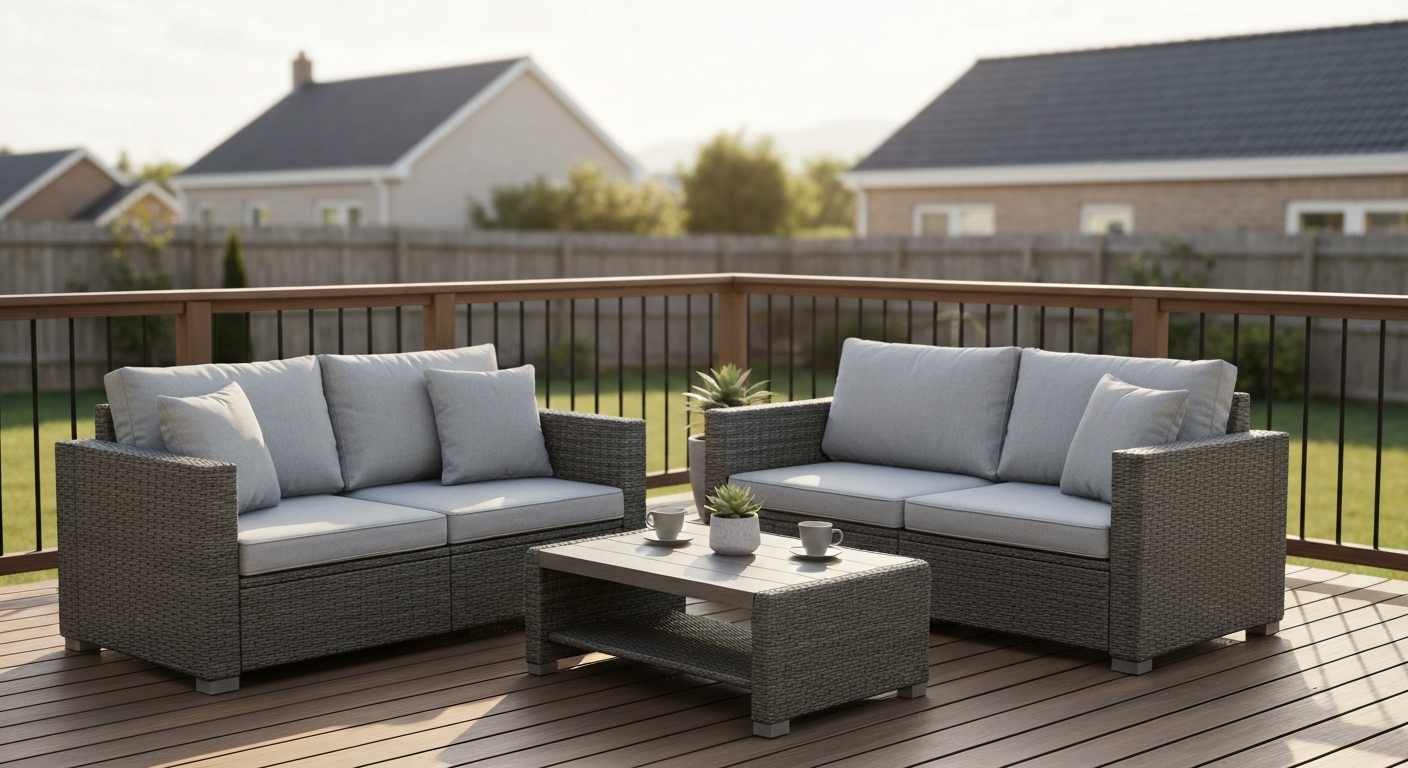
How much to spend: quick budget targets
Before diving into materials, here are the spending tiers I use as a practical starting point. These reflect what the market actually delivers at each price band, based on real retailer listings and manufacturer specs, not aspirational marketing copy.
| Budget Tier | Typical Spend (Full Set) | What You Get | Expected Lifespan |
|---|---|---|---|
| Entry | $200 – $500 | Basic PE wicker or low-gauge steel, thin cushions, 1-year warranties | 3 – 5 years |
| Mid-Range | $500 – $1,500 | Better PE wicker, powder-coated aluminum, FSC acacia, Sunbrella-grade cushions | 7 – 12 years |
| Upper-Mid | $1,500 – $3,500 | Cast aluminum, dense PE wicker, eucalyptus or teak entry, quality foam | 10 – 18 years |
| Premium | $3,500 – $8,000+ | Grade A teak, marine-grade aluminum, luxury brands, full Sunbrella seating | 20 – 30+ years |
One thing worth noting: the $200 to $500 band is not necessarily a bad buy for a screened porch or a rarely-used secondary seating area. The problem is assuming entry-level outdoor furniture will survive uncovered on a south-facing deck for a decade. It will not. When people complain that patio furniture is overpriced, it is often because they bought at the entry tier expecting upper-mid performance. See community discussions such as 'why is patio furniture so expensive reddit' for firsthand buyer complaints and price-context anecdotes. For a deeper breakdown of the factors that drive sticker prices, see why patio furniture so expensive.
When to splurge and when to save
Deciding whether to spend more comes down to four variables: how exposed the furniture will be, how long you plan to stay in your home, your climate, and how much maintenance you are actually willing to do. Here is the honest decision framework I walk through with anyone asking where to put their budget.
Situations where spending more pays off
- You live within a mile of saltwater. Salt air accelerates corrosion and UV degradation dramatically. Cheap powder coat and low-grade wicker will fail within two to three years. Spend at least $1,500 on a set rated for coastal use.
- The furniture will live outdoors uncovered year-round in a wet or freeze-thaw climate. Moisture cycling destroys cheap joints, swells wood, and cracks thin wicker. Higher material density pays for itself fast.
- You plan to be in your home for ten or more years. The per-year math shifts dramatically at longer ownership horizons (more on that below).
- You entertain frequently and the patio is high-visibility. Structural failure or obvious degradation in a primary living space has real replacement costs, including your time.
- You want to avoid cushion replacement cycles. Cheap cushions use basic foam and thin covers that compress and fade within two seasons. Investing in Sunbrella-covered cushions with quick-dry foam costs more upfront but avoids $100 to $220 per-cushion replacements every few years.
Situations where saving makes more sense
- The furniture will be stored seasonally in a garage or shed. Covered storage dramatically extends the life of even modest-quality pieces. Entry-to-mid gear stored properly can outlast uncovered premium furniture.
- You are renting or plan to move within five years. The cost-per-year equation shifts against premium buys when the ownership window is short.
- The patio is covered or screened. A pergola or roof removes direct UV and precipitation exposure, the two biggest durability killers. Mid-range furniture in a covered setting easily reaches ten-plus years.
- It is a secondary space (a side yard, a vacation property used a few weeks a year, a seldom-used back corner). Match spend to actual use.
- You enjoy refreshing your outdoor space every few years anyway. Some people genuinely prefer the flexibility of not being locked into a large investment.
Per-seat price ranges: what each chair or seat costs you
Breaking price down to a per-seat figure is one of the clearest ways to compare across different set configurations. A four-piece conversation set that lists at $800 sounds reasonable, but at $200 per seat it may be mid-entry range. A single POLYWOOD Adirondack with a MAP price of $289 is expensive by sticker but represents a completely different material and warranty tier. Here is how per-seat costs break down across the market.
| Price Tier | Per-Seat Cost | Typical Materials | Cushion Quality |
|---|---|---|---|
| Entry | $40 – $120 | Thin-gauge steel, low-density PE wicker, basic resin | Thin polyester fill, basic covers |
| Mid-Range | $120 – $280 | Powder-coated aluminum, mid-density PE wicker, acacia | Moderate foam, sometimes Sunbrella-compatible covers |
| Upper-Mid | $280 – $600 | Cast aluminum, solid teak entry-grade, high-density PE wicker, HDPE lumber | Quick-dry foam, Sunbrella or equivalent fabrics |
| Premium / Luxury | $600 – $3,000+ | Grade A teak, marine aluminum, wrought iron, luxury brand cast pieces | High-density marine foam, full Sunbrella, custom options |
The POLYWOOD Adirondack example is instructive. At $289 MAP to $470 MSRP for a single chair, it sits at the upper end of mid-range per-seat pricing. But POLYWOOD backs that chair with a 20-year residential structural warranty. If you own it for 20 years, that is roughly $15 to $24 per year for the seat. An entry-level chair at $60 that needs replacing every three years costs $20 per year and delivers a fraction of the durability. The per-year math consistently favors quality above entry tier at ownership horizons of seven years or longer.
Common set prices: bistro through sectional
Here is how the most common patio furniture configurations price out across tiers. These are based on current 2026 retail listings across major retailers and direct-to-consumer brands, not manufacturer MSRP fantasy numbers.
| Set Type | Entry Range | Mid-Range | Upper-Mid / Premium |
|---|---|---|---|
| Bistro (2 chairs + table) | $80 – $200 | $200 – $500 | $500 – $1,500+ |
| 3-Piece (loveseat/sofa + 2 chairs or table) | $150 – $350 | $400 – $900 | $900 – $3,000+ |
| 4-Piece Conversation Set | $220 – $500 | $500 – $1,200 | $1,200 – $4,000+ |
| 5-Piece Dining Set (table + 4 chairs) | $300 – $700 | $700 – $1,800 | $1,800 – $6,000+ |
| 6-Piece Conversation / Sofa Set | $500 – $1,000 | $900 – $2,500 | $2,500 – $8,000+ |
| Sectional (5–8 piece modular) | $600 – $1,200 | $1,200 – $3,500 | $3,500 – $15,000+ |
To anchor these with real numbers: Home Depot's Hampton Bay Newshire 4-piece wicker conversation set was listed at $324 in mid-2026, sitting at the low end of mid-range. Wayfair's entry point for 4-piece PE wicker sets starts around $220 (the Atila set at $219.99), while a well-specified 6-piece Ovios rattan set at Lowe's ranged from $888 to $1,351 depending on configuration. Trex's 4-piece conversation set lands around $1,049 at mass retailers. Brown Jordan's luxury systems start at MSRP $11,381 for flagship sofa pieces alone. The spread is enormous, and where you land should match your exposure, climate, and ownership horizon, not just your initial comfort with the sticker price.
Material deep dives: what you actually get for the money
Material choice is where most of the real spend decision lives. Two sets at identical prices can deliver completely different real-world lifespans depending on what they are made from. Here is my honest assessment of each major material category, including where each performs well and where it falls apart.
Teak: the premium benchmark
Teak is the benchmark for outdoor hardwood furniture because it earns that reputation. The USDA Forest Products Laboratory classifies teak as a naturally durable hardwood with very high resistance to rot and insect attack, which is not marketing language but materials science. Quality teak furniture is routinely cited across trade and manufacturer literature as having a service life of 25 to 50-plus years in outdoor exposure when properly built. That claim holds up in practice because teak's natural silica and oil content resists moisture infiltration at the cellular level.
What does teak actually cost? Entry-grade plantation teak chairs (Grade B or C, smaller cross-sections) start around $300 to $600 per seat. Grade A teak, which uses the dense heartwood from the center of the log with tight grain and higher oil content, runs $500 to $1,200 per seat and more for complex pieces. A quality Grade A teak 5-piece dining set from a reputable brand typically retails between $2,500 and $6,000. Luxury pieces from Brown Jordan, Gloster, or similar brands can exceed that substantially.
Regional suitability: teak is one of the few materials that performs well in virtually every climate. It handles coastal humidity and salt air better than any other outdoor wood. In hot, dry climates it can dry and crack if left completely unmaintained, so an annual teak oil or sealer application matters more in Arizona than in Seattle. In wet Pacific Northwest or Florida climates, teak can develop surface mold without occasional cleaning, but the wood itself will not rot. For snow-belt climates, teak is excellent as long as you avoid trapping water in joints during freeze cycles, which good furniture design handles through drain holes and mortise-and-tenon construction.
Maintenance cost: annual teak oil runs $20 to $50 per application depending on set size and product. A full cleaning and re-oiling service from a furniture refinisher typically costs $100 to $300 per set. Alternatively, letting teak weather to its natural silver-gray patina requires no maintenance at all but is purely an aesthetic choice. Cost-per-year on a quality teak set held for 25 years, even at $4,000 purchase price plus $40 per year maintenance, works out to roughly $200 per year, which is comparable to replacing a $500 mid-range set every three years.
Aluminum (including powder-coated): the best all-rounder
Aluminum is my default recommendation for most homeowners because it hits the best combination of corrosion resistance, weight, and mid-range cost. It does not rust, which immediately separates it from steel in any humid or coastal environment. Powder-coated aluminum is the dominant form in mid-to-upper-mid furniture, and quality varies enormously based on coating thickness, pretreatment process, and alloy grade.
Cost range: extruded aluminum furniture starts around $150 to $300 per seat at mid-range and climbs to $400 to $900 per seat for cast aluminum pieces from quality brands. A 5-piece cast aluminum dining set typically runs $1,200 to $3,500. Extruded and tubular aluminum sets start lower, often $600 to $1,500 for a 5-piece configuration.
On powder coating: a quality powder-coat finish applied over a proper zinc phosphate or chromate pretreatment provides 10 to 20-plus years of corrosion protection in non-coastal settings. blank" rel="noopener noreferrer">Powder‑coat systems applied to outdoor furniture are capable of providing 10–20+ years of useful protection in ordinary residential environments; however, manufacturers’ residential powder‑coat warranties commonly run 2–5 years for finish defects. For coastal environments, look for sets that reference salt-spray testing. The ASTM B117 salt-spray test is the industry standard: finishes passing 1,000-plus accelerated hours correlate with decade-plus coastal performance in trade literature. Most manufacturer warranty terms for powder-coat finishes are 2 to 5 years for finish defects (POLYWOOD warranties its powder coat for 5 years; Oxford Garden and comparable brands typically offer 3 years). Oxford Garden's Furniture Warranty, Oxford Garden (manufacturer warranty page) states a three-year warranty for powder‑coat finishes blank" rel="noopener noreferrer">Oxford Garden's warranty page. That warranty window is not the expected life of the finish but rather the manufacturer's liability window. A well-applied coating on a well-made frame should last significantly longer.
If you are considering powder-coating existing aluminum furniture rather than buying new, professional re-coating typically costs $50 to $150 per piece at a local powder coater, or $150 to $400 for a full set depending on complexity and whether the old coating needs stripping. That cost is often worth it to extend the life of a solid aluminum frame.
Regional suitability: aluminum is excellent in coastal climates (the metal itself does not corrode from salt air the way steel does), humid subtropical zones, desert heat, and temperate climates. It gets very hot to the touch in direct desert sun, which is a real usability consideration for armrests and tabletops. In freeze-thaw climates, aluminum outperforms most materials because it does not absorb moisture and is not susceptible to the wood-splitting and metal-rusting failure modes. Expected lifespan for mid-to-quality aluminum furniture is 10 to 20 years with minimal maintenance, and longer for quality cast aluminum if the frame is not physically damaged.
Wicker and rattan: what the price difference actually means
Wicker and rattan is where the most confusion lives in the outdoor furniture market, mostly because the terms are used interchangeably in retail listings for products that are completely different materials with very different outdoor performance.
Natural rattan and wicker
True natural rattan is a plant-fiber material that looks beautiful and performs acceptably in covered, sheltered outdoor settings. It is not suitable for year-round uncovered outdoor use in any climate with regular rain, humidity, or UV exposure. It will bleach, dry out, crack, and mold. Natural wicker and rattan furniture belongs on a covered porch or sunroom, not an exposed deck. Pricing for quality natural rattan sets runs $600 to $2,500 for a 4-to-6 piece set. If you are buying natural rattan for outdoor use, factor in annual sealing or lacquer maintenance and realistic 5 to 8-year performance even with care.
Synthetic PE and HDPE wicker
Synthetic resin wicker (usually PE or HDPE) is what most outdoor furniture sold as wicker actually is. It wraps around an aluminum or steel frame and can handle genuine outdoor exposure. Performance varies dramatically with weave density and resin quality. Low-end PE wicker, like many sets in the $220 to $500 range, uses thin-gauge resin that fades, becomes brittle, and starts unraveling within 3 to 5 years. Higher-density HDPE weave from quality brands holds up for 8 to 12-plus years. The difference is not always obvious from a photo, which is why price and warranty terms matter as a proxy for quality.
The $324 Hampton Bay 4-piece set at Home Depot and the $220 entry sets on Wayfair deliver reasonable value for covered or lightly exposed settings. For year-round exposed use in a humid or coastal climate, the $800 to $1,500 band for 4-to-6 piece synthetic wicker sets is a better starting point. At this range you typically get aluminum frames (not steel, which will rust through the weave), thicker PE weave, and better cushions.
Regional suitability: synthetic wicker works in all temperate and subtropical climates. Avoid steel-framed wicker in coastal or humid subtropical regions entirely; salt air will rust the frame from the inside. In high-UV desert climates, even quality PE wicker fades faster than aluminum or teak, so UV-stabilized resin formulation matters more in Phoenix or Las Vegas than in Portland. Synthetic wicker frames cannot be meaningfully repaired if the frame bends or weave unravels at scale, so end-of-life replacement is usually the outcome rather than refinishing.
Wood (acacia, eucalyptus, and other outdoor hardwoods)
Below teak, the outdoor wood category includes several species that offer reasonable to good durability at lower price points. The most commonly sold options are acacia, eucalyptus, shorea (sometimes sold as meranti or balau), and ipe. Each has a distinct durability profile and maintenance requirement.
Acacia
Acacia is the dominant budget-to-mid hardwood in the outdoor furniture market right now because it is fast-growing, FSC-certifiable, relatively hard, and inexpensive to source. A 5-piece acacia dining set runs $400 to $1,200 at most retailers. The catch is that acacia's durability varies significantly by species and how it was dried and finished. In moderate climates with seasonal storage or covered settings, a quality acacia set can last 8 to 12 years with annual oiling. Left uncovered in a wet climate or exposed to freeze-thaw cycles without proper annual maintenance, expect 3 to 5 years before cracking, checking, and joint failure become real issues.
Eucalyptus
Eucalyptus is a legitimate teak alternative and one I recommend more often than its market share suggests. It is a dense, naturally oily hardwood with natural rot resistance that outperforms acacia significantly. In dry weight and oil content it sits between plantation teak and acacia. A 5-piece eucalyptus set runs $700 to $2,000 from quality brands. With annual oiling it routinely reaches 15-plus years in moderate to humid climates. In coastal settings it performs better than acacia but not quite as robustly as Grade A teak. For the value-conscious buyer who wants genuine hardwood performance without the teak price tag, eucalyptus is often the right call.
Ipe and shorea
Ipe (also called Brazilian walnut) is extremely dense and rot-resistant, with a Janka hardness that rivals or exceeds teak. It is more common in decking than in furniture, partly because it is difficult to work with. When you do find it in furniture form, prices approach or match lower-grade teak. Shorea is sold in various grades and used for teak-look furniture at lower price points; quality varies considerably. Both species are worth researching for FSC certification given sourcing concerns in tropical hardwood supply chains.
Maintenance costs across outdoor wood types
All outdoor wood furniture requires annual to biennial oiling or sealing regardless of species. Budget $20 to $60 per year in product for a typical set. Professional refinishing (sanding, re-oiling, joint tightening) runs $150 to $400 for a full set depending on your market. In freeze-thaw climates, wood furniture ideally should be covered or stored from late fall through early spring. In wet climates like the Pacific Northwest, teak and eucalyptus are the only species I would leave uncovered year-round without significant maintenance concerns. Acacia in a Seattle winter without annual oiling and winter covering is a recipe for premature failure.
Cushion costs: the hidden variable in your budget
Cushions are where entry and mid-range sets cut the most corners and where long-term costs sneak up on buyers. A set listed at $600 with cushions may include $30 worth of thin polyester fill in basic covers. When those flatten and fade in two seasons, replacement cushions for a 4-piece set can cost $400 to $1,200 depending on size and material.
Sunbrella solution-dyed acrylic fabric is the quality benchmark for outdoor cushion covers. It retails at roughly $40 to $75 per yard, and Sunbrella backs many of its upholstery fabrics with a 5-year limited warranty, with some shade and awning products covered for 10 years. A replacement chair cushion with a Sunbrella cover and quality quick-dry foam runs $100 to $220; deep-seating cushions and chaise pads push $140 to $300 or more. That means recovering a 4-piece deep-seating set with quality cushions can run $500 to $1,000, which is more than the original set cost in many cases.
The practical upshot: if a set comes with cushions that feel thin or have covers made from basic polyester, budget for replacement cushions as part of your total cost. Alternatively, buy a cushionless frame set in the mid-to-upper range and spec Sunbrella cushions separately. This approach lets you get the most durability from both the frame and the seating surface without paying a premium for a bundled cushion you will replace in three years.
Lifecycle cost-per-year: the number that actually matters
Sticker price is the least useful number for evaluating patio furniture value. Cost per year of useful life is the right metric. If you’re asking whether expensive patio furniture is worth it, compare cost-per-year numbers and expected lifespan to decide whether the higher upfront price delivers better long-term value is expensive patio furniture worth it. Here is how the math plays out across realistic scenarios.
| Scenario | Purchase Price | Annual Maintenance | Expected Life | Annual Cost |
|---|---|---|---|---|
| Entry PE wicker set, uncovered, humid climate | $350 | $0 | 3 years | $117/yr |
| Mid PE wicker set, stored seasonally | $900 | $20 | 10 years | $110/yr |
| Powder-coated aluminum, moderate climate | $1,400 | $20 | 15 years | $107/yr |
| Eucalyptus dining set, annual oiling, temperate | $1,200 | $40 | 15 years | $120/yr |
| Grade A teak, coastal, annual oil | $4,000 | $50 | 25 years | $210/yr |
| POLYWOOD Adirondack (4 chairs), low maintenance | $1,200 | $10 | 20 years | $65/yr |
The teak scenario looks expensive at $210 per year, but that figure includes a set that will still be structurally sound and visually presentable in 2050. The entry PE wicker scenario at $117 per year also does not account for the disruption and time cost of replacement shopping every three years. HDPE lumber products like POLYWOOD genuinely deliver some of the best per-year economics in the market because of that 20-year warranty backing and near-zero maintenance requirement.
How to save money without buying junk
Spending smart is not the same as spending less. Here are the strategies that actually work. For community-driven recommendations and owner reviews, see discussions titled "best patio furniture reddit" where homeowners share firsthand experiences, model suggestions, and long-term durability reports.
- Buy cushionless frames and source cushions separately. You get better quality control over both, and the frame tends to be what lasts. Sunbrella cushions from a custom cushion shop often cost the same as bundled premium cushions but can be sized and resized as needed.
- Shop end-of-season sales in August and September. Major retailers clear outdoor inventory at 30 to 50 percent off to make room for fall stock. The same set at $800 in May may sell for $450 in late August.
- Consider used or lightly used teak and cast aluminum. Both materials refinish well. Teak can be sanded and re-oiled to look close to new. Cast aluminum can be powder-coated for $150 to $400 at a local shop. A 10-year-old teak set bought used for $600 and refinished for $200 may deliver better value than a new $1,200 mid-range set.
- Prioritize frame quality over cushion quality when comparing sets at the same price. Frames are expensive and difficult to replace. Cushions are replaceable. A solid frame with mediocre cushions is a better starting point than a mediocre frame with premium cushions.
- Choose materials that match your actual storage and maintenance habits, not your aspirational ones. An acacia set that you will consistently store and oil every year is a reasonable buy. That same set for someone who will leave it uncovered and never oil it is a waste of money at any price.
What to look for in warranties and brand quality
Warranty terms are one of the most honest signals of a manufacturer's confidence in their product. Here is what to look for and what to ignore.
- Structural frame warranty of 5 years or more signals the manufacturer believes the frame will hold up. POLYWOOD's 20-year structural warranty is exceptional and reflects their confidence in HDPE lumber. Most mid-range brands offer 1 to 5 years.
- Powder-coat finish warranties of 3 to 5 years are standard. Be skeptical of brands offering less than 2 years or no finish warranty at all. The warranty term does not equal the coating's useful life, but it signals coating quality.
- Cushion and fabric warranties of 1 to 3 years for covers and fill are typical. Sunbrella's 5-year fabric warranty is above average and independently verifiable.
- Avoid sets with no published warranty information. Reputable brands publish warranty terms; no-name import brands often do not. That gap in information is itself informative.
- Look for brands that sell replacement parts, especially cushions and hardware. A brand willing to sell you replacement components plans for the furniture to last long enough to need them.
Brand markup is real in this category. The question of what you are actually paying for in a premium brand versus a mass-market set is worth examining carefully. Brands like Brown Jordan, Gloster, and Restoration Hardware carry significant brand equity premiums. For specifics on typical retail and brand markups, see what is the markup on patio furniture for a clear breakdown of pricing practices. The quality is generally genuine at the top tier, but the gap between a $3,000 teak set from a reputable mid-tier brand and a $10,000 set from a luxury brand is largely in aesthetics, customization, and brand prestige, not in fundamental material or durability differences.
Climate-based buying recommendations
Climate is probably the single most underweighted variable in furniture buying decisions. Here is a region-by-region quick guide to matching material to environment.
| Climate / Region | Best Materials | Avoid | Key Concern |
|---|---|---|---|
| Coastal / Saltwater (within 1 mile) | Grade A teak, marine-grade or anodized aluminum, HDPE lumber | Steel frames, untreated iron, natural rattan, low-end PE wicker | Salt air corrosion, UV intensity |
| Humid Subtropical (Southeast US, Gulf Coast) | Teak, eucalyptus, powder-coated aluminum, quality PE wicker on aluminum frames | Steel frames, natural rattan, low-density PE wicker, untreated softwood | Mold, humidity, UV, storm exposure |
| Freeze-Thaw (Midwest, Northeast, Mountain West) | Powder-coated aluminum, HDPE lumber, teak (with winter covering), quality cast aluminum | Natural rattan, thin PE wicker, low-grade steel, softwood | Freeze-thaw cycling, moisture in joints |
| Hot Arid / Desert (Southwest US) | Powder-coated aluminum (check UV stability), teak with annual oiling, HDPE lumber | Natural wood without UV protection, cheap resin | UV degradation, thermal expansion, drying and cracking |
| Temperate / Pacific Northwest | Teak, eucalyptus, powder-coated aluminum, quality PE wicker | Untreated acacia, natural rattan, cheap steel frames | Constant moisture, mold, moss growth |
| Mild / Four-Season Moderate | Most mid-to-upper materials perform well with seasonal care | Purely budget entry-tier if left uncovered year-round | General UV exposure over time |
New vs. used: when the secondhand market makes sense
The secondhand market for outdoor furniture is genuinely underused. Teak, cast aluminum, and wrought iron all refinish well, meaning a used piece in rough cosmetic condition but with a solid frame can be a significant value. A teak table with weathered gray patina and some surface checks can often be sanded and re-oiled to near-new appearance for $50 to $100 in materials. A powder-coated aluminum chair with chipped finish can be stripped and re-coated professionally for $50 to $100 per piece. The categories to avoid in the used market are steel-frame PE wicker (hidden rust is hard to assess), low-density PE wicker with unraveling weave (not repairable at scale), and wood with soft spots or joint failure (structural repairs on outdoor furniture are rarely cost-effective).
Marketplace platforms and estate sales are the best sources for used quality outdoor furniture. Teak sets from brands like Smith and Hawken (discontinued but still widely available used), Jensen Leisure, or Barlow Tyrie regularly surface in decent condition for 30 to 60 percent of original retail. At those prices, a $4,000 teak set available for $1,200 used and $200 in refinishing costs represents genuinely compelling value, provided the structural integrity checks out.
FAQ
How much should I budget per seat and per set for patio furniture overall (broad targets)?
Budget targets (U.S., retail ranges): • Entry: $75–$200 per seat / $200–$800 per small 4‑piece set — mass‑market resin/low‑end wicker. • Midrange: $200–$600 per seat / $800–$2,500 per 4‑6‑piece set — better aluminum frames, higher‑density resin wicker, quality cushions. • Premium: $600–$1,500+ per seat / $2,500–$8,000+ per set — teak, high‑end aluminum/brand collections, premium cushions. • Luxury: $1,500–5,000+ per seat / $8,000–20,000+ per system — designer/architectural brands (e.g., Brown Jordan). Use these bands to match lifespan and features you need.
Price ranges by common materials (per seat and 4‑piece set) and expected lifespans
Material price ranges and typical lifespans (normal residential use, not extreme coastal salt exposure): • Teak (solid): $400–$1,500+ per seat; 4‑piece set $2,000–$10,000. Lifespan: 25–50+ years with maintenance. • Aluminum (powder‑coat): $250–$900 per seat; set $1,000–$4,000. Lifespan: 10–20+ years with quality powder coat and touch‑up. • Wicker (synthetic PE/ resin): $100–$700 per seat; set $400–$2,500. Lifespan: 5–12+ years (higher‑density weaves last longer). • Cast iron/steel: $200–$1,000 per seat; set $1,000–$5,000. Lifespan: 15–30+ years if coatings maintained and rust managed. • Rattan (natural): $100–$500 per seat; set $500–$2,000. Lifespan: 3–10 years outdoors (better for covered porches). • POLYWOOD/HDPE poly lumber: $200–$700 per seat; set $800–$3,000. Lifespan: 10–25+ years; strong UV and rot resistance. Adjust upward in high‑end designer lines.
How do regions/climates change what I should spend and buy?
Region guidance: • Coastal (salt air): Prioritize corrosion‑resistant aluminum with premium powder coat, high‑grade stainless hardware, or HDPE/teak. Expect to spend 10–30% more for coastal‑rated finishes and higher‑salt‑spray spec coatings. • Hot/sunny (South/Southwest): Invest in UV‑stable frames and Sunbrella or comparable solution‑dyed acrylic cushions; midrange to premium cushions pay off. • Cold/wet (Northeast/Pacific NW): Choose rot‑resistant materials (teak, HDPE, powder‑coated aluminum) and higher seats with drainage; budget for covers and storage (adds $100–$500/season if renting storage). • Inland low‑humidity: You can save on finish spec; midrange aluminum or resin wicker typically performs well. In short, harsher climates justify splurging on materials/coatings and maintenance.
What are the main cost drivers for patio furniture?
Key cost drivers: • Material raw cost (teak, aluminum alloys, HDPE, resin). • Frame construction and joinery quality (welds, hardware). • Finish/coating quality and pretreatment (powder‑coat spec, salt‑spray performance). • Cushion fabric and foam (Sunbrella vs generic, quick‑dry foam). • Brand and retailer markup (designer and imported brands add premium). • Warranty and after‑sales services. • Shipping, customization, and assembly. These determine initial price and long‑term maintenance costs.
How do I calculate lifecycle cost and cost‑per‑year?
Simple lifecycle cost example: • Midrange aluminum dining chair: purchase $350, expected life 15 years → cost/year = $350/15 = $23/year. • Teak lounge chair: purchase $1,200, life 30 years → $40/year. • Low‑end resin chair: purchase $120, life 6 years → $20/year. Include recurring costs (cushion replacements, refinishing): add $X/year (see maintenance estimates). Compare total cost/year rather than upfront price to judge value.
Are high‑end pieces worth the premium? When should I splurge vs save?
Decision framework: Splurge when: • You need decades‑long durability (teak, POLYWOOD) or are in a harsh climate. • You desire heirloom quality, resale value, or custom fit. • The piece is a focal, frequently used item (outdoor sofa, dining table). Save when: • You want seasonal/temporary furniture, or for secondary spaces and rental properties. • You’ll replace frequently for style changes or expect heavy abuse. General rule: splurge for frames and coatings that are costly to repair; save on cushions and accessories you can replace more cheaply.
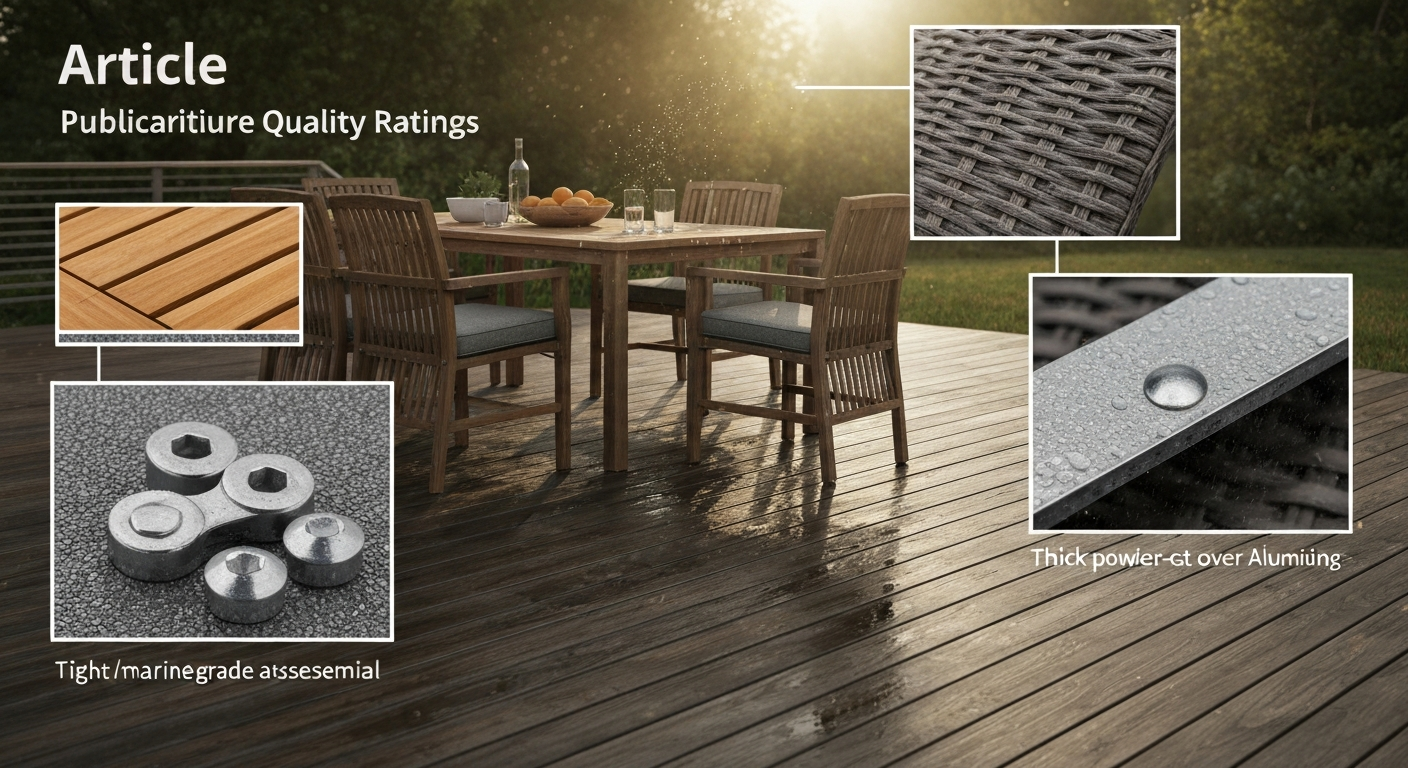
Why is patio furniture so expensive? Reddit buyers' insights, cost breakdowns, material comparisons, and checklist
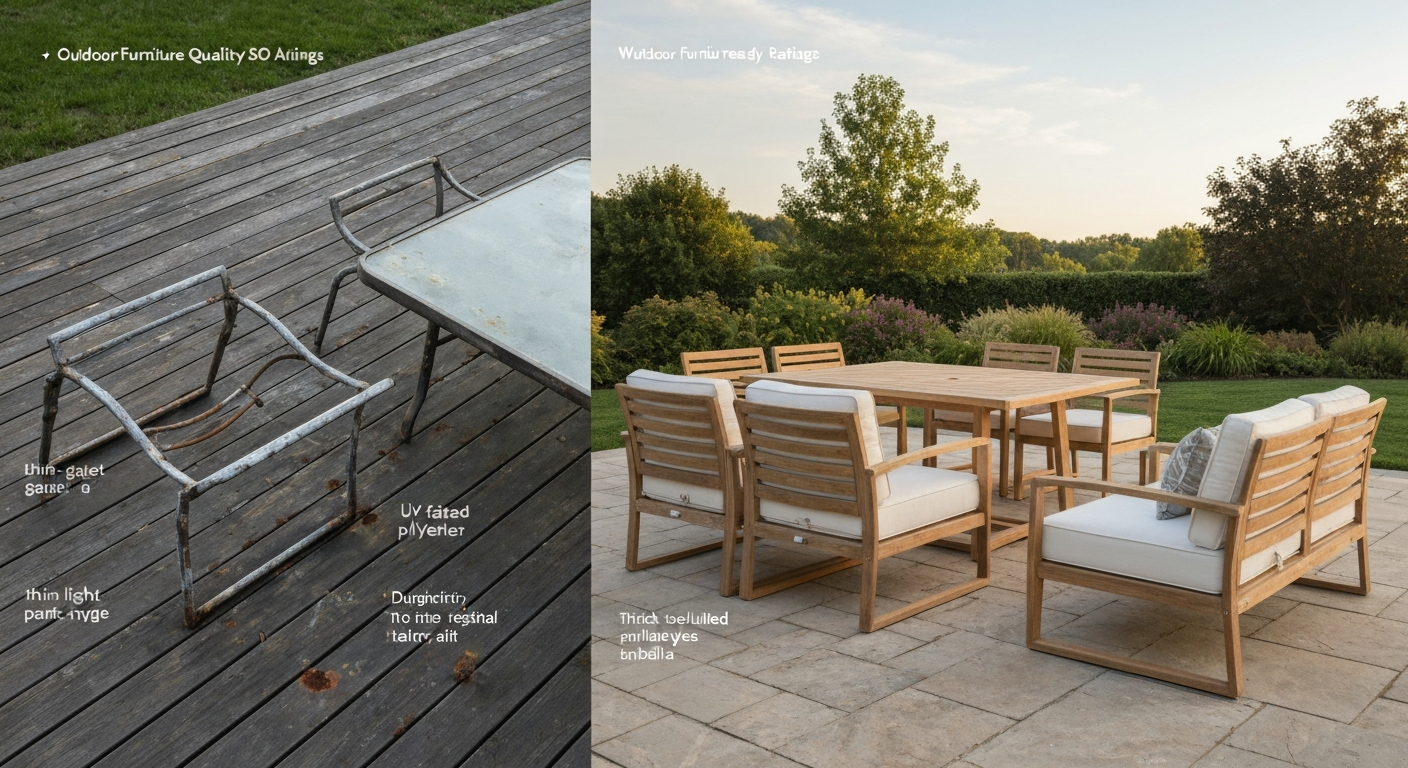
Decide when to splurge on patio furniture: cost-per-year, lifespans by material, climate tips, repair & resale guidance.
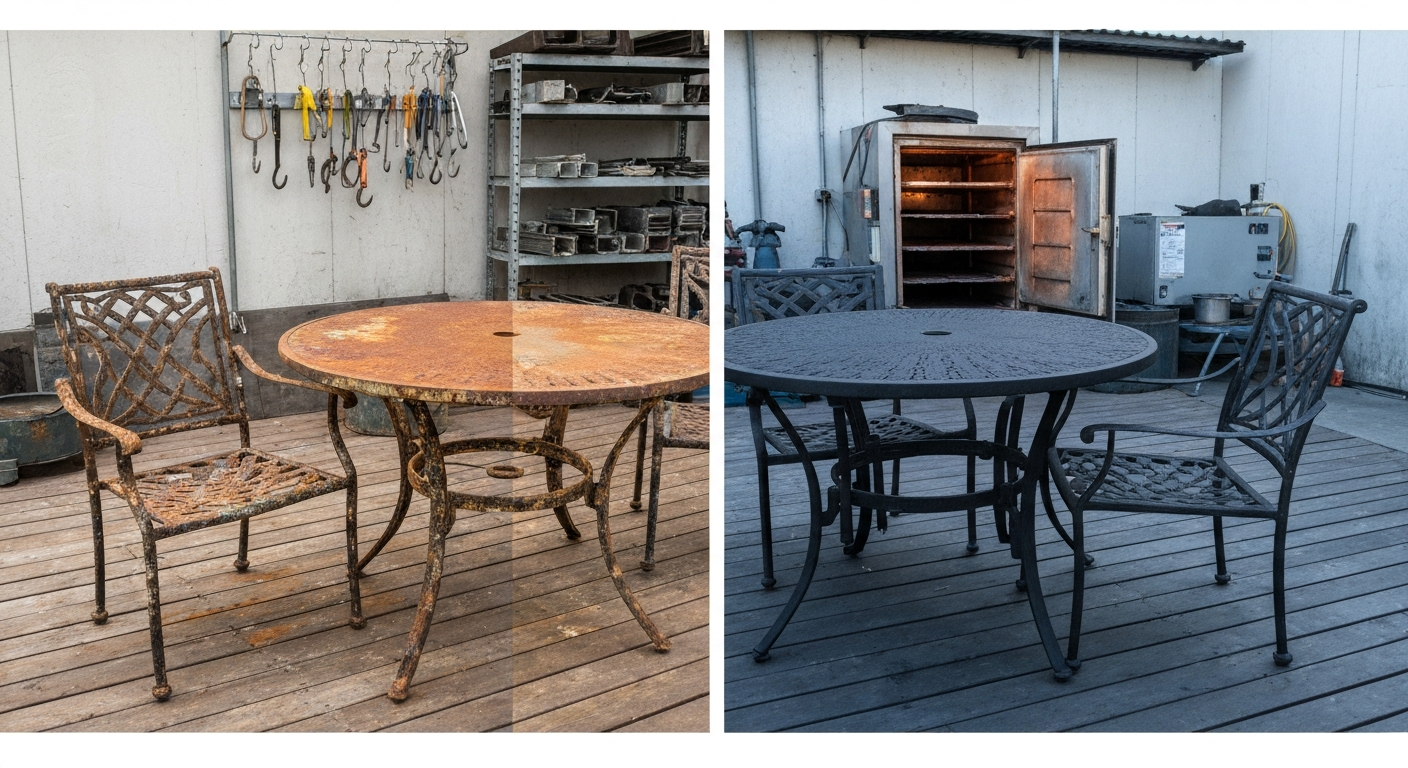
Exact powder-coat costs for patio furniture, national & regional ranges, per-item and per-ft/pound pricing, DIY vs pro