
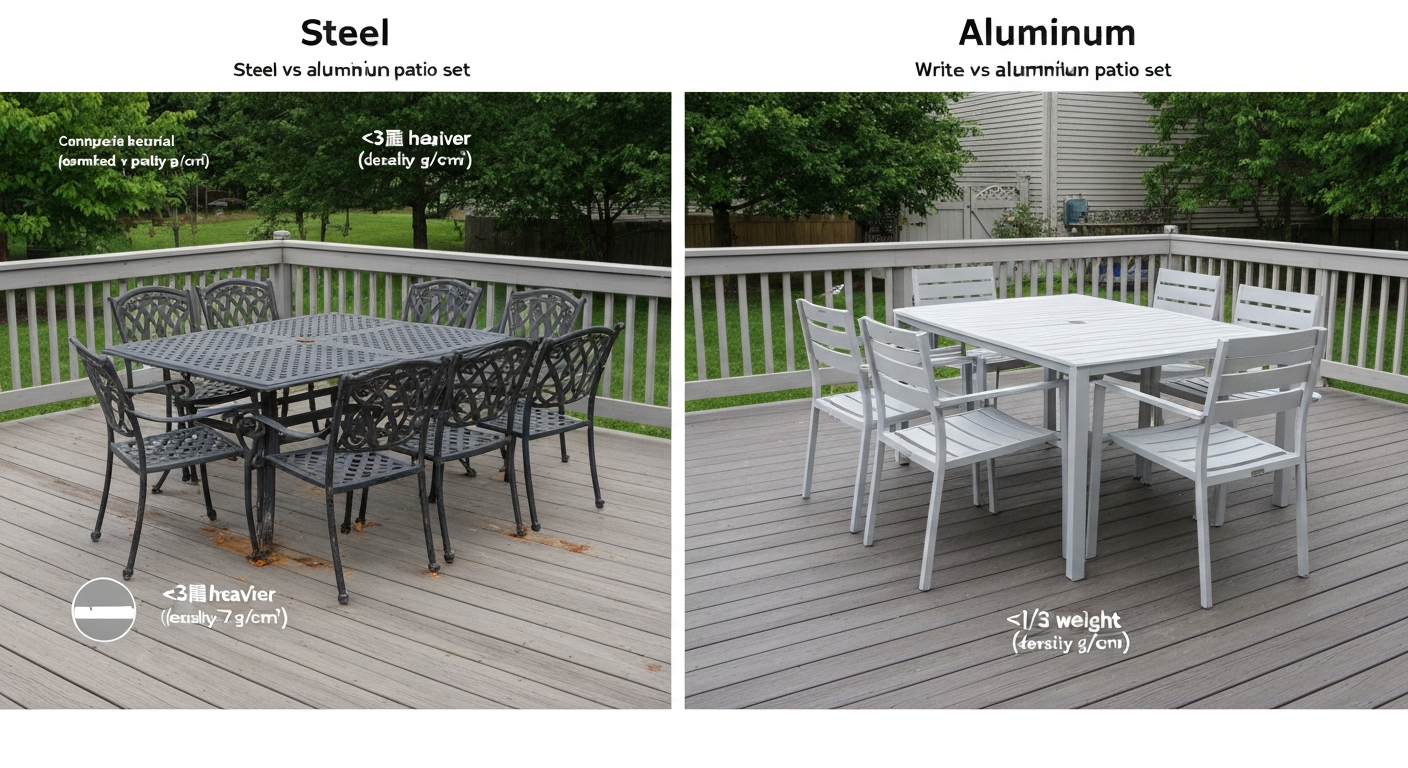
For most inland and suburban climates, aluminum is the better default choice for a patio set: it weighs roughly one-third as much as steel (density around 2.70 g/cm³ versus steel's 7.87 g/cm³), it won't rust, and a quality powder-coated aluminum frame can realistically last 15 to 25 years with very little intervention. Steel earns its place when you need heavier structural strength, a specific wrought-iron aesthetic, or you're buying a galvanized-and-coated set for a sheltered patio in a dry climate. But the gap closes fast when you factor in coastal salt air, freeze-thaw cycles, and the true cost of repainting a rusted frame every few years.
Steel vs Aluminum Patio Set: Which Material Should You Buy?

Marcus Kellerman
20 Jul 2026
Who this comparison is for
This article is aimed at homeowners shopping for a new patio dining or lounge set, outdoor designers specifying furniture for residential or light commercial spaces, and anyone who already owns a metal set and wants to understand why it's failing or how to extend its life. I'll cover durability and corrosion science in plain terms, give you a realistic lifespan range for both materials, explain what to look for in coatings and finishes, and tell you exactly which climate scenarios tip the decision one way or the other. I'll also flag where wood and other materials genuinely compete, since the answer to 'steel or aluminum?' sometimes turns out to be 'neither.'
Quick verdict: which material fits your situation
Before diving into the details, here are direct recommendations by climate and lifestyle. Each one is grounded in the corrosion and material data covered later in the article.
| Situation | Best choice | Key reason |
|---|---|---|
| Coastal (within 1–3 miles of salt water) | Marine-grade aluminum or 316 stainless steel | Steel corrodes rapidly in chloride-rich air even with coatings; 316's molybdenum content resists pitting that 304 cannot |
| Humid inland / Southeast US | Powder-coated aluminum | High humidity accelerates rust on coated steel once any scratch exposes bare metal; aluminum's passive oxide self-heals |
| Freeze-thaw / Northern climates | Aluminum or hot-dip galvanized steel (sheltered) | Water infiltration into paint chips causes rust blisters in steel; aluminum is unaffected by freeze-thaw cycling |
| High-UV / Desert Southwest | Powder-coated aluminum (AAMA 2604+) | UV degrades cheaper coatings on both materials; aluminum's lighter weight also prevents wind damage on hot, dry patios |
| Mobile / apartment / frequent movers | Aluminum | A six-piece aluminum dining set typically weighs 40–60% less than a comparable steel set; much easier to move or store |
| Covered patio, dry inland climate | Steel (galvanized + powder-coated) or aluminum | Either works well when rain and humidity exposure are limited; steel can be worth it for the heavier aesthetic and lower upfront cost |
Head-to-head at a glance
| Attribute | Steel (powder-coated / galvanized) | Aluminum (extruded / cast, powder-coated) |
|---|---|---|
| Tensile strength | ~440 MPa (mild/carbon steel, AISI 1018) | ~241–310 MPa (6061-T6 / 6063-T6) |
| Density / weight | ~7.87 g/cm³ — roughly 3x heavier | ~2.70 g/cm³ — about one-third of steel |
| Rust / corrosion risk | High without galvanizing + intact coating; moderate with both | Low — forms self-protecting oxide layer; pitting risk in heavy salt-splash zones |
| Expected lifespan (quality set) | 10–20 years inland; 5–10 years coastal | 15–25 years inland; 10–20 years coastal with maintenance |
| Finish options | Powder coat, galvanize, paint; wide color range | Powder coat, anodize (Type II/III), cast textures; excellent color retention |
| Upfront cost (6-piece set) | $300–$1,500 (budget to mid-range dominant) | $400–$3,000+ (wider range; cast aluminum at high end) |
| Lifecycle cost | Higher if recoating needed every 5–8 years | Lower over 15+ years with minimal maintenance |
| Repairability | Touch-up paint or zinc-rich primer (ASTM A780); rust removal needed | Scratch touch-up paint; no rust to address, just cosmetic chips |
| DIY maintenance | Moderate to high effort — rust must be fully removed before repainting | Low — clean, inspect, touch up chips annually |
| Aesthetic / style range | Classic wrought-iron look, ornate options, heavier visual weight | Sleek modern to traditional; cast aluminum mimics wrought iron well |
Durability and realistic lifespan
The honest lifespan of any metal patio set depends less on the base material and more on coating quality, environment, and how consistently you maintain it. That said, aluminum has a meaningful structural advantage: it forms a natural aluminum oxide layer when exposed to air, and that passive film continuously regenerates if scratched in most environments. Steel has no such self-repair mechanism. Scratch through a painted steel tube and iron oxide (rust) starts forming almost immediately, especially in humid air.
For steel sets, realistic service life breaks down roughly like this: a budget powder-coated steel set from a big-box retailer in a humid climate might show rust at weld points and cut edges within 3 to 5 years. A properly hot-dip galvanized steel frame with a powder-coat topcoat, kept on a covered patio in a dry inland climate, can last 15 to 20 years before requiring significant work. The American Galvanizers Association's guidance confirms that hot-dip galvanizing performs well in rural and urban inland atmospheres but loses service life substantially in marine (high-chloride) zones. And once galvanizing is damaged in the field, ASTM A780 repair methods (zinc-rich paint, zinc solder, or thermal spray) are your options, but they won't fully replicate the original coating's appearance or identical long-term performance.
For aluminum, a quality extruded or cast set using 6061-T6 or 6063 alloy with a well-adhered powder coat can realistically run 20 to 25 years in inland settings. In coastal environments, aluminum holds up better than coated steel, but it isn't immune. Long-term field exposure studies show that aluminum alloys in heavy marine aerosol or salt-splash conditions can develop pitting and, in the case of some alloys (notably the 2xxx series), mechanical property degradation over multi-decade exposure. See ScienceDirect, long‑term atmospheric corrosion study comparing mild steel, galvanized iron, zinc and aluminium (multi‑year exposure) for multi‑year field data supporting these findings ScienceDirect — long‑term atmospheric corrosion study comparing mild steel, galvanized iron, zinc and aluminium (multi‑year exposure). For coastal furniture, alloy choice and coating quality matter: look for 6000-series alloys (6061, 6063) rather than unspecified 'aluminum' claims, paired with a high-performance powder coat or Type III hard anodize finish.
Failure modes to watch for
- Steel: rust starting at welds, cut edges, or scratched coating — progresses under the paint and causes blistering and flaking
- Steel: galvanic corrosion at hardware contact points if zinc plating or galvanize is incomplete
- Aluminum: cosmetic pitting in coastal environments — usually surface-level but can deepen over years without annual freshwater rinses
- Aluminum: white oxidation ('chalking') on anodized or poorly coated surfaces in high-UV climates
- Both: coating delamination where tubing is bent during manufacturing, creating a pathway for moisture
Strength, weight, and structural performance
Steel is genuinely stronger. AISI 1018 mild steel carries an ultimate tensile strength of around 440 MPa versus roughly 276 to 310 MPa for aluminum 6061-T6. MatWeb datasheet, AISI 1018 (mild/low‑carbon) reports UTS ≈ 440 MPa, 0.2% offset yield ≈ 370 MPa, and density ≈ 7.87 g/cm³ MatWeb datasheet — AISI 1018 (mild/low‑carbon). That strength gap has real implications: a steel dining chair can use thinner wall tubing and still handle a heavy load, while an aluminum equivalent may need larger tube diameters to achieve the same rigidity. In practice, most well-engineered aluminum furniture compensates with tube geometry and wall thickness rather than material strength alone, and for typical residential seating loads that's perfectly adequate.
Where weight becomes a genuine factor: a large aluminum sectional sofa can be moved by one person for seasonal storage. The equivalent steel sectional often requires two people and leaves you with a strained back. If you live in a hurricane-prone area and need to bring furniture indoors before storms, that weight difference isn't trivial. Conversely, if you have a windy hilltop patio and want furniture that stays put, a heavier steel set can work in your favor without additional anchoring.
For commercial or semi-commercial use (restaurants, rental properties, high-traffic outdoor spaces), steel's higher strength allows for more robust structural joints at high-use stress points like armrests and sling attachment points. Cast aluminum handles these loads well too, but thin extruded aluminum at cheap price points can flex or crack at joints under repeated heavy use. Always check wall thickness specifications: furniture-grade extruded aluminum tube should have a minimum wall thickness of around 1.5 to 2.0 mm for structural members.
Appearance, finishes, and how they hold up
Both materials take powder coating well, and powder coat is what most quality patio furniture uses today regardless of base metal. The difference is what happens when the coating is damaged. On aluminum, a chip means a cosmetic issue and a potential minor pitting spot. On steel, that same chip is a corrosion initiation point that will spread under the coating if left unaddressed.
For finish quality, the architectural coatings industry uses AAMA classifications as a benchmark. AAMA 2604 is a high-performance standard for powder coatings commonly specified for exterior aluminum, while AAMA 2605 (often PVDF liquid systems) is the most stringent for long-term color and gloss retention. When buying patio furniture, you won't always see these specs on the product listing, but premium brands will reference them or equivalent testing. Budget furniture rarely specifies coating standards at all, which tells you something about expected performance.
Anodizing is another option exclusive to aluminum. Type II (sulfuric decorative) anodize is common for architectural and appearance uses and is durable in normal conditions. Type III (hard anodize) provides superior wear resistance. The trade-off is repairability: anodized finishes are very difficult to touch up in the field, so a large chip or scratch on an anodized set will be visually obvious and hard to fix without professional help.
Style-wise, steel's weight and malleability make it the traditional material for ornate, scrolled, wrought-iron-style designs. If you want that heavy European garden aesthetic, steel (or cast iron) delivers it more authentically. Cast aluminum does a credible impression of wrought iron and is available in very similar ornamental patterns, but at a fraction of the weight and with significantly better corrosion resistance. For clean, modern lines, extruded aluminum profiles are often the designer's first choice because of their precise tolerances and excellent surface finish for coating.
Cost and long-term value
Upfront, steel patio sets tend to be cheaper at the entry and mid-range levels. You can find a 6-piece steel dining set for $300 to $600 at mass-market retailers. Comparable aluminum sets usually start around $400 to $700, and quality cast aluminum sets can run $1,500 to $3,000 or more. That initial gap is real, but it's only half the picture.
The more useful way to look at this is cost per year of usable life. If a $450 steel set needs repainting (materials plus time, or a professional job) at year 5 and is structurally compromised by year 10, your cost-per-year is roughly $45 to $90 plus maintenance labor. A $900 aluminum set that runs 20 years with nothing more than an annual cleaning and occasional chip touch-up works out to $45 per year with virtually no additional cost. That math shifts further toward aluminum in humid, coastal, or freeze-thaw climates where steel degrades faster.
Resale value is another consideration that rarely gets discussed. Quality cast aluminum furniture from established brands holds resale value reasonably well on secondary markets. Steel sets, especially once they show rust, are nearly unsellable and typically go to the curb. If there's any chance you'll want to upgrade or move in 10 years, aluminum gives you more flexibility.
Corrosion risks explained: does steel rust and how bad is it?
Yes, steel rusts, and the type of steel in your patio furniture matters enormously. For a focused explanation of whether steel patio furniture rusts and how quickly in different environments, see does steel patio furniture rust. Most budget and mid-range steel patio furniture uses mild carbon steel (similar to AISI 1018), which is highly susceptible to oxidation. Rust forms when iron, oxygen, and moisture react, and the process accelerates in the presence of chloride ions (salt air, road salt, pool splash). Once started, rust is self-reinforcing: it creates a porous surface that holds moisture and oxygen, accelerating further attack.
Types of steel and their corrosion behavior
- Carbon/mild steel (most common in budget furniture): rusts rapidly without protection; rely entirely on coating integrity
- Galvanized steel (hot-dip per ASTM A123/A153): zinc coating acts as a sacrificial barrier; performs well inland but degrades in marine salt-spray zones; damaged areas must be touched up using ASTM A780 methods
- Type 304 stainless steel: contains chromium for corrosion resistance; acceptable for inland and light-coastal use with regular freshwater washing; can pit in persistent chloride (salt) exposure
- Type 316 stainless steel: adds 2–3% molybdenum to the 304 formula, substantially improving pitting and crevice corrosion resistance in chloride environments; the industry standard recommendation for coastal furniture and marine hardware
Stainless steel furniture (304 or 316) is a different category from standard steel patio furniture. It costs significantly more and is mostly found in commercial or high-end residential applications. The British Stainless Steel Association and major stainless producers like Outokumpu both confirm that 316 (or 316L) is the right call for persistent salt exposure, while 304 can be adequate inland if salt deposits are regularly washed off.
Aluminum forms a thin, stable aluminum oxide layer on contact with air. This passive film is genuinely self-repairing in most environments: scratch it and it reforms within hours. The exceptions are heavily chloride-saturated environments (direct ocean splash zones) where the oxide can be disrupted faster than it reforms, leading to pitting. Long-term atmospheric exposure studies show that aluminum in coastal zones develops pitting over time but at a far slower and less structurally dangerous rate than unprotected or poorly coated carbon steel.
One nuance worth flagging: accelerated salt-spray testing (ASTM B117, ISO 9227) is widely used by furniture manufacturers to claim corrosion resistance. These lab tests are useful for comparing coatings and catching manufacturing defects, but they don't reliably predict real-world field lifetime without supplementary cyclic corrosion and outdoor exposure testing. When a product listing says 'passed 500-hour salt spray test,' that's a minimum quality check, not a lifespan guarantee.
Maintenance: what each material actually requires
Aluminum maintenance is mostly about keeping the coating intact and clean. An annual freshwater rinse (especially after summer in coastal areas), a wipe-down with mild soap, and touch-up paint on any chips is genuinely all most aluminum sets need. That level of upkeep takes an afternoon per year.
Steel maintenance is more demanding, particularly if the set is already showing rust. The standard repair sequence: remove loose rust mechanically (wire brush, sandpaper), treat remaining rust with a phosphoric acid converter, prime with a zinc-rich or epoxy primer, then apply finish paint or powder coat. Skipping any of these steps and painting over rust is a waste of time, it will blister and fail within one season. For larger rust areas or structural concerns, professional refinishing or replacement becomes the realistic option.
Annual maintenance checklist (both materials)
- Wash all frames with mild dish soap and water; rinse thoroughly, especially at joints and welds where dirt and moisture accumulate
- Inspect all welds, joints, and hardware attachment points for early rust (steel) or pitting/white oxide (aluminum)
- Sand any rust spots on steel down to bare metal, apply zinc-rich primer, touch up with matching finish paint
- Touch up paint chips on aluminum frames with manufacturer-matched touch-up paint to prevent pitting at exposed spots
- Check and tighten all bolts, screws, and fasteners — loose hardware accelerates wear at contact points
- Lubricate folding mechanisms and adjustable components with a silicone-based lubricant (avoid petroleum-based products that attract dirt)
- For coastal locations: perform an additional freshwater rinse after any storm or period of heavy salt-air exposure
- Store cushions indoors or in a ventilated storage box during the off-season; store frames covered or indoors in freeze-thaw climates
Steel vs aluminum by climate: regional recommendations
Climate is the single biggest variable in this decision, and it's worth spelling out the regional picture clearly rather than giving a generic answer.
Coastal and marine environments
Within roughly one to three miles of salt water (and especially in direct ocean-facing or splash-zone situations), standard steel is a poor choice. Even galvanized and powder-coated steel faces an uphill battle: the American Galvanizers Association's own guidance shows substantially reduced service life in marine atmospheres compared to inland environments. Aluminum is the more logical base material here, supplemented by regular freshwater rinse-downs after storm events or extended salt-air periods. For the highest-quality coastal installation, 316 stainless steel hardware (bolts, fasteners) paired with aluminum frames is the combination I'd recommend.
Humid subtropical and Southeast US
High humidity year-round with warm temperatures is the environment steel dislikes most. The moisture never really goes away, and any coating damage leads to rapid under-film rust. Aluminum is strongly preferred here. A quality powder-coated aluminum set in Savannah, New Orleans, or Tampa will outperform a comparable steel set by a wide margin over a 10-year horizon.
Freeze-thaw climates (Midwest, Northeast US, Canada)
Repeated freeze-thaw cycles accelerate coating failure on steel because water infiltrating micro-cracks in the paint expands when it freezes, widening the crack and exposing more bare metal. Aluminum's structural properties are unaffected by freeze-thaw cycling, and its passive oxide film continues to function. If you live in Chicago, Minneapolis, or Toronto and keep furniture outdoors through part of winter, aluminum is the far more durable choice.
Dry inland and desert climates
The one scenario where steel becomes genuinely competitive: a covered or semi-sheltered patio in a dry inland or desert climate. In Phoenix or Las Vegas conditions, the near-absence of sustained moisture dramatically slows corrosion on even budget steel sets. UV degradation of coatings becomes the primary concern, and both materials need UV-stable coatings. Aluminum still edges out steel on long-term convenience, but a high-quality galvanized steel set on a covered Scottsdale patio could easily last 20 years.
What makes a patio set genuinely high quality: buying criteria
Whether you're buying steel or aluminum, quality markers are remarkably consistent. Here's what I actually check when evaluating a set.
- Frame wall thickness: look for at least 1.5–2.0 mm on structural aluminum tubes; thinner than that on a dining chair or lounger is a red flag
- Weld quality: smooth, continuous welds with no gaps or porosity; rough or gappy welds are moisture traps on steel and stress concentrators on both materials
- Coating specification: brands that reference AAMA 2604 or 2605 for their powder coat, or MIL-A-8625 Type II/III for anodize, are being transparent about performance; generic 'powder coated' without a spec is common on budget pieces
- Hardware material: fasteners, brackets, and pivot points should be stainless steel (304 minimum, 316 for coastal) — galvanic corrosion between steel hardware and aluminum frames is a known failure mode
- Alloy disclosure: '6061' or '6063' aluminum disclosed on a product sheet is a good sign; 'aluminum alloy' without further specification is not
- Weight as a proxy: a 7-piece aluminum dining set that weighs under 30 kg total is almost certainly using thin-wall tubing throughout; heft matters
- Brand warranty: 5+ years on the frame finish (not just the structure) from a brand that's been in business long enough to honor it
- Country of origin and quality certification: less definitive than specs, but premium European and North American manufacturers tend to apply more rigorous material and coating standards than the cheapest offshore imports
How steel and aluminum compare to wood and other materials
Metal versus wood is a genuinely different trade-off, and worth a brief note here. Teak and eucalyptus require annual oiling and eventual sanding to maintain their appearance but are remarkably resilient in coastal and humid environments. They also add visual warmth that neither steel nor aluminum can replicate. Rattan and wicker (synthetic or natural) are lighter and often more comfortable but generally don't match the structural lifespan of quality metal frames.
The honest answer is that for most climates and budgets, a quality powder-coated aluminum set is the lowest-effort, longest-lived, most versatile outdoor furniture purchase you can make. For specific options and buying guidance on patio furniture that will not rust, see our dedicated guide. Wood earns its place when aesthetics and a willingness to do annual maintenance align. Steel makes sense when budget is the hard constraint and the climate is forgiving, or when you specifically want the weight and wrought-iron aesthetic that steel delivers uniquely well. If rusting is your primary concern, the options extend to aluminum and stainless, and the question of what construction quality to look for applies across all metal types.
Top categories to consider when shopping
Rather than recommending specific brands (which change inventory and pricing regularly), here are the product categories where each material performs best, so you can evaluate current offerings with a clear framework. For curated recommendations and buying guidance, see our roundup of the best metal patio furniture.
| Use case | Best material category | What to prioritize |
|---|---|---|
| Coastal dining set | Cast aluminum + 316 SS hardware | Thick-wall casting, AAMA 2604+ coating, regular rinse schedule |
| Lightweight lounge set for small patio | Extruded aluminum sling or sling-back | Low weight, stackable design, UV-stable sling fabric |
| Traditional / ornate garden set | Cast aluminum (wrought-iron style) or wrought iron | Authentic heavy casting vs. lightweight cast aluminum depending on desired weight |
| Budget covered-patio dining | Galvanized + powder-coated steel | Full weld coverage in galvanizing, no bare cut edges visible |
| High-traffic commercial terrace | Heavy-gauge cast aluminum or 304/316 SS | Commercial-grade frame warranty, replaceable components |
| Rooftop or high-wind location | Heavy steel or weighted aluminum with anchoring | Wind load stability; consider furniture weights and anchor points |
The bottom line
Aluminum wins on ease of ownership, corrosion resistance, lifespan, and long-term value in the vast majority of climates and use cases. Steel wins on structural strength, upfront cost at budget price points, and visual weight in settings where a heavy, traditional aesthetic is the goal. For a focused discussion of steel patio furniture pros and cons, see our detailed guide. The choice only becomes genuinely difficult in dry sheltered environments where steel's corrosion vulnerability is minimized and its lower price becomes the dominant factor. For coastal, humid, and freeze-thaw environments, aluminum isn't just the preference, it's the practical necessity unless you're willing to commit to regular steel maintenance that most homeowners simply won't sustain. If you're still wondering is steel good for patio furniture, read our detailed guidance comparing steel and aluminum to see which performs best in your climate and budget. Whatever material you choose, coating quality, hardware specification, and wall thickness are what separate a set that looks the same in year 15 from one that's headed for the dumpster in year 5.
FAQ
Which is the better choice overall: steel or aluminum patio furniture for homeowners and outdoor designers?
There is no single "better" material — choose by use case: aluminum for lightweight, low‑maintenance furniture in most inland, humid, and moderate coastal settings; hot‑dip galvanized + high‑quality powder‑coat steel or marine‑grade stainless (316) for heavy‑duty strength and long life in high‑use or very salty coastal/splash environments. For premium salt‑air durability choose 316 stainless; for budget‑conscious strength with good corrosion resistance choose galvanized and powder‑coated steel; for easy handling, rust‑resistance and low maintenance choose aluminum.
Head‑to‑head: How do steel and aluminum compare on durability, strength, weight, appearance and cost?
Durability: Steel (galvanized or stainless) generally offers higher structural durability if protected; bare carbon steel corrodes faster than aluminum. Strength: Mild steel has higher yield and tensile strength per volume than common aluminum alloys (e.g., AISI 1018 steel >> 6061/6063 by UTS/yield). Weight: Aluminum is ~1/3 the density of steel — same geometry is much lighter. Appearance: Aluminum extrusions anodize or powder‑coat to a clean finish; steel offers varied finishes (powder, paint, hammered/textured) and a heavier look. Cost: Raw steel is typically cheaper by material cost, but stainless (316) is expensive; aluminum sits between mild galvanized steel and 316 stainless in price depending on alloy and finish.
Does steel rust and are there steel options that won’t rust?
Yes, unprotected carbon (mild) steel will rust (corrode) in atmospheric conditions. Non‑rusting or highly corrosion‑resistant steel options include stainless steels (316 or 304). Hot‑dip galvanizing (ASTM A123/A153) applies a sacrificial zinc coating that substantially slows corrosion; combined with powder‑coating it performs well inland but can require maintenance in marine zones. Repairs to galvanized coatings are possible with zinc‑rich paints or thermal spray per ASTM A780 but cannot fully replicate the original coating.
Is aluminum immune to corrosion? What are its corrosion risks?
Aluminum forms a passive oxide that resists uniform corrosion, so it does not "rust" like steel. However aluminum can suffer localized pitting and crevice corrosion in high‑chloride (marine/splash) environments; alloy selection matters (some alloys fare better). Anodizing and high‑quality powder‑coats improve resistance and appearance but are harder to touch up than painted steel.
Which finishes are best for each material to maximize outdoor life?
Aluminum: Type II decorative anodize or AAMA‑rated powder/paint (AAMA 2604/2605) for color and durability; Type III hard‑coat where abrasion resistance is needed. Steel: hot‑dip galvanizing (ASTM A123) for base corrosion protection, then high‑performance powder coat (AAMA 2604/2605) or marine paint. Stainless: polished or passivated finish; 316 is best for marine. For coastal use, prioritize stainless (316) or HDG + heavy topcoat; inland, aluminum with powder or coated steel work well.
What practical maintenance steps extend life for steel and aluminum patio sets?
Routine maintenance (both materials): rinse with fresh water after salt exposure, clean annually with mild detergent, remove leaf debris and standing water, check and tighten fasteners, and address coating damage promptly. Steel specifics: inspect for coating breaches and touch up with zinc‑rich primer or compatible touch‑up paint (steel with HDG require zinc‑rich products per ASTM A780). Aluminum specifics: avoid using dissimilar metals that can cause galvanic corrosion, touch up powder‑coat scratches promptly, and avoid aggressive cleaners that remove anodize.
Next Articles
Steel Patio Furniture Pros and Cons: Buy Care & Rust Guide
Steel patio furniture pros and cons: verdict, rust prevention, buying checklist, maintenance & lifespan guide.
Patio Furniture That Will Not Rust: Best Materials Today
Shop patio furniture that will not rust: best materials, coating checks, fastener tips, and maintenance for coastal or d
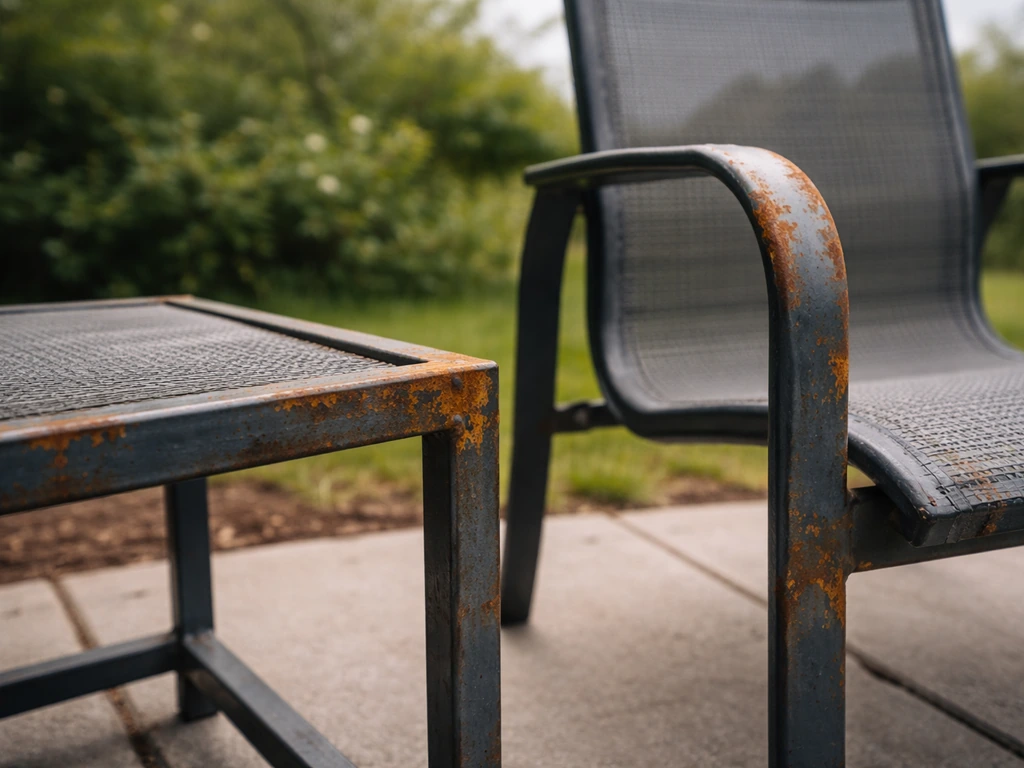
Does Steel Patio Furniture Rust? How to Prevent and Stop It
See if steel patio furniture rusts and how to prevent or stop it fast with coatings, cleaning, drying, and repair steps.